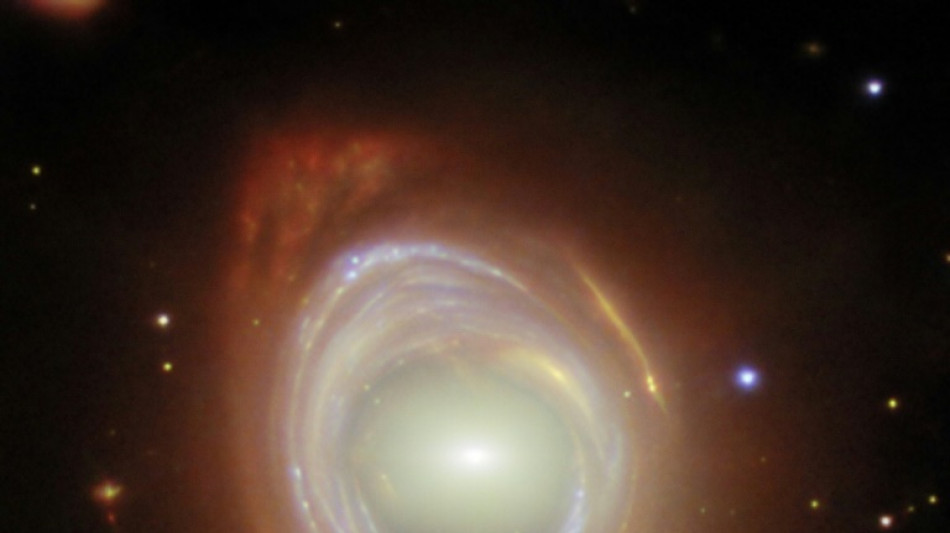
Universe dying quicker than thought, says new research / Photo: © ESA/Webb, NASA & CSA, G. Mahler/AFP

 ASEAN calls for open straits as US-Iran war casts shadow

 Ford and Geely to form joint venture at struggling Spain plant

 Russia warns US against Ukraine arms sales in Manila meeting

 New UK PM announces tax cut for struggling pubs

 Supporters flood India's 'cockroach' protesters with food

 Modi vows punishment for exam leaks fuelling India protests

 Norway set to make formal complaint to FIFA over Balogun red card saga

 Floods in northeast India kill at least 41

 Nestle siphons off bottled water business into joint venture

 Hundreds hospitalised in Japan heatwave 'disaster'

 Renault says sales stalled in first half

 EasyJet says profits nosedive on Mideast war

 Modi vows punishment for exam fraud fuelling India protests

 Six candidates in race to lead UN set for televised debate

 Comic-Con kicks off with Marvel's return

 Dutch riders dreaming of crazy party corner of Alpe d'Huez

 Houthis target Red Sea shipping as US hits Iran

 Record-equalling Red Sox streak halted at 15 wins

 Messi-less Miami beat Fire 3-2 to spoil Lewandowski's MLS debut

 Mercedes expect Hungary challenge from Hamilton and Ferrari

 In Ghana, one man's race to save critically endangered fish

 Wilson captain, Slipper absent in Kiss's first Wallabies squad

 New Mideast fighting puts eurozone rate-setters on alert

 Venezuelans search for animal companions lost in the quakes

 Argentine Football Association says US did not detain its president

The universe is poised to die much faster than previously thought, according to new research by Dutch scientists.
But there's no great need to panic. We still have 10 to the power of 78 years before it happens -- that's a one with 78 zeroes.
However, that is a major revision from the previous estimate of 10 to the power of 1,100 years, notes the research paper from Radboud University, published in the Journal of Cosmology and Astroparticle Physics.
"The final end of the universe is coming much sooner than expected but fortunately it still takes a very long time," said lead author Heino Falcke.
A trio of scientists at Radboud set out to calculate when the most "durable" celestial bodies -- white dwarf stars -- would eventually die out.
They based their calculations on Hawking radiation, named after celebrated British physicist Stephen Hawking.
Hawking postulated in the mid-1970s that black holes leak radiation, slowly dissolving like aspirin in a glass of water -- giving them a finite lifetime.
The Radboud scientists extended this to other objects in the universe, calculating that the "evaporation time" depends on density.
This enabled them to calculate the theoretical dissolution of the longest-lasting body, the white dwarf.
"By asking these kinds of questions and looking at extreme cases, we want to better understand the theory, and perhaps one day, we can unravel the mystery of Hawking radiation," said co-author Walter van Suijlekom.
Humankind needn't worry too much about the end of the universe. Unless we escape planet Earth, we'll be long gone.
Scientists think that our Sun will be too hot for life in about a billion years, boiling our oceans.
In about eight billion years, our star will eventually expand towards the Earth, finally gobbling up our by-then barren and lifeless planet and condemning it to a fiery death.
T.Ziegler--VB