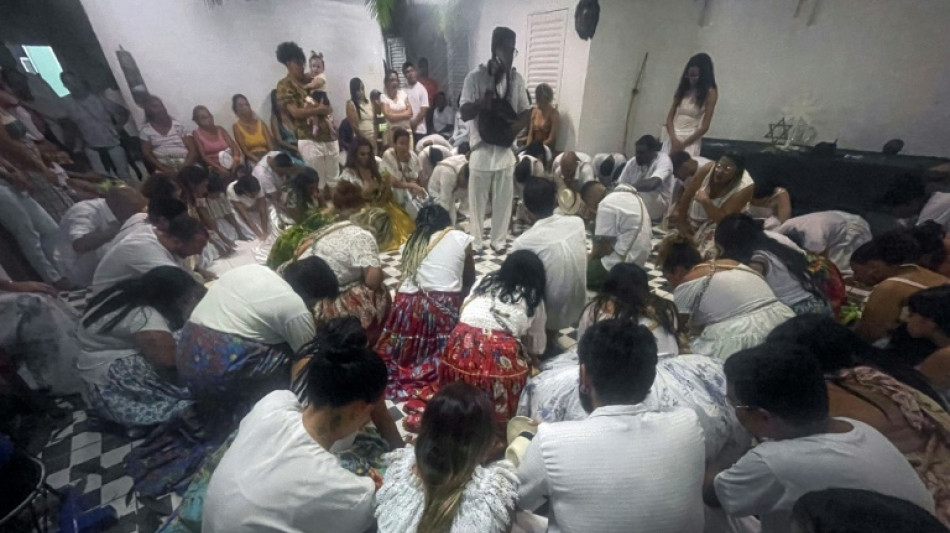
Brazilian ritual root gets second life as potential anti-depressant / Photo: © AFP

 ASEAN calls for open straits as US-Iran war casts shadow

 Ford and Geely to form joint venture at struggling Spain plant

 Russia warns US against Ukraine arms sales in Manila meeting
 New UK PM announces tax cut for struggling pubs

 Supporters flood India's 'cockroach' protesters with food

 Modi vows punishment for exam leaks fuelling India protests

 Norway set to make formal complaint to FIFA over Balogun red card saga

 Floods in northeast India kill at least 41

 Nestle siphons off bottled water business into joint venture

 Hundreds hospitalised in Japan heatwave 'disaster'

 Renault says sales stalled in first half

 EasyJet says profits nosedive on Mideast war

 Modi vows punishment for exam fraud fuelling India protests

 Six candidates in race to lead UN set for televised debate

 Comic-Con kicks off with Marvel's return

 Dutch riders dreaming of crazy party corner of Alpe d'Huez

 Houthis target Red Sea shipping as US hits Iran

 Record-equalling Red Sox streak halted at 15 wins

 Messi-less Miami beat Fire 3-2 to spoil Lewandowski's MLS debut

 Mercedes expect Hungary challenge from Hamilton and Ferrari

 In Ghana, one man's race to save critically endangered fish

 Wilson captain, Slipper absent in Kiss's first Wallabies squad

 New Mideast fighting puts eurozone rate-setters on alert

 Venezuelans search for animal companions lost in the quakes

 Argentine Football Association says US did not detain its president

Long used in Indigenous Brazilian rituals, the jurema preta plant, which contains a potent psychedelic, is gaining ground as a potential treatment for depression.
At street stalls where medicinal herbs are sold, customers can buy the plant's root which contains dimethyltryptamine (DMT), a hallucinogenic substance that researchers say could be used to alleviate symptoms.
Following instructions he found on the internet, Guaracy Carvajal extracted DMT at home in 2016 from roots he bought on the street.
The 31-year-old software programmer, who had tried various treatment for chronic depression he has suffered since adolescence, said the drug makes it "feel like you've solved something in your life."
Physicist Draulio Araujo, who has conducted extensive research on the drug, said "the response is rapid. One day after treatment, (patients) already showed a significant improvement in their depression symptoms."
Yet he also warned that it "is not a magic cure" and that psychedelics "are not for everyone."
As a researcher at the Brain Institute of the Federal University of Rio Grande do Norte, Araujo and his team treated 14 people with the drug for six months.
The patients inhaled vaporized DMT, under medical supervision.
"It's common for our patients to say that something changed, that a key opened something," he said.
His patients also received psychological therapy, and some continued with conventional pharmaceutical drugs.
Neuroscientist Fernanda Palhano-Fontes, also of the Brain Institute, said "we have patients who improve significantly, others who don't improve at all."
Araujo's findings were published in the scientific journal Nature in April. In 2024, he published another study with promising results in the journal Psychedelic Medicine.
As for Carvajal, who stopped using jurema preta some time ago, he said the drug really allows a person to "start to have a lighter life."
It helped him get through a time when he was in "a state of questioning myself" about "work, day-to-day life," he said.
- Spiritual channels -
Brazil occupies a fairly prominent place in DMT research due to the substance's prominence in society, Araujo said.
While there is no ban on the cultivation or possession of jurema, which is also known as Mimosa tenuiflora, consumption of DMT is prohibited, except for religious and scientific use.
Jurema's roots are combined with other plants in a wine-like beverage that is consumed at rituals that include dancing and drums, part of Indigenous tradition in northeast Brazil where the plant grows.
"It's not hallucination," said Joyce Souza, a young woman attending a jurema ceremony in Planaltina, on the outskirts of Brasília.
"My spiritual channels become more accessible, I can communicate better with myself," Souza said.
Gathered in a house courtyard and dressed in white, the group of mostly novices waited for more seasoned practitioners to enter a trance and bring messages from ancient spirits.
Meanwhile, back in the lab, Araujo is hoping to expand his DMT research to a study of 100 patents.
"Let's say that in five years we'll have... a clear picture on when it will reach a real clinical setting," he said.
S.Gantenbein--VB