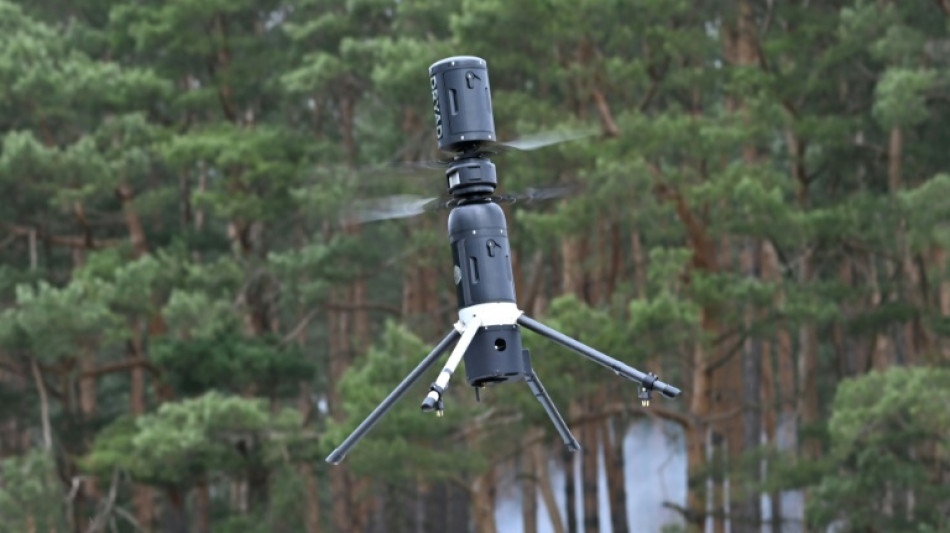
AI-powered drones track down fires in German forests / Photo: © AFP/File

 ECB opens door to September rate-hike as Iran war flares up

 World Bank estimates Venezuela quakes caused $19.6 bn in damage
 Italy's far-right line up to defend jeweller who killed robbers

 AI-led boom in IPOs raises concerns about a bust

 Klopp expected to be named new Germany coach on Friday

 ECB holds rates as Iran war flare-up threatens to drive prices higher

 MEXC's "Kickoff Fest" Trading Event Concludes with Top Individual Reward of 27,352 USDT
 Oil soars close to $100 on fresh Mideast attacks

 India's angry Gen Z protesters say Modi must fix accountability

 Barca sign Adeyemi from Borussia Dortmund

 EasyJet profits nosedive on Mideast war

 EU fines Google 890 mn euros, risking US fury

 France evacuates thousands of tourists as fire rages in pine forest

 French Jewish DJ sues after activists disrupt stage show: lawyer

 Nokia says AI, cloud boosted sales in second quarter

 Repsol says profit more than triples on higher oil prices

 TotalEnergies says profit doubled on Mideast war
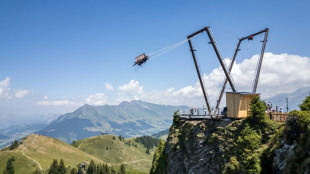 Giant swing on Swiss peak aims to boost summer tourism as Alps warm

 ASEAN to call for open straits as US-Iran war casts shadow

 AI catches up with humans to score 100% at top maths contest

 South Korea election office raided in fake turnout figures probe: investigators
 Killer whales: orcas blow fish to bits 'for fun', study finds

 Deadly wildfires force thousands from homes in parts of Europe

 Tech bounce lifts Asia stocks, oil extends gains on US-Iran fears

 Surrounded by militias, Sudanese fear endless cycle of war

Inside a green orb planted in the German countryside is a high-tech aid to prevent wildfires that have grown more common and destructive with rising global temperatures.
The installation, resembling a giant golf ball covered in solar panels, is the hangar for an AI-powered drone that its developer hopes one day will be able to sniff out and extinguish new blazes in minutes.
"Fires are spreading much faster and more aggressively than in the past. That also means we have to react more quickly," Carsten Brinkschulte, the CEO of the German firm Dryad, told AFP at a demonstration of the technology outside Berlin.
Once a rarity, the German capital has to get used to more wildfires. Flames ripped through a forest on the city's western edge in the midst of a 2022 heatwave that saw several wildfires spring up in Germany.
The sort of tinderbox conditions which promote blazes -- where heat, drought and strong winds dry out the landscape -- have increased with climate change.
Wildfires have reached the point where they were "basically unstoppable", said Lindon Pronto, senior wildfire management expert at the European Forest Institute.
That is why action is needed to develop tools to "address fire in the prevention phase, during the operational phase, and also post-fire", said Pronto.
- 'Prevent a disaster' -
Dryad is in the running with 29 other teams from around the globe for a multi-million-dollar prize to develop the ability to autonomously put out fires within 10 minutes.
During Dryad's demonstration on Thursday -- the first for a computer-steered wildfire detection drone according to the company -- chemicals in smoke from burning wood were picked up by sensors distributed in the forest.
The signal was relayed back to the company's platform which released the drone from the orb. The unit rose above the trees, charting a zig-zag course to track down the precise location and extent of the fire.
Firefighters using the information collected by the drone would be able "to respond much more efficiently and quickly and prevent a disaster", Brinkschulte said.
Dryad eventually hopes to have the drone descend below the canopy and put out the fire using a novel technology: a "sonic cannon" blasting low-frequency sound waves at the right pressure to suppress small fires.
An experimental acoustic suppression method, if it can be realised, would save the drone from carrying "large amounts of heavy water", making the unit more nimble and effective, according to Brinkschulte.
- 'Civilisation meets nature' -
Technologies like Dryad's are a step towards putting out fires "without putting people's lives in danger", said Pronto, a native of California, where recent wildfires have had a devastating impact.
Huge blazes in Los Angeles in January killed 29 people, razed more than 10,000 homes and caused some $250 billion (231 billion euros) in damage, according to estimates by the private meteorological firm AccuWeather.
The greatest benefits of an autonomous fire prevention system would be in areas where "civilisation meets nature", Brinkschulte said.
Such crossover zones are the most vulnerable to man-made wildfires and "where the risk to life and limb is naturally highest".
The company hopes to bring the drone to market in 2026, with the first deployment likely to be outside Europe.
"These systems still need to have the regulatory framework to be able to operate commercially," Brinkschulte said, adding that Dryad was aiming for deployment in Europe in the "coming years"
A couple of kinks need to be worked out before then, however. The first attempt to respond to the dummy fire on Thursday was held up by a faulty GPS signal.
A.Kunz--VB