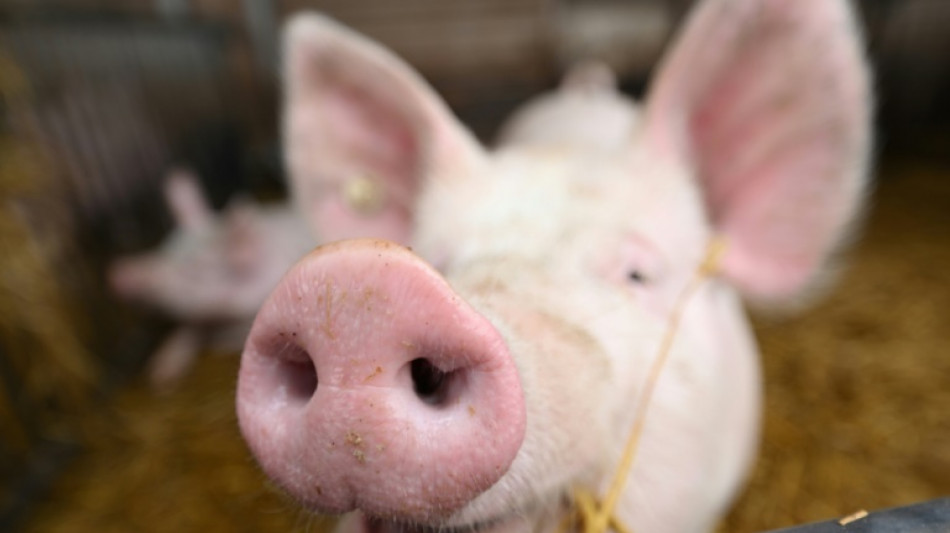
Chinese doctors implant pig liver in human for first time / Photo: © AFP/File

 ECB opens door to September rate-hike as Iran war flares up

 World Bank estimates Venezuela quakes caused $19.6 bn in damage

 Italy's far-right line up to defend jeweller who killed robbers

 AI-led boom in IPOs raises concerns about a bust

 Klopp expected to be named new Germany coach on Friday

 ECB holds rates as Iran war flare-up threatens to drive prices higher

 MEXC's "Kickoff Fest" Trading Event Concludes with Top Individual Reward of 27,352 USDT

 Oil soars close to $100 on fresh Mideast attacks

 India's angry Gen Z protesters say Modi must fix accountability

 Barca sign Adeyemi from Borussia Dortmund

 EasyJet profits nosedive on Mideast war

 EU fines Google 890 mn euros, risking US fury

 France evacuates thousands of tourists as fire rages in pine forest

 French Jewish DJ sues after activists disrupt stage show: lawyer

 Nokia says AI, cloud boosted sales in second quarter

 Repsol says profit more than triples on higher oil prices

 TotalEnergies says profit doubled on Mideast war

 Giant swing on Swiss peak aims to boost summer tourism as Alps warm

 ASEAN to call for open straits as US-Iran war casts shadow

 AI catches up with humans to score 100% at top maths contest

 South Korea election office raided in fake turnout figures probe: investigators

 Killer whales: orcas blow fish to bits 'for fun', study finds

 Deadly wildfires force thousands from homes in parts of Europe

 Tech bounce lifts Asia stocks, oil extends gains on US-Iran fears

 Surrounded by militias, Sudanese fear endless cycle of war

Chinese doctors said Wednesday that they had transplanted a liver from a genetically modified pig into a brain-dead human for the first time, raising hopes of a live-saving donor option for patients in the future.
Pigs have emerged as the best animal organ donors, with several living patients in the United States having received pig kidneys or hearts in the last few years.
Livers have proved trickier -- and had not previously been tested out inside a human body.
But with a huge and growing demand for liver donations across the world, researchers hope that gene-edited pigs can offer at least temporary relief to seriously ill patients on long waiting lists.
Doctors at the Fourth Military Medical University in Xi'an, China, announced the field's latest breakthrough in a study in the journal Nature.
A liver from a miniature pig, which had six edited genes to make it a better donor, was transplanted into a brain-dead adult at the hospital on March 10, 2024, according to the study.
The trial was terminated after 10 days at the request of the family, the doctors said, adding that they had followed strict ethical guidelines.
- 'Bridge organ' -
The patient, whose name, gender and other details were not revealed, still had their original liver, receiving what is called an auxiliary transplant.
The hope is that this kind of transplant can serve as a "bridge organ" to support the existing liver of sick people waiting on a human donor.
Over the 10 days, the doctors monitored the liver's blood flow, bile production, immune response and other key functions.
The pig liver "functioned really well" and "smoothly secreted bile" as well as producing the key protein albumin, study co-author Lin Wang of the Xi'an hospital told a press conference.
"It's a great achievement" that could help people with liver problems in the future, he added.
Other researchers also hailed the breakthrough but emphasised that this early step could not confirm whether the pig organ would work as a replacement for human livers.
Transplants of livers have proved difficult because they carry out several different functions -- unlike hearts, for example, which simply pump blood, Lin said.
Livers filter the body's blood, breaking down things like drugs and alcohol, as well as producing bile that carries away waste and breaks down fats.
The pig liver produced far smaller amounts of bile and albumin than a human liver could achieve, Lin said.
More research is needed -- including studying the pig liver for more than 10 days, he added.
Next, the doctors plan to trial the gene-edited pig liver in a living human.
- 'Impressive' -
Oxford University transplantation professor Peter Friend, who was not involved in the study, said the results were "valuable and impressive".
However, "this is not a replacement for liver transplantation from human donors (at least in the near-term)," he told AFP in an email.
"This is a useful test of the compatibility of genetically modified livers with humans and points to a future in which such livers can provide support for patients in liver failure."
Lin emphasised that collaboration with US researchers was crucial.
"To be frank, we have learned quite a lot from all the research performed and investigated by the United States doctors," he said.
Last year, scientists at the University of Pennsylvania attached a pig liver to a brain-dead patient -- but instead of being transplanted, the organ remained outside the body.
Both US recipients of pig heart transplants died.
But Towana Looney, 53, is back home in Alabama after receiving a pig kidney on November 25, 2024.
U.Maertens--VB