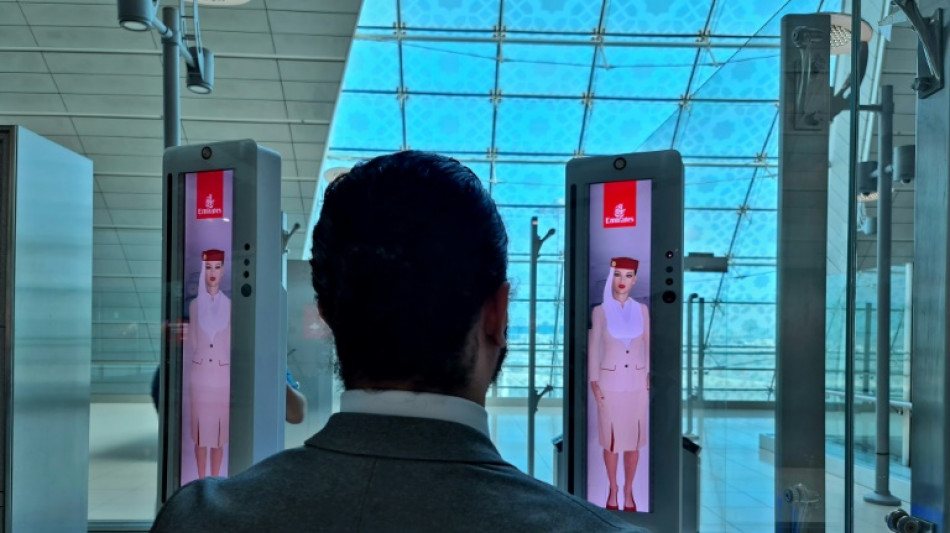
Settlement curbs firm's facial recognition database in US / Photo: © AFP

 Reigning champ Knicks earn first win against Pistons
 Runners swap streets for shopping malls as haze chokes Singapore

 Billionaire Ambani's Jio to debut after record India IPO

 UK set for cautious budget as borrowing costs climb

 Anthropic's record IPO faces some big questions

 US Fed expected to hold rates steady ahead of key midterm elections
 Can this Latin Grammy-winner help Democrats win back Congress?

 Tuvalu has 'limited' power to halt its fossil fuel investments: NZ govt papers seen by AFP

 Palestinian activist Khalil returns to Columbia after US detention

 Trump drastically loosens oil and gas methane rules

 French Senate weighs bill to make protesters pay for unrest damage
 'A very sad day': Arteta despair as Arsenal stunned by Fleetwood
 Charles tackles thorny legacy of slavery on Caribbean trip

 Former Grand Slam winner Wawrinka ends tennis career

 Brazil's Flavio Bolsonaro flees to US after election loss

 'Faerie' nights: 'ACOTAR' fans finally get their book

 American woman convicted of getting military training from Islamic State

 Israel opposition holds narrow edge over Netanyahu in first projections

 Floriani hits maiden goal as Lazio go top
 Trump set to drastically loosen oil and gas sector's methane rules

 Storied Paris department store seeks bankruptcy protection
 Xhaka, Embolo can return to Swiss squad after fake Covid docs affair
 Allegri suspended for two Serie A games after red card

 Flight data, satellite images reveal growing US role at Ecuador base
 McInnes feels 'guilt' ahead of Hearts return with Rangers

Startup Clearview AI has agreed to limit access to its controversial facial recognition database in the United States, settling a lawsuit filed by privacy advocates, a court filing showed Monday.
The deal, which needs approval by the court to become final, would resolve litigation filed two years ago by the American Civil Liberties Union (ACLU) and rights groups accusing Clearview of violating a strict biometric privacy law in the state of Illinois.
A main provision of the settlement permanently bans Clearview from making its "faceprint" database available to most businesses or other private entities in the country, according the ACLU.
"Clearview can no longer treat people's unique biometric identifiers as an unrestricted source of profit," said ACLU speech, privacy and technology director Nathan Freed Wessler.
"Before this agreement, Clearview ignored the fact that biometric information can be misused to create dangerous situations and threats" to lives, said Linda Xochitl Tortolero, chief executive of Chicago-based nonprofit Mujeres Latinas en Accion.
"Today that's no longer the case."
Clearview will also stop its practice of offering free trial accounts to police officers without the knowledge or approval of their employers, the ACLU said.
The ban does not limit Clearview from working with federal or state agencies other than those in Illinois, the lawsuit said.
Clearview admits no wrongdoing in the settlement.
Clearview AI says it has built up a database of more than 10 billion facial images taken from public websites, ranging from social media to news portals, which it touts as a tool for law enforcement.
- Still checking faces -
Clearview chief executive Hoan Ton-That said the company has told the court that it intends to make its facial recognition software available to commercial customers, without the database of images.
"Clearview AI's posture regarding sales to private entities remains unchanged," the chief executive said in response to an AFP inquiry.
Facial recognition is used to unlock smartphones, verify identities, board aircraft and more, he noted.
The settlement does not require any "material change" in the Clearview business model," said Cahill Gordon, an attorney representing the company.
Campaigners have condemned Clearview's use of images for being open to abuse, and a number of groups including Privacy International last year filed complaints with data regulators in France, Austria, Italy, Greece and Britain.
Italy's data privacy watchdog in March fined Clearview 20 million euros (almost $22 million) over its facial recognition software.
The watchdog ordered the company to delete data relating to people in Italy and banned it from further collection and processing of information there.
France's privacy watchdog as well in December ordered Clearview to delete data on its citizens and cease further collection.
Meanwhile in June last year, Canada's independent parliamentary watchdog ruled that both Clearview's database and the use of it by federal police were illegal.
H.Seidel--BTB