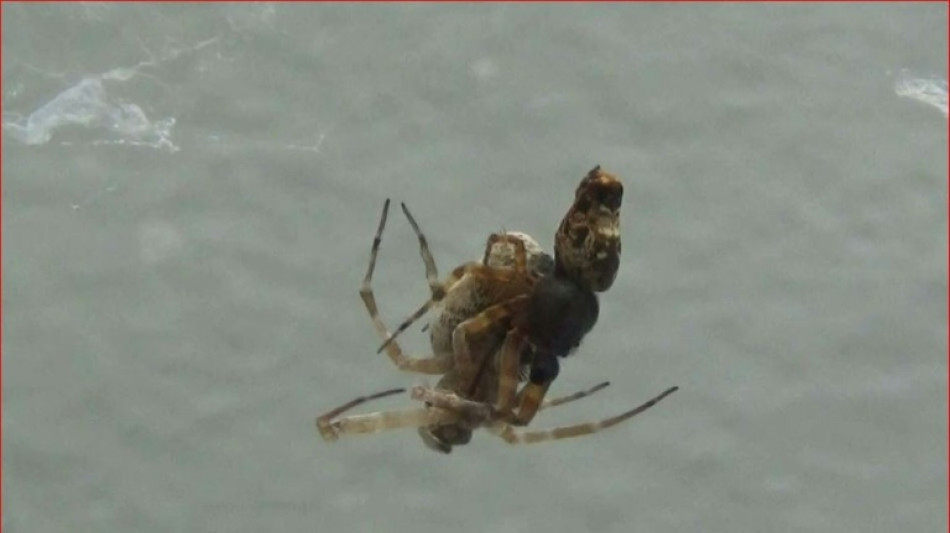
Some male spiders catapult away after sex to avoid death / Photo: © Hubei University/AFP

 Colombian judge bans strikes on guerrillas if minors are present

 Khachanov shocks ailing Auger-Aliassime, Swiatek and Osaka advance at US Open

 Lone juror blocking verdict in US mother's child murder trial: defense

 'Kinda chic' - Williams sisters set to launch US Open doubles bid

 Volkswagen says cutting 100,000 jobs by end of decade

 Russia slaps curfew on charity director over army criticism

 Ailing Auger-Aliassime upset by Khachanov at US Open

 Richarlison omitted from Tottenham's Premier League squad

 How El Nino is choking the Panama Canal

 Hamilton drives his Ferrari dream at Monza

 Senegal has an IMF loan, now what?

 Auger-Aliassime upset by Khachanov at US Open

 Hugging Face, the French start-up that became AI's warehouse

 World Cup winner Llorente retires from Spain team at 31

 Osaka squeezes into US Open third round

 Apple faces £2 bn lawsuit in UK over app privacy feature

 Former champ Swiatek eases into US Open third round

 DR Congo latest to promise moving Israel embassy to Jerusalem

 War criminal Mladic's body returns to Serbia with military honours

 Pierre Cardin museum brings designer's futurist style to Venice

 Slovenian rookie Omrzel triumphs as Mas extends Vuelta lead

 British, French leaders talk migrants, EU relations

 Heading for Ferrari's home race, Leclerc still dreams of world title

 Cafe at centre of Israel culture clash agrees to shut on Sabbath

 Spacecraft bound for Mercury begins 'tricky' arrival

Sometimes there are pretty valid reasons for leaving right after sex.
A team of Chinese scientists has discovered that male orb-weaving spiders fling themselves away from their partners -- pulling 20 Gs of acceleration in order to avoid being killed and eaten.
The mechanism, described for the first time in the journal Current Biology on Monday, involves the spiders' first pair of legs to immediately undertake a split-second catapult action.
Lead author Shichang Zhang of Hubei University in Wuhan told AFP he was "excited" to make the discovery, which required high-speed, high-resolution cameras to detect.
Zhang and colleagues were studying sexual selection in this spider, "Philoponella prominens," which live in communal groups of up to 300 individuals.
Of 155 successful matings, they found 152 ended with the male catapulting and thus surviving the encounter.
Males can mate up to six times with the same female -- bouncing off, climbing back up using a silk safety line, mating, and bouncing off again.
The three males that didn't catapult were promptly captured, killed and consumed by their partners.
Another 30 males that were prevented from catapulting by placing a fine brush behind their dorsum all met the same fate -- leading the researchers to conclude catapulting is essential to avoiding sexual cannabalism.
The escaping spiders clocked some impressive statistics: their average peak speed was 65 centimeters per second, with an acceleration of 200 meters per second squared. That's equivalent to 20 Gs, or 20 times the acceleration felt during freefall.
While soaring through the air, the males spin around at some 175 revolutions per second.
The males catapult by folding the tibia-metatarsus joint of their first leg pair against females. When released, it exerts hydraulic pressure and causes the legs to expand.
Zhang said he believes the females were judging males' sexual suitability by their ability to escape.
"Through the catapulting, a male can escape female sexual cannibalism, and a female can choose males with high quality, because the kinetic performance may directly correlate with male's physical condition," he said.
Even though they have already mated, females may go on to only accept the sperm of males that passed the test, explained Zhang.
Spiders differ from mammals in that females have a structure known as spermatheca where deposited sperm is stored. She can decide whether to use it to fertilize her eggs, or reject it by squeezing it out or changing the pH value to kill the sperm.
Future work will confirm whether there is a correlation between male catapulting and reproductive success, said Zhang.
L.Janezki--BTB