Polish researchers invent anti-smog sound cannon / Photo: ©

 UK set for cautious budget as borrowing costs climb

 Anthropic's record IPO faces some big questions

 US Fed expected to hold rates steady ahead of key midterm elections

 Can this Latin Grammy-winner help Democrats win back Congress?

 Tuvalu has 'limited' power to halt its fossil fuel investments: NZ govt papers seen by AFP

 Palestinian activist Khalil returns to Columbia after US detention

 Trump drastically loosens oil and gas methane rules

 French Senate weighs bill to make protesters pay for unrest damage

 'A very sad day': Arteta despair as Arsenal stunned by Fleetwood

 Charles tackles thorny legacy of slavery on Caribbean trip

 Former Grand Slam winner Wawrinka ends tennis career

 Brazil's Flavio Bolsonaro flees to US after election loss

 'Faerie' nights: 'ACOTAR' fans finally get their book

 American woman convicted of getting military training from Islamic State

 Israel opposition holds narrow edge over Netanyahu in first projections

 Floriani hits maiden goal as Lazio go top

 Trump set to drastically loosen oil and gas sector's methane rules

 Storied Paris department store seeks bankruptcy protection

 Xhaka, Embolo can return to Swiss squad after fake Covid docs affair

 Allegri suspended for two Serie A games after red card

 Flight data, satellite images reveal growing US role at Ecuador base

 McInnes feels 'guilt' ahead of Hearts return with Rangers

 Brazil's Lula turns 81, vows to work '24 hours a day'

 Boeing releases cautious growth plan as shares fall sharply

 Exiled Russian dissident Navalnaya warns dictators becoming 'more cunning'

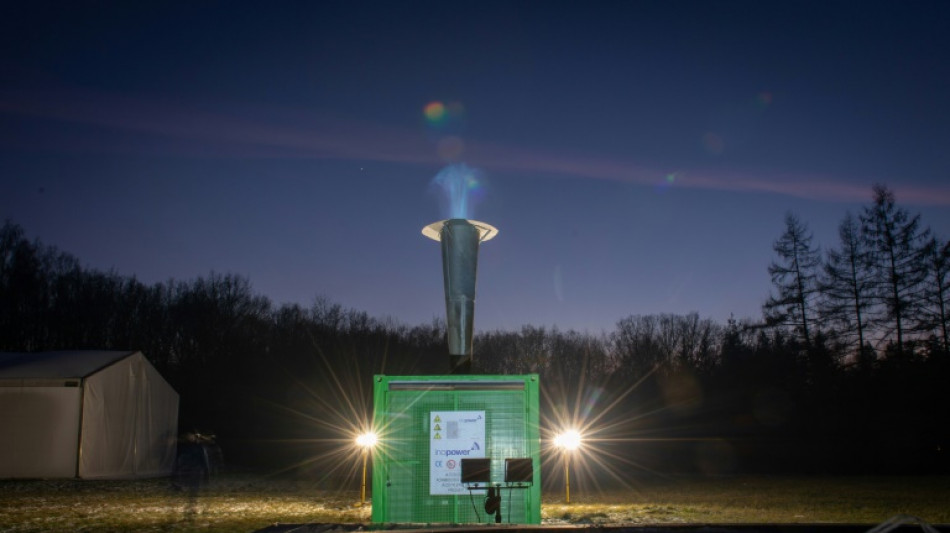
In a battle against Poland's constant smog, scientists are testing out a new "cannon" that uses soundwaves to push toxic particles higher into the atmosphere to allow residents to breathe.
Installed on top of a metal container, the experimental device consists of a large upside-down cone that makes a loud sound every six seconds.
The aim is to chase the smog from Kalwaria Zebrzydowska, which like many Polish towns and cities faces the problem every winter when residents fire up highly polluting heating systems.
When the sun goes down, a heavy smog descends on the town as chimneys belch out thick smoke.
Poland is one of the most polluted countries in Europe, breaching EU norms by hundreds of percentage points at the worst times of year.
By creating soundwaves, researchers say that the "cannon" helps reduce the concentration of harmful PM2.5 and PM10 particles in the town's air.
"We are using a vertical shockwave that is created by the combustion of acetylene and air," said Dominik Grybos from the Academy of Mining and Metallurgy in Krakow, one of the inventors.
"The wave projects the polluted air higher," he told AFP.
The toxic particles are sent up several hundred metres (yards) higher, making them harmless for residents.
"We have found that if we use the cannon for between half an hour and an hour, the pollution is reduced by 15-30 percent within a perimeter of two-three kilometres (1.2-1.9 miles) from the cannon," Grybos said, adding that the effects last for "between one and three hours".
Researchers are trying to work out the required frequency of the blasts, as well as the duration and the time needed for the entire procedure.
The price is estimated at 1,000-1,500 zloty ($250-$375) for one hour of use.
Grybos said he hopes the invention could find a commercial use, particularly in Poland.
Residents of Kalwaria Zebrzydowska are broadly in favour of the idea despite the sound.
"The smog is very heavy here. We can't air our flats because it stinks so much. So, if it can help, let them do the tests," said Jolanta Walkowicz, a 43-year-old accountant.
"We can barely hear the sound -- it's like fireworks going off," she added.
O.Lorenz--BTB