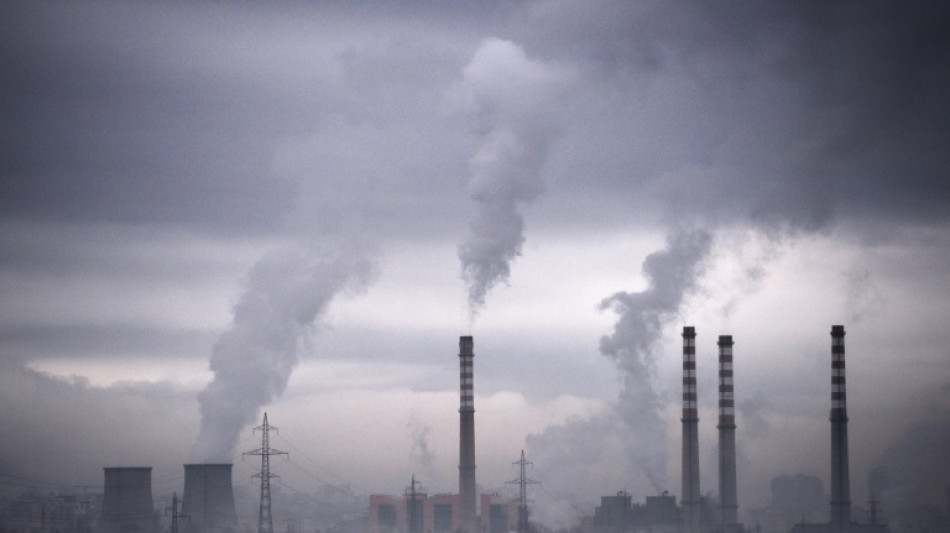
Paris climate targets feasible if nations keep vows / Photo: © AFP/File

 Colombian judge bans strikes on guerrillas if minors are present

 Khachanov shocks ailing Auger-Aliassime, Swiatek and Osaka advance at US Open

 Lone juror blocking verdict in US mother's child murder trial: defense
 'Kinda chic' - Williams sisters set to launch US Open doubles bid

 Volkswagen says cutting 100,000 jobs by end of decade

 Russia slaps curfew on charity director over army criticism

 Ailing Auger-Aliassime upset by Khachanov at US Open

 Richarlison omitted from Tottenham's Premier League squad

 How El Nino is choking the Panama Canal

 Hamilton drives his Ferrari dream at Monza

 Senegal has an IMF loan, now what?

 Auger-Aliassime upset by Khachanov at US Open

 Hugging Face, the French start-up that became AI's warehouse
 World Cup winner Llorente retires from Spain team at 31

 Osaka squeezes into US Open third round

 Apple faces £2 bn lawsuit in UK over app privacy feature
 Former champ Swiatek eases into US Open third round

 DR Congo latest to promise moving Israel embassy to Jerusalem

 War criminal Mladic's body returns to Serbia with military honours

 Pierre Cardin museum brings designer's futurist style to Venice

 Slovenian rookie Omrzel triumphs as Mas extends Vuelta lead
 British, French leaders talk migrants, EU relations

 Heading for Ferrari's home race, Leclerc still dreams of world title

 Cafe at centre of Israel culture clash agrees to shut on Sabbath

 Spacecraft bound for Mercury begins 'tricky' arrival

If all nations honour promises to reduce greenhouse gas emissions, there is a chance of capping the rise in global temperatures to under two degrees Celsius, the cornerstone target of the Paris Agreement, researchers said Wednesday.
But that is a very big "if", they acknowledge in a peer-reviewed study, published in Nature.
The calculus includes not only carbon-cutting commitments officially registered under the 2015 treaty, but a raft of pledges made on the sidelines of last years COP26 UN climate summit in Glasgow -- to curb deforestation and methane leaks, for example -- that lack means for monitoring or verification.
They also include actions to lower emissions in developing countries that are contingent on financing, something wealthy nations have so far failed to deliver at agreed-upon levels.
The new estimates likewise fold in pledges to become carbon neutral by mid-century that do not detail how that will be achieved.
"Long-term targets should be treated with scepticism if they are not supported by short-term commitments to put countries on a pathway in the next decade to meet those targets," Zeke Hausfather, a researcher at Berkeley Earth, said, commenting on the study.
Most rich countries have announced they will be "net zero" by 2050, while China and India have vowed to reach that point by 2060 and 2070, respectively.
"Is our study a good news story?" lead author Malte Meinshausen, a professor at the University of Melbourne, asked in a briefing with journalists.
"Yes, because for the first time we can possibly keep warming below the symbolic 2C mark with promises on the table," he continued.
- Curb your optimism -
"And no, because we show clearly that increased action this decade is necessary for us to have a chance of not shooting past 1.5C by a large margin."
As deadly and costly climate impacts have increased, most nations have embraced the Paris deal's more ambitious "aspirational" target of holding the rise in global temperatures to 1.5C above preindustrial levels.
The UN's Intergovernmental Panel on Climate Change (IPCC) said in a landmark report earlier this month that carbon pollution must peak before 2025 and be cut in half by 2030 to have even a chance of reaching that goal.
Recent trends do not suggest the world is headed in the right direction: greenhouse gas emissions last year regained the record levels of 2019 after Covid lockdowns lowered them in 2020.
"Some government and business leaders are saying one thing –- but doing another," UN chief Antonio Guterres said last week when the IPCC report was launched. "Simply put, they are lying."
The new research analyses data from 196 countries from 2015 until the end of the COP26 meeting in mid-November 2021.
It concludes that if all pledges are implemented in full and on time, warming can be limited to 1.9C to 2.0C.
Unless immediate steps are taken to drive down emissions even further, 1.5C will almost certainly remain out of reach, the authors said.
If no additional efforts are made beyond pledges -- know as nationally determined contributions -- submitted under the Paris Agreement, Earth's surface will warm to a catastrophic 2.8C, the IPCC has said.
"Optimism should be curbed until promises to reduce emissions in the future are backed up with stronger short-term action," Hausfather and Frances Moore, a scientist at the University of California, Davis said in a comment, also in Nature.
F.Müller--BTB