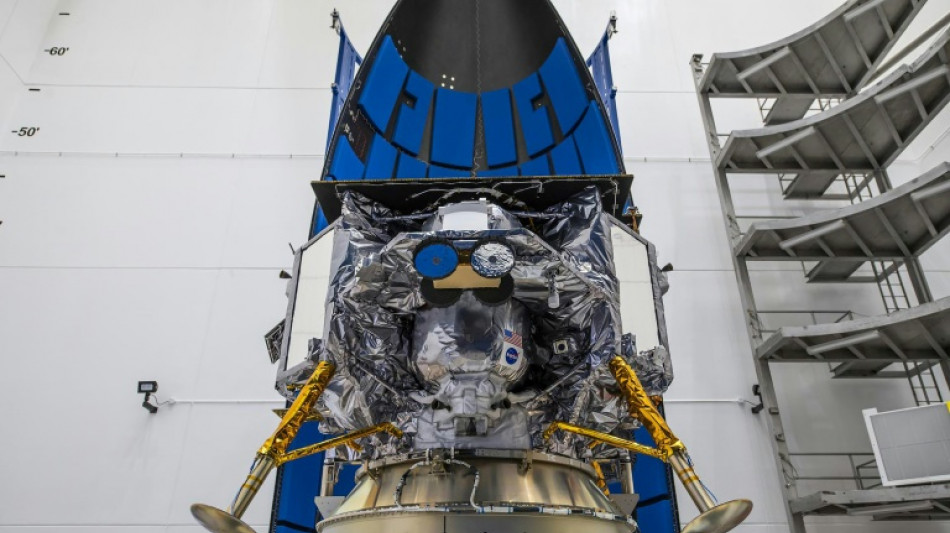
Private US lunar lander facing failure after 'critical loss' of fuel / Photo: © NASA/AFP/File

 Thousands flee wildfires in southern Europe

 South Korean tycoon ordered to pay $644m in divorce

 Hundreds flee French peninsula by boat to escape wildfire

 Brian Lara Stadium hosts maiden Test as West Indies face Pakistan

 Volkswagen profit plunges as carmaker weighs mass job cuts

 India protest leaders to meet govt after Modi vows action

 Fear, arrests keep Cambodians quiet decade after critic's murder

 Over 80% of Mexican exports exempt from new US tariffs

 Is 'superstar' Pogacar's Tour de France domination boring?

 Iran ramps up executions under shadow of war

 Rosalia's Argentine fans up in arms over alleged World Cup snub

 Six candidates to lead UN take stage for televised debate

 King Charles opens slimmed down Commonwealth Games in Glasgow

 US unveils new tariffs on 60 partners as Trump rebuilds trade agenda

 WNBA viral star Cunningham wades into trans athletes row
 Hearn dismisses Fury talk of Joshua no-show for super fight

 'Like a war zone': France evacuates 20,000 due to wildfires

 Ships avoid Ukrainian grain ports after Russian attacks

 Oil passes $100 a barrel again: why it's more serious this time

 Who are the six candidates vying to lead the UN?

 Hamilton proud of recovery after hitting rock bottom a year ago

 Carapaz eyes polkadot mountains jersey after stage win

 Fields medal awarded to four young mathematicians

 Carapaz claims Tour de France stage as Pogacar loses key team-mate

 Alonso welcomes Aston Martin upgrade, warns against unreal expectations

An historic private mission to land on the Moon was facing near-certain failure Monday after the spacecraft suffered a "critical loss" of fuel, in a major blow to America's hopes of placing its first robot on the lunar surface in five decades.
Fixed to the top of United Launch Alliance's new Vulcan rocket, Astrobotic's Peregrine Lunar Lander blasted off overnight from Florida's Cape Canaveral Space Force Station, then successfully separated from its launch vehicle.
A few hours later, Astrobotic began reporting technical malfunctions, starting with an inability to orient Peregrine's top-mounted solar panel towards the Sun and keep its onboard battery topped up, owing to malfunction in its propulsion system.
Though engineers found a way to tilt the spacecraft in the right direction thanks to an "improvised maneuver," the company then posted that the propulsion system failure appeared to be the cause of a "critical loss of propellant."
"The team is working to try and stabilize this loss, but given the situation, we have prioritized maximizing the science and data we can capture," Astrobotic tweeted.
"We are currently assessing what alternative mission profiles may be feasible at this time," it added, an apparent admission that the Peregrine would not touch down on the Moon as planned.
Peregrine was supposed to reach the Moon, then maintain an orbit for several weeks before touching down on a mid-latitude region called Sinus Viscositatis, or Bay of Stickiness, on February 23.
Until now, a soft landing on Earth's nearest celestial neighbor has only been accomplished by a handful of national space agencies: the Soviet Union was first, in 1966, followed by the United States, which is still the only country to put people on the Moon.
China has successfully landed three times over the past decade, while India was the most recent to achieve the feat on its second attempt, last year.
Now, the United States is turning to the commercial sector to stimulate a broader lunar economy and ship its own hardware at a fraction of the cost, under the Commercial Lunar Payload Services (CLPS) program -- but a failure for Astrobotic could lead to criticism of the new strategy.
"Each success and setback are opportunities to learn and grow," said Joel Kearns, deputy associate administrator for exploration at NASA's Science Mission Directorate in Washington.
"We will use this lesson to propel our efforts to advance science, exploration, and commercial development of the Moon."
- Failure commonplace -
NASA paid Astrobotic more than $100 million for the task, while another contracted company, Houston-based Intuitive Machines, is looking to launch in February and land near the Moon's south pole.
NASA says they will help pave the way for its Artemis program to return astronauts to the Moon later this decade, in preparation for future missions to Mars.
Controlled touchdown on the Moon is a challenging undertaking, with roughly half of all attempts failing.
In the absence of an atmosphere that would allow the use of parachutes, a spacecraft must navigate treacherous terrain using only its thrusters to slow descent.
Private missions by Israel and Japan, as well as a recent attempt by the Russian space agency, have all ended in failure -- though the Japanese Space Agency is targeting mid-January for the touchdown of its SLIM lander launched last September.
This weekend's blast-off was the first launch for ULA's Vulcan rocket, maintaining the company's 100 percent success rate in more than 150 launches.
- Navajo objections -
On board Peregrine is a suite of scientific instruments designed to probe radiation and surface composition, helping to pave the way for the return of astronauts.
But it also contains more colorful cargo, including a shoebox-sized rover built by Carnegie Mellon University, a physical Bitcoin and cremated remains and DNA, including those of Star Trek creator Gene Roddenberry, legendary sci-fi author and scientist Arthur C. Clarke and a dog.
The Navajo Nation, America's largest Indigenous tribe, has objected to sending human remains, calling it a desecration of a sacred space. Though they were granted a last-ditch meeting with White House and NASA officials, their objections failed to remove the cargo.
T.Suter--VB