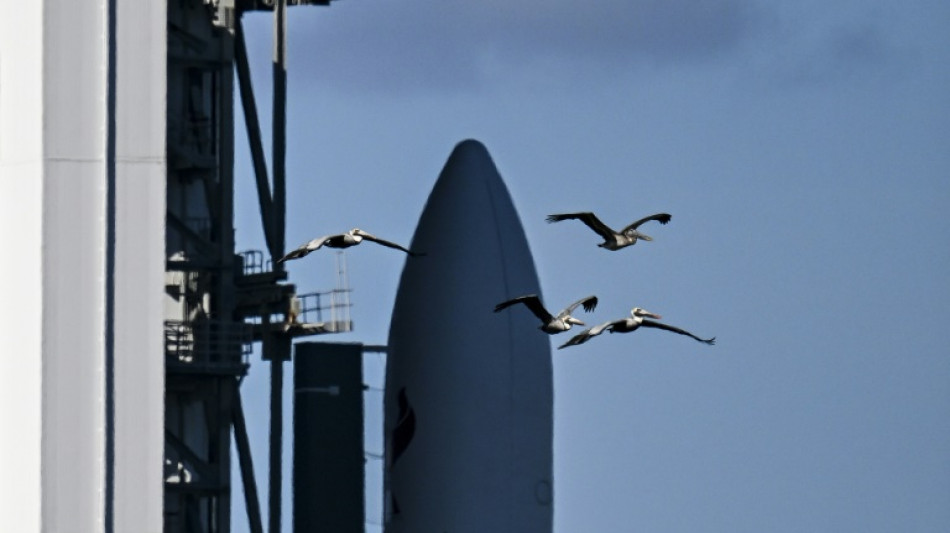
First US lunar lander in five decades blasts off on private mission / Photo: © AFP

 Thousands flee wildfires in southern Europe

 South Korean tycoon ordered to pay $644m in divorce

 Hundreds flee French peninsula by boat to escape wildfire

 Brian Lara Stadium hosts maiden Test as West Indies face Pakistan

 Volkswagen profit plunges as carmaker weighs mass job cuts

 India protest leaders to meet govt after Modi vows action

 Fear, arrests keep Cambodians quiet decade after critic's murder

 Over 80% of Mexican exports exempt from new US tariffs

 Is 'superstar' Pogacar's Tour de France domination boring?

 Iran ramps up executions under shadow of war

 Rosalia's Argentine fans up in arms over alleged World Cup snub

 Six candidates to lead UN take stage for televised debate

 King Charles opens slimmed down Commonwealth Games in Glasgow

 US unveils new tariffs on 60 partners as Trump rebuilds trade agenda

 WNBA viral star Cunningham wades into trans athletes row
 Hearn dismisses Fury talk of Joshua no-show for super fight

 'Like a war zone': France evacuates 20,000 due to wildfires

 Ships avoid Ukrainian grain ports after Russian attacks

 Oil passes $100 a barrel again: why it's more serious this time

 Who are the six candidates vying to lead the UN?

 Hamilton proud of recovery after hitting rock bottom a year ago
 Carapaz eyes polkadot mountains jersey after stage win

 Fields medal awarded to four young mathematicians

 Carapaz claims Tour de France stage as Pogacar loses key team-mate

 Alonso welcomes Aston Martin upgrade, warns against unreal expectations

The first American spacecraft to attempt to land on the Moon in more than half a century blasted off early Monday -- but this time, private industry is leading the charge.
A brand new rocket, United Launch Alliance's Vulcan Centaur, lifted off from Cape Canaveral Space Force Station in Florida at 2:18 am (0718 GMT) for its maiden voyage, carrying Astrobotic's Peregrine Lunar Lander.
"Successful #VulcanRocket staging, ignition," ULA said on X, formerly Twitter, following the launch.
Eric Monda, ULA's strategic planning director, described the launch as "spot on."
"It was so cool. I ran outside to watch the launch," he said on NASA's live stream.
If all goes to plan, Peregrine will touch down on a mid-latitude region of the Moon called Sinus Viscositatis, or Bay of Stickiness, on February 23.
"Leading America back to the surface of the Moon for the first time since Apollo is a momentous honor," Astrobotic's CEO John Thornton said ahead of the launch.
Until now, a soft landing on Earth's nearest celestial neighbor has only been accomplished by a handful of national space agencies: the Soviet Union was first, in 1966, followed by the United States, which is still the only country to put people on the Moon.
China has successfully landed three times over the past decade, while India was the most recent to achieve the feat on its second attempt, last year.
Now, the United States is turning to the commercial sector to stimulate a broader lunar economy and ship its own hardware at a fraction of the cost, under the Commercial Lunar Payload Services (CLPS) program.
- A challenging task -
NASA paid Astrobotic more than $100 million for the task, while another contracted company, Houston-based Intuitive Machines, is looking to launch in February and land near the south pole.
"We think that it's going to allow... more cost effective and more rapidly accomplished trips to the lunar surface to prepare for Artemis," said Joel Kearns, the US space agency's deputy associate administrator for exploration.
Artemis is the NASA-led program to return astronauts to the Moon later this decade, in preparation for future missions to Mars.
Controlled touchdown on the Moon is a challenging undertaking, with roughly half of all attempts ending in failure. Absent an atmosphere that would allow the use of parachutes, a spacecraft must navigate through treacherous terrain using only its thrusters to slow descent.
Private missions by Israel and Japan, as well as a recent attempt by the Russian space agency, have all ended in failure -- though the Japanese Space Agency is targeting mid-January for the touchdown of its SLIM lander launched last September.
Making matters more fraught is the fact that it is the first launch for ULA's Vulcan, although the company claims a 100 percent success rate in more than 150 prior launches.
ULA's new rocket is planned to have reusable first stage booster engines, which the company, a joint venture between Lockheed Martin and Boeing, expects will help save costs.
- Science instruments, human remains -
On board Peregrine is a suite of scientific instruments that will probe radiation and surface composition, helping to pave the way for the return of astronauts.
But it also contains more colorful cargo, including a shoebox-sized rover built by Carnegie Mellon University, a physical Bitcoin, and, somewhat controversially, cremated remains and DNA, including those of Star Trek creator Gene Roddenberry, legendary sci-fi author and scientist Arthur C. Clarke and a dog.
The Navajo Nation, America's largest Indigenous tribe, has said sending this cargo to the Moon desecrates something that is sacred to their culture. Though they were granted a last-ditch meeting with White House, NASA and other officials, their objections failed to remove the cargo.
The Vulcan rocket's upper stage, which will circle the Sun after it deploys the lander, is meanwhile carrying more late cast members of Star Trek, as well as hair samples of presidents George Washington, Dwight D. Eisenhower and John F. Kennedy.
P.Staeheli--VB