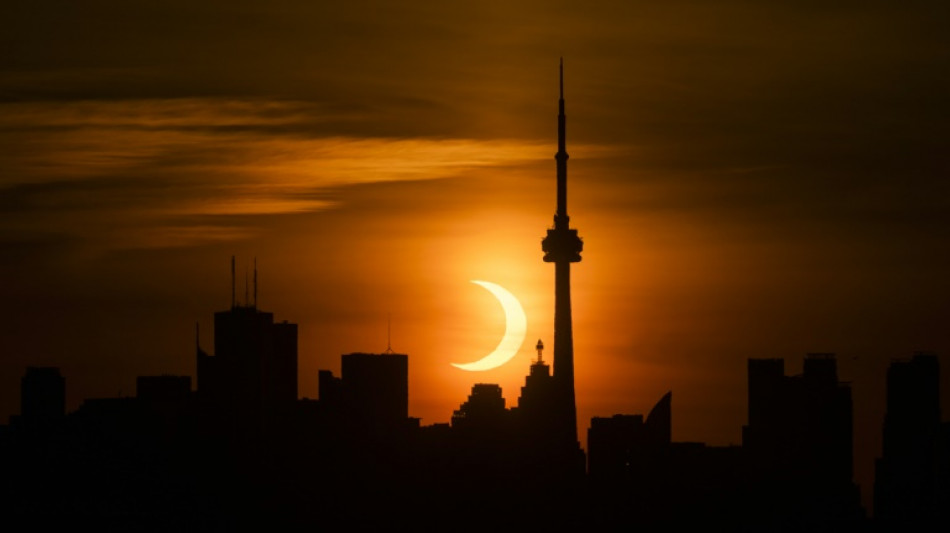
Western Hemisphere readies for a 'Ring of Fire' eclipse / Photo: © GETTY IMAGES NORTH AMERICA/AFP/File

 US imposes new tariffs on 60 partners as Trump rebuilds trade agenda

 Stocks suffer fresh blow as markets hit by perfect storm

 Trump under pressure from all sides over Chinese AI surge

 ICC member states decide fate of embattled prosecutor Karim Khan

 Dodgers return to Trump White House despite fan anger

 Lyles, Richardson ease into 100m semis at US athletics championships

 Salman Rushdie testifies at knife attacker's US terror trial

 World Bank confirms plan to phase out China lending by 2031

 US panel backs trendy peptides despite safety concerns

 Justice Dept withdraws NY Times subpoenas over Trump plane report

 Barcelona's De Jong returns from World Cup with torn ligament
 Albania police teargas protesters against Trump-linked resort
 US panel says to loosen restrictions on popular peptide despite safety concerns

 Verstappen swerves around future questions

 EU renews online child sex abuse detection powers

 Airbus, Boeing fly in different directions at Farnborough

 Bab al-Mandeb Strait: another key oil shipping route under threat

 Deadly wildfires in Europe force thousands to flee

 NATO to overhaul European fuel pipeline network

 US trade envoy to make tariff announcement as 10% duty soon expires

 Trump stuns Saudis by pinning nuclear deal to Israel ties

 Tough day for Ubisoft stock topped with weaker revenues

 Swelling jet fuel costs hit American Airlines outlook
 Carapaz climbs unopposed to Tour de France 18th stage win

 Sooryavanshi hits maiden 50 as India thump Zimbabwe in T20

Skygazers across the Americas are in for a celestial treat on Saturday: an annular solar eclipse.
These occur when the Moon passes between the Sun and Earth at its furthest point from our planet. Since it is so distant, it doesn't cover the Sun completely, creating a "ring of fire" effect.
In the United States, the most striking "path of the annularity" will cross a handful of major cities, including Eugene, Oregon, Alburquerque, New Mexico, and San Antonio, Texas, between 9:15 am to 11:50 am in local time zones, according to NASA, with partial eclipse phases lasting an hour or two before and after.
At any given location, it will be visible from between 30 seconds and five minutes -- but people are urged to take safety precautions and use solar viewing glasses, and never regular sunglasses, to preserve their vision.
"Do NOT look at the Sun through a camera lens, telescope, binoculars, or any other optical device while wearing eclipse glasses or using a handheld solar viewer —- the concentrated solar rays will burn through the filter and cause serious eye injury," NASA says.
Next it will cross Mexico and Central America, then into South America through Colombia and northern Brazil before ending at sunset in the Atlantic Ocean.
For those not lucky enough to be in the path of this special astronomical transit, NASA is also planning a live broadcast on nasa.gov/nasatv/ from 11:30am to 1:15 pm eastern time (1530 to 1715 GMT) from Albuquerque, New Mexico, as well as Carville, Texas and White Sands New Mexico.
- Sounding rockets -
The event also serves as a dress rehearsal before a total eclipse set for April 2024.
Both eclipses are going to be "absolutely breathtaking for science," said Madhulika Guhathakurta, a heliophysics program scientist.
Solar eclipses have a noticeable effect on the upper atmosphere, such as the ionosphere which is full of charged particles and responsible for reflecting and refracting radio waves.
"Although the atmospheric effects of solar eclipses have been studied for over 50 years, many unanswered questions remain," said Guhathakurta.
To study these effects, NASA will launch three rockets from the White Sands Missile Range in New Mexico to gather data on the electric and magnetic fields, electron density, and temperature.
A total eclipse took place in 2017 in the United States. After next April's total eclipse, the next one will take place in 2044, while the next annular eclipse will be in 2046.
P.Staeheli--VB