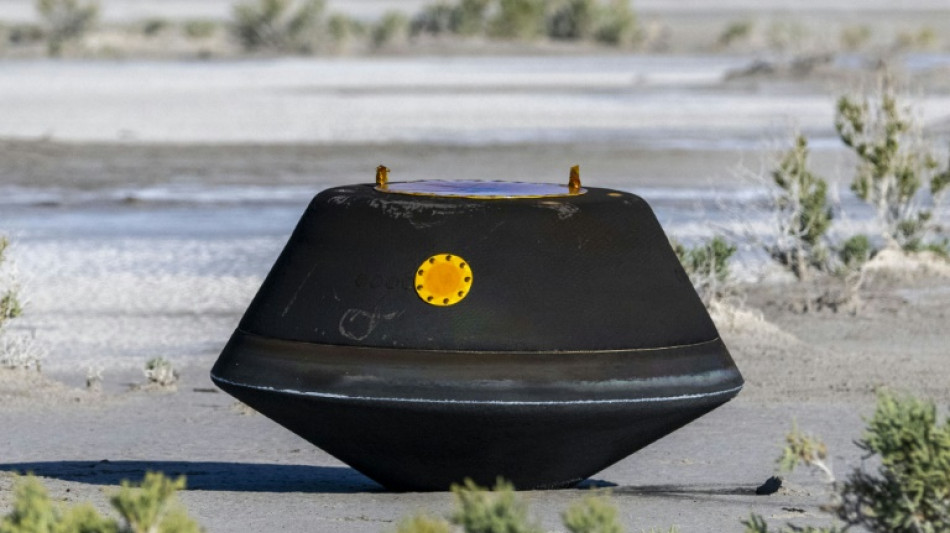
NASA asteroid sample contains life-critical water and carbon / Photo: © NASA/AFP/File

 US imposes new tariffs on 60 partners as Trump rebuilds trade agenda

 Stocks suffer fresh blow as markets hit by perfect storm

 Trump under pressure from all sides over Chinese AI surge

 ICC member states decide fate of embattled prosecutor Karim Khan

 Dodgers return to Trump White House despite fan anger

 Lyles, Richardson ease into 100m semis at US athletics championships

 Salman Rushdie testifies at knife attacker's US terror trial

 World Bank confirms plan to phase out China lending by 2031

 US panel backs trendy peptides despite safety concerns

 Justice Dept withdraws NY Times subpoenas over Trump plane report

 Barcelona's De Jong returns from World Cup with torn ligament

 Albania police teargas protesters against Trump-linked resort

 US panel says to loosen restrictions on popular peptide despite safety concerns

 Verstappen swerves around future questions

 EU renews online child sex abuse detection powers

 Airbus, Boeing fly in different directions at Farnborough

 Bab al-Mandeb Strait: another key oil shipping route under threat
 Deadly wildfires in Europe force thousands to flee

 NATO to overhaul European fuel pipeline network

 US trade envoy to make tariff announcement as 10% duty soon expires

 Trump stuns Saudis by pinning nuclear deal to Israel ties

 Tough day for Ubisoft stock topped with weaker revenues

 Swelling jet fuel costs hit American Airlines outlook
 Carapaz climbs unopposed to Tour de France 18th stage win

 Sooryavanshi hits maiden 50 as India thump Zimbabwe in T20
A sample collected from the 4.5-billion-year-old asteroid Bennu contains abundant water and carbon, both vital materials for the formation of our planet, NASA revealed on Wednesday.
The finding offers yet more evidence for the theory that the foundations for life on Earth were seeded from outer space.
"The first analysis shows samples that contain abundant water in the form of hydrated clay minerals," Bill Nelson said in a press event.
"This is the biggest carbon rich asteroid sample ever returned to Earth," he said, with the carbon contained in the form of both minerals and organic molecules.
The OSIRIS-REx mission collected rock and dust from Bennu in 2020, and a capsule containing the precious cargo successfully returned to Earth a little over two weeks ago, landing in the Utah desert.
It is now being painstakingly analyzed in a specialized clean room at NASA's Johnson Space Center in Houston.
OSIRIS-REx wasn't the first mission to rendezvous with an asteroid and bring back samples for study -- Japan succeeded in the feat twice, returning bits of space pebbles in 2010 and 2020.
But the substantial amount of material -- an estimated 250 grams (half a pound) -- as opposed to the 5.4 grams returned by Japan's Hayabusa2 -- is a key difference.
NASA chose Bennu because they think similar asteroids could have delivered organic building blocks to Earth along with water through collisions billions of years ago.
Bennu's orbit, which intersects that of our planet, also made the roundtrip journey easier than going to the Asteroid Belt, which lies between Mars and Jupiter.
Researchers have so far focused their efforts not on the main sample itself but on "bonus particles," described as black dust and debris coating the sample collector.
Back in October 2020, when OSIRIS-REx probe shot nitrogen gas at Bennu to collect its sample, a flap meant to seal it got wedged open with a piece of rock, allowing some of the finer material to flow out of the collector without escaping altogether.
"The very best 'problem' to have is that there is so much material, it's taking longer than we expected to collect it," said deputy OSIRIS-REx curation lead Christopher Snead, in a statement.
An inspection of the remainder of the sample will follow later.
It's thought that Bennu formed from pieces of a larger asteroid in the asteroid belt, following a massive collision between one and two billion years ago.
Data gathered by the spacecraft revealed the particles making up its exterior were so loosely packed that if a person were to step onto the surface, they might sink in, much like stepping into a pit of plastic balls.
In addition to scientific insights, better understanding of Bennu's composition could prove useful if humanity ever needs to steer it away.
While it has no chance of hitting Earth through the mid 2100s, the chances rise to around 1 in 1750 between then and the year 2300, NASA says.
D.Schaer--VB