Major asteroid sample brought to Earth in NASA first / Photo: © AFP

 US imposes new tariffs on 60 partners as Trump rebuilds trade agenda

 Stocks suffer fresh blow as markets hit by perfect storm

 Trump under pressure from all sides over Chinese AI surge

 ICC member states decide fate of embattled prosecutor Karim Khan

 Dodgers return to Trump White House despite fan anger

 Lyles, Richardson ease into 100m semis at US athletics championships

 Salman Rushdie testifies at knife attacker's US terror trial

 World Bank confirms plan to phase out China lending by 2031

 US panel backs trendy peptides despite safety concerns

 Justice Dept withdraws NY Times subpoenas over Trump plane report

 Barcelona's De Jong returns from World Cup with torn ligament

 Albania police teargas protesters against Trump-linked resort

 US panel says to loosen restrictions on popular peptide despite safety concerns

 Verstappen swerves around future questions

 EU renews online child sex abuse detection powers

 Airbus, Boeing fly in different directions at Farnborough

 Bab al-Mandeb Strait: another key oil shipping route under threat
 Deadly wildfires in Europe force thousands to flee

 NATO to overhaul European fuel pipeline network

 US trade envoy to make tariff announcement as 10% duty soon expires

 Trump stuns Saudis by pinning nuclear deal to Israel ties

 Tough day for Ubisoft stock topped with weaker revenues

 Swelling jet fuel costs hit American Airlines outlook

 Carapaz climbs unopposed to Tour de France 18th stage win

 Sooryavanshi hits maiden 50 as India thump Zimbabwe in T20

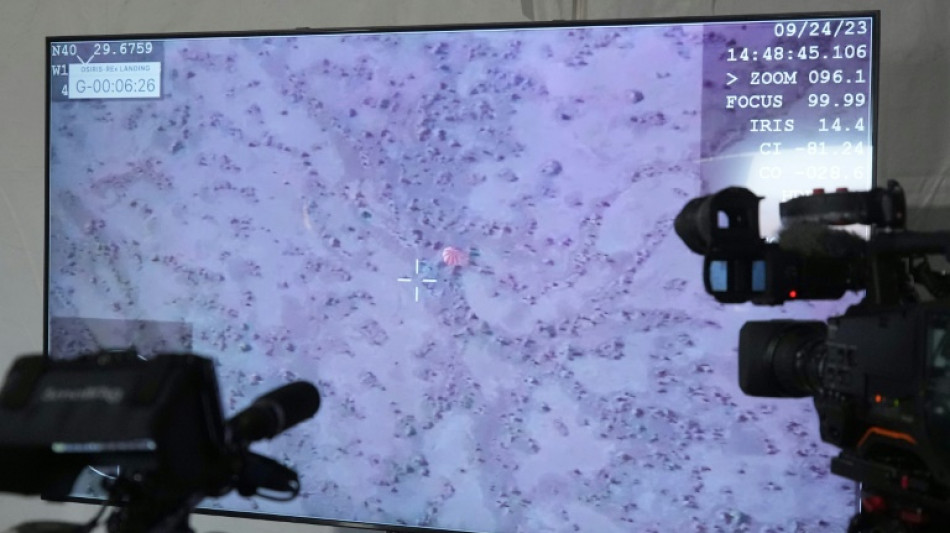
A seven-year space voyage came to its climactic end Sunday when a NASA capsule landed in the desert in the US state of Utah, carrying to Earth the largest asteroid samples ever collected.
Scientists have high hopes for the sample, saying it will provide a better understanding of the formation of our solar system and how Earth became habitable.
"Touchdown of the Osiris-Rex sample return capsule!" a commentator said on NASA's live video webcast of the landing.
It completed a 3.86-billion-mile (6.21 billion-kilometer) journey. It marked "the US's first sample return mission of its kind and will open a time capsule to the beginnings of our solar system," the US space agency said in a post on X, the former Twitter.
The Osiris-Rex probe's final, fiery descent through Earth's atmosphere was perilous, but NASA managed to engineer a soft landing at 8:52 am local (1452 GMT), in the military's Utah Test and Training Range.
Four years after its 2016 launch, the probe had landed on the asteroid Bennu and collected roughly nine ounces (250 grams) of dust from its rocky surface.
Even that small amount, NASA says, should "help us better understand the types of asteroids that could threaten Earth" and cast light "on the earliest history of our solar system," NASA Administrator Bill Nelson said.
"This sample return is really historic," NASA scientist Amy Simon told AFP. "This is going to be the biggest sample we've brought back since the Apollo moon rocks" were returned to Earth.
Osiris-Rex released the capsule early Sunday -- from an altitude of more than 67,000 miles (108,000 kilometers) -- some four hours before it landed.
The fiery passage through the atmosphere came only in the last 13 minutes, as the capsule hurtled downward at a speed of more than 27,000 miles per hour, with temperatures of up to 5,000 Fahrenheit (2,760 Celsius).
Its rapid descent, monitored by army sensors, was supposed to be slowed by two successive parachutes as it made its way to the 37-mile by nine-mile landing zone.
The main chute, however, deployed "much higher than was originally anticipated," at about 20,000 feet rather than the planned 5,000 feet, the NASA commentator said.
NASA images showed the tire-sized capsule on the ground in a desert wash, with scientists approaching the device and taking readings.
Meanwhile, the probe that made the space journey fired its engines and shifted course away from Earth, NASA said, "on its way" for a date with another asteroid, known as Apophis.
Scientists predict that asteroid will come within 20,000 miles of Earth in 2029.
- Japanese samples -
The team will carefully airlift the device by helicopter to a temporary "clean room" nearby.
NASA wants this done quickly and carefully to avoid any contamination of the sample with desert sands, skewing test results.
On Monday the sample is to be flown by plane to NASA's Johnson Space Center in Houston. There, the box will be opened in another "clean room."
NASA plans to announce its first results at a news conference October 11.
Most of the sample will be conserved for study by future generations. Roughly one-fourth will be immediately used in experiments, and a small amount will be sent to mission partners Japan and Canada.
Japan had earlier given NASA a few grains from asteroid Ryugu, after bringing 0.2 ounces of dust to Earth in 2020 during the Hayabusa-2 mission. Ten years before, it had brought back a microscopic quantity from another asteroid.
But the sample from Bennu is much larger, allowing for significantly more testing, Simon said.
- Earth's origin story -
Asteroids are composed of the original materials of the solar system, dating back some 4.5 billion years, and have remained relatively intact.
They "can give us clues about how the solar system formed and evolved," said Osiris-Rex program executive Melissa Morris.
"It's our own origin story."
By striking Earth's surface, "we do believe asteroids and comets delivered organic material, potentially water, that helped life flourish here on Earth," Simon said.
Scientists believe Bennu, about 500 meters (1,640 feet) in diameter, is rich in carbon -- a building block of life on Earth -- and contains water molecules locked in minerals.
Bennu surprised scientists in 2020 when the probe, during its brief contact with the asteroid's surface, sank into the soil, revealing an unexpectedly low density, like a children's pool filled with plastic balls.
Understanding its composition could come in handy in the -- distant -- future.
For there is a slight, but non-zero, chance (one in 2,700) that Bennu could collide catastrophically with Earth, though not until 2182.
But NASA last year successfully deviated the course of an asteroid by crashing a probe into it in a test, and it might at some point need to repeat that exercise -- but with much higher stakes.
E.Gasser--VB