G77+China summit in Cuba calls for new global order / Photo: © AFP

 Trump under pressure from all sides over Chinese AI surge

 ICC member states decide fate of embattled prosecutor Karim Khan
 Dodgers return to Trump White House despite fan anger

 Lyles, Richardson ease into 100m semis at US athletics championships
 Salman Rushdie testifies at knife attacker's US terror trial

 World Bank confirms plan to phase out China lending by 2031
 US panel backs trendy peptides despite safety concerns

 Justice Dept withdraws NY Times subpoenas over Trump plane report
 Barcelona's De Jong returns from World Cup with torn ligament
 Albania police teargas protesters against Trump-linked resort
 US panel says to loosen restrictions on popular peptide despite safety concerns
 Verstappen swerves around future questions
 EU renews online child sex abuse detection powers
 Airbus, Boeing fly in different directions at Farnborough

 Bab al-Mandeb Strait: another key oil shipping route under threat
 Deadly wildfires in Europe force thousands to flee

 NATO to overhaul European fuel pipeline network
 US trade envoy to make tariff announcement as 10% duty soon expires

 Trump stuns Saudis by pinning nuclear deal to Israel ties
 Tough day for Ubisoft stock topped with weaker revenues
 Swelling jet fuel costs hit American Airlines outlook
 Carapaz climbs unopposed to Tour de France 18th stage win

 Sooryavanshi hits maiden 50 as India thump Zimbabwe in T20
 ECB opens door to September rate-hike as Iran war flares up
 World Bank estimates Venezuela quakes caused $19.6 bn in damage
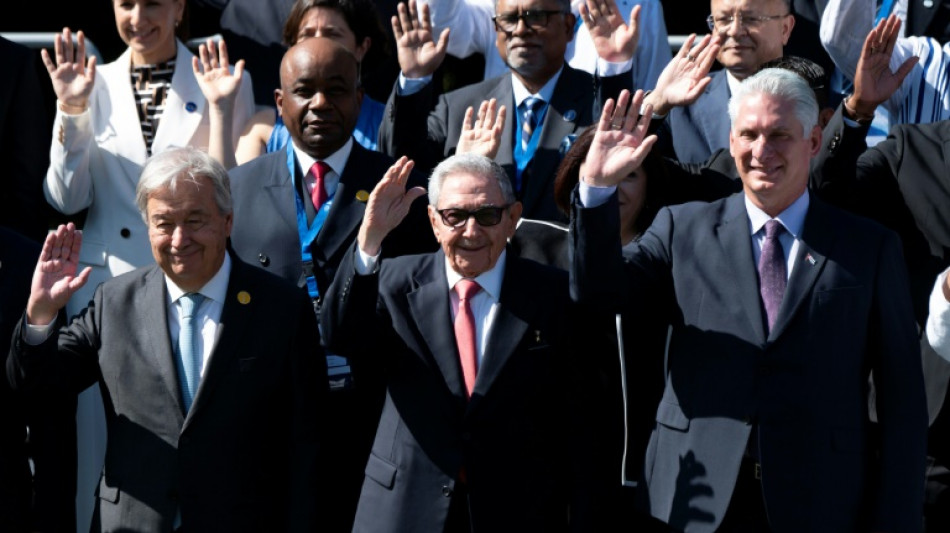
The G77+China, a group of developing and emerging countries representing 80 percent of the world's population, kicked off a summit in Cuba Friday with a call to "change the rules of the game" of the global order.
The meeting comes at a time of growing frustration with the Western-led world order amid widening differences over the Russian war in Ukraine, the fight against climate change, and the global economic system.
"After all this time that the North has organized the world according to its interests, it is now up to the South to change the rules of the game," Cuban President Miguel Diaz-Canel said at the opening of the summit.
Diaz-Canel said that developing countries were the main victims of a "multidimensional crisis" in the world today, from "abusive unequal trade" to global warming.
United Nations chief Antonio Guterres is joining some 30 heads of state and government from Africa, Asia and Latin America at the two-day summit in Havana.
At the opening of the meeting he called for a world that was "more representative and responsive to the needs of developing economies", stressing that these countries were "trapped in a tangle of global crises."
The bloc was established by 77 countries of the global South in 1964 "to articulate and promote their collective economic interests and enhance their joint negotiating capacity," according to the group's website.
Today it has 134 members, among which the website lists China although the Asian giant says it is not a full member.
Cuba took over the rotating presidency in January.
Latin American leaders such as Venezuela's Nicolas Maduro, Colombia's Gustavo Petro, and Argentina's Alberto Fernandez were present at the summit, alongside Palestinian leader Mahmoud Abbas, Angola's Joao Lourenco and Mozambican President Filipe Nyusi.
Brazilian President Luiz Inacio Lula da Silva will arrive on Friday night.
- 'Unjust' international order -
China is represented by top Communist Party official Li Xi, who said his country "will always make South-South" cooperation a priority" in its dealings with the outside world.
The meeting should conclude Saturday with a statement underscoring "the right to development in an increasingly exclusive, unfair, unjust and plundering international order," the foreign minister of host Cuba, Bruno Rodriguez, told reporters on Wednesday.
A draft of the closing statement underlines the many obstacles facing developing nations, and includes "a call for the establishment of a new economic world order," he said.
Guterres has recently attended a rash of multilateral summits, including a gathering of the G20 club of major economies in India and the BRICS group that includes Russia.
Ahead of the Havana meeting, Guterres said "this multiplicity of summits reflects the growing multipolarity of our world."
And he warned that "multipolarity could be a factor for escalating geostrategic tensions, with tragic consequences."
The G77 meeting comes after key changes in global blocs.
The African Union has joined the G20 group of the world's most powerful economies, and the BRICS -- Brazil, Russia, India, China and South Africa -- trade group for emerging economies has expanded to admit six new members.
- 'A valid interlocutor' -
The presence of world leaders on its soil amounts to a recognition for the Cuban government even as the country battles its worst economic crisis in 30 years, one analyst told AFP.
"Despite the difficulties of the moment, Cuba has been recognized as a valid interlocutor," said Cuban international relations expert Arturo Lopez-Levy, a visiting professor at the Autonomous University of Madrid.
The communist-ruled island is still under the yoke of US sanctions first imposed in 1962.
Diaz-Canel has in recent months represented the G77+China at several international meetings including a June global financial summit in Paris and an EU meeting in July with Latin American and Caribbean states.
C.Kreuzer--VB