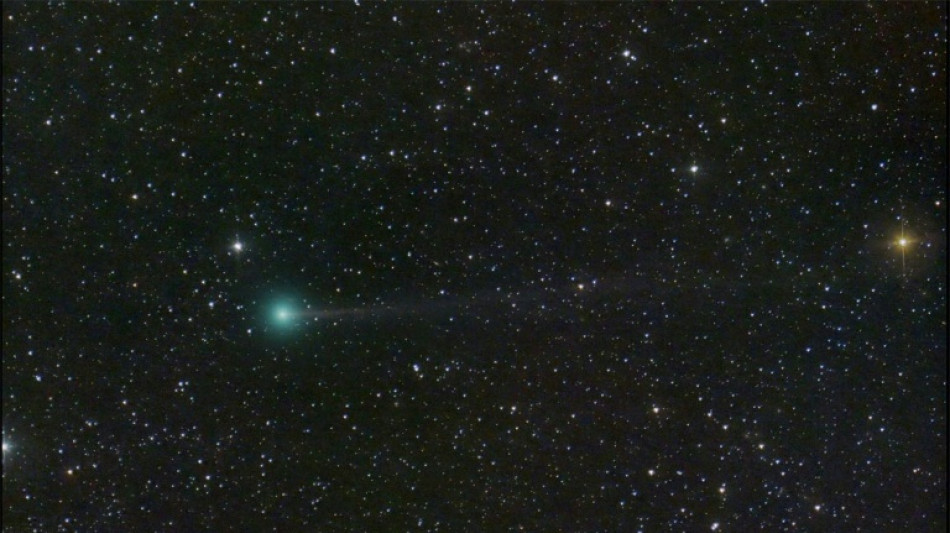
Newly discovered comet visible in night sky this weekend / Photo: © NASA/AFP

 Trump under pressure from all sides over Chinese AI surge

 ICC member states decide fate of embattled prosecutor Karim Khan

 Dodgers return to Trump White House despite fan anger

 Lyles, Richardson ease into 100m semis at US athletics championships

 Salman Rushdie testifies at knife attacker's US terror trial

 World Bank confirms plan to phase out China lending by 2031

 US panel backs trendy peptides despite safety concerns

 Justice Dept withdraws NY Times subpoenas over Trump plane report

 Barcelona's De Jong returns from World Cup with torn ligament

 Albania police teargas protesters against Trump-linked resort

 US panel says to loosen restrictions on popular peptide despite safety concerns

 Verstappen swerves around future questions

 EU renews online child sex abuse detection powers

 Airbus, Boeing fly in different directions at Farnborough

 Bab al-Mandeb Strait: another key oil shipping route under threat

 Deadly wildfires in Europe force thousands to flee

 NATO to overhaul European fuel pipeline network

 US trade envoy to make tariff announcement as 10% duty soon expires

 Trump stuns Saudis by pinning nuclear deal to Israel ties

 Tough day for Ubisoft stock topped with weaker revenues

 Swelling jet fuel costs hit American Airlines outlook

 Carapaz climbs unopposed to Tour de France 18th stage win

 Sooryavanshi hits maiden 50 as India thump Zimbabwe in T20

 ECB opens door to September rate-hike as Iran war flares up

 World Bank estimates Venezuela quakes caused $19.6 bn in damage

A comet called Nishimura discovered just a month ago could be visible to the naked eye this weekend, offering stargazers a once-in-a-437-year chance to observe the celestial visitor.
The ball of rock and ice, whose exact size remains unknown, is named after the Japanese amateur astronomer Hideo Nishimura who first spotted it on August 11.
It is rare that comets reach their moment of peak visibility so soon after being discovered, said Nicolas Biver, an astrophysicist at the Paris Observatory.
"Most are discovered months, even years before they pass closest to the Sun," he told AFP.
The comet only swings by the Sun every 437 years, he said, a long orbital period which sees it spend much of its time in the freezing outer Solar System.
When comets approach the Sun from the vastness of space, the heat causes its ice core to turn into dust and gas, which form a long tail.
The Sun's light reflects off this tail, allowing us to view comets from Earth.
Nishimura, which has the scientific name C/2023 P1, will pass closest to the Sun on September 17.
It will be 33 million kilometres (20 million miles) from the Sun, which is less than a quarter of the distance between the Earth and the Sun, Biver pointed out.
The comet will then pass harmlessly by Earth at a distance of 125 million kilometres.
For stargazers, the comet will be easiest to observe this Saturday and Sunday, particularly in the Northern Hemisphere.
"The best thing to do is look at the sky before sunrise, in a northeastern direction to the left of Venus, in a clear sky, free of pollution," Biver advised.
People with small binoculars will easily be able to enjoy the spectacle. But, if conditions allow, the comet may also be visible by the naked eye.
The comet's tail is greenish, because it contains "more gas than dust," Biver said.
C.Meier--BTB