NASA to unveil new Webb image on telescope's first anniversary / Photo: © NASA/AFP/File

 Dodgers return to Trump White House despite fan anger

 Lyles, Richardson ease into 100m semis at US athletics championships
 Salman Rushdie testifies at knife attacker's US terror trial
 World Bank confirms plan to phase out China lending by 2031

 US panel backs trendy peptides despite safety concerns

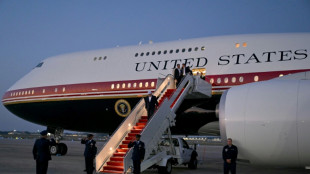 Justice Dept withdraws NY Times subpoenas over Trump plane report

 Barcelona's De Jong returns from World Cup with torn ligament
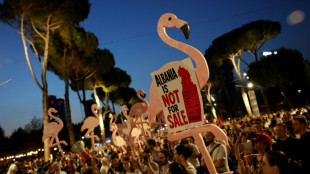 Albania police teargas protesters against Trump-linked resort
 US panel says to loosen restrictions on popular peptide despite safety concerns

 Verstappen swerves around future questions
 EU renews online child sex abuse detection powers
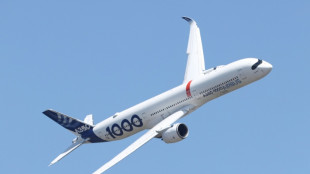 Airbus, Boeing fly in different directions at Farnborough

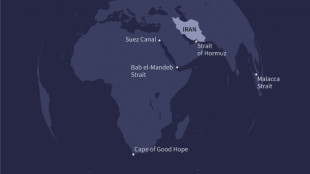 Bab al-Mandeb Strait: another key oil shipping route under threat
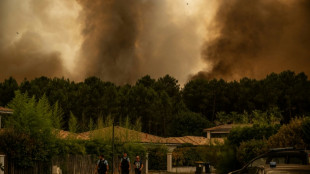
 Deadly wildfires in Europe force thousands to flee

 NATO to overhaul European fuel pipeline network
 US trade envoy to make tariff announcement as 10% duty soon expires

 Trump stuns Saudis by pinning nuclear deal to Israel ties
 Tough day for Ubisoft stock topped with weaker revenues

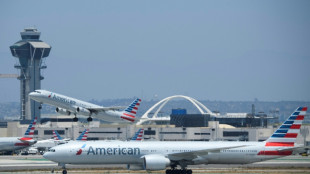 Swelling jet fuel costs hit American Airlines outlook
 Carapaz climbs unopposed to Tour de France 18th stage win

 Sooryavanshi hits maiden 50 as India thump Zimbabwe in T20
 ECB opens door to September rate-hike as Iran war flares up

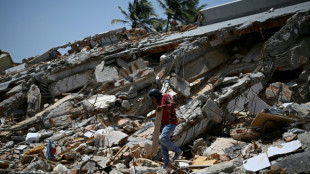
 World Bank estimates Venezuela quakes caused $19.6 bn in damage
 Italy's far-right line up to defend jeweller who killed robbers

 AI-led boom in IPOs raises concerns about a bust

NASA is set Wednesday to unveil a new image from the James Webb Space Telescope a year after it first stunned the world with breathtaking views of the distant cosmos.
Webb, the most powerful observatory in orbit, was launched in December 2021 from French Guiana, on a million mile (1.6 million kilometer) voyage to a region called the second Lagrange point.
Its first full color picture was revealed by President Joe Biden on July 11, 2022: the clearest view yet of the early universe, going back 13 billion years.
The next wave included "mountains" and "valleys" of a star-forming region, dubbed the Cosmic Cliffs, in a region of space called the Carina Nebula; and a grouping of five galaxies bound in a celestial dance, called Stephan's Quintet.
NASA has remained coy about the nature of Wednesday's release, which will be made available on its website at 6:00 am Eastern Time (1000 GMT).
Webb boasts a primary mirror measuring more than 21 feet (6.5 meters) that is made up of 18 hexagonal, gold-coated segments, as well as a five-layer sunshield the size of a tennis court.
Unlike its predecessor Hubble, it operates primarily in the infrared spectrum, allowing it to look back nearer towards the start of time, and to better penetrate dust clouds where stars and planetary systems are being formed today.
Key discoveries include some of the earliest galaxies formed a few hundred million years after the Big Bang, finding carbon dioxide in the atmosphere of a planet outside our solar system, and, in our own neck of the woods, stunning new views of the planet Jupiter.
Webb has enough fuel for a 20-year-long mission, promising a new era of astronomy.
It will soon be joined in its orbit by Europe's Euclid space telescope, which launched on July 1 on a mission to shed light on two of the universe's greatest mysteries: dark energy and dark matter.
M.Furrer--BTB