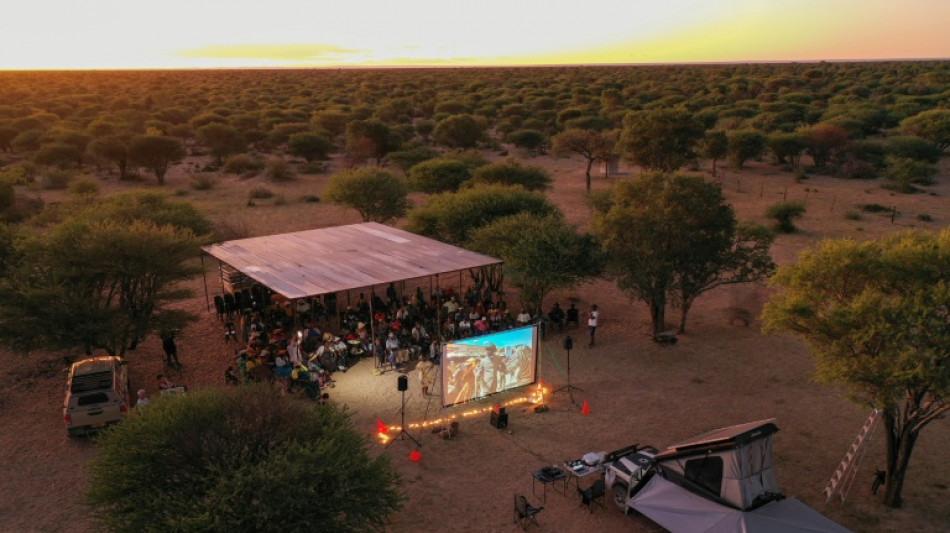
Germany's colonial crimes in Namibia tackled on screen / Photo: © STUDIOCANAL/AFP

 Oil passes $100 a barrel again: why it's more serious this time

 Who are the six candidates vying to lead the UN?

 Hamilton proud of recovery after hitting rock bottom a year ago

 Carapaz eyes polkadot mountains jersey after stage win

 Fields medal awarded to four young mathematicians

 Carapaz claims Tour de France stage as Pogacar loses key team-mate

 Alonso welcomes Aston Martin upgrade, warns against unreal expectations

 Anderson declares Man City 'kings of Manchester' after £116 mn move

 Relieved Russell says Mercedes have solved his power problems mystery

 Oil soars above $100 as Middle East fears grow

 Venezuelans turn to scrap collecting in quake-hit beach 'paradise'

 Heptathlon champion Johnson-Thompson joins list of Commonwealth Games absentees

 Nigeria's Dangote raises $2.5bn to expand Africa's largest refinery

 Oil soars to $100 on fresh Mideast attacks
 Coal-fired power generation rising globally on Mideast war: IEA

 Premier League champions Arsenal sign Greece winger Tzolis from Brugge

 French Jewish DJ sues after activists disrupt gig: lawyer

 Venice film festival promises Pattinson, Oasis and Musk doc

 ASEAN calls for open straits as US-Iran war casts shadow

 Ford and Geely to form joint venture at struggling Spain plant

 Russia warns US against Ukraine arms sales in Manila meeting
 New UK PM announces tax cut for struggling pubs

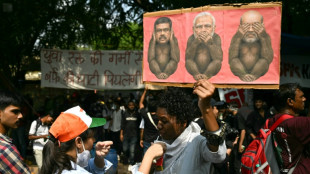
 Supporters flood India's 'cockroach' protesters with food

 Modi vows punishment for exam leaks fuelling India protests

 Norway set to make formal complaint to FIFA over Balogun red card saga

Long overshadowed by World War II and the Holocaust, a colonial-era genocide committed by Germany in Namibia has been brought to the big screen, shining a light on the country's neglected crimes.
Lars Kraume's "Measures of Men" tells the story of a German ethnologist who travels to what was German South West Africa in the early 1900s to study the country's indigenous peoples and harvest their skulls.
The film was released in German cinemas on March 23 and has also been the subject of special screenings, including in schools and the Bundestag lower house of parliament.
"The colonial era was long repressed by Germany, which lost all its colonies in 1919," Kraume, 50, told AFP.
"This film is a contribution to making Germans aware of their responsibilities," he said.
Germany is well known for its efforts to remember and atone for the atrocities committed during World War II.
Children are taught about the Holocaust in schools, a memorial to the murdered Jews occupies a prominent place in Berlin, and countless films and documentaries have been made about the Nazis.
But only one other film, "Morenga" by German director Egon Guenther, based on the novel of the same name by Uwe Timm, has been made in Germany about the country's role in Namibia.
- Racist experiments -
Though smaller than those of France and Britain, Germany's colonial empire encompassed parts of several African countries, including present-day Burundi, Rwanda, Tanzania, Namibia and Cameroon.
In Namibia, Germany was responsible for mass killings of indigenous Herero and Nama people that many historians refer to as the first genocide of the 20th century.
Over the past 20 years, Germany has been gradually starting to talk more about the massacre, in which at least 60,000 Herero and 10,000 Nama were killed between 1904 and 1908.
Germany has returned skulls and other human remains to Namibia that it had sent to Berlin during the period for "scientific" experiments.
And in May 2021, the country officially acknowledged that it had committed genocide in Namibia and promised a billion euros in financial support to descendants of the victims.
"Since the centenary of the genocide in 2004, historians and activists have done a lot of work on the subject," said Joel Glasman, a professor of African history at the University of Bayreuth.
In "Measures of Men", an ethnologist from Berlin, Alexander Hoffmann (Leonard Scheicher), is sent to Namibia to conduct experiments on the population and collect their bones for research.
At the beginning of the film, Hoffmann believes no race is superior to any other.
But he is ambitious and, in order to further his career, ends up going along with the prevailing scientific wisdom -- which went on to pave the way for the racist ideology of the Nazis.
The story is told mainly from the German perspective, though Hoffmann's friend Kezia Kambazembi (Girley Charlene Jazama), a Herero translator, also plays a prominent role.
- 'Very emotional' -
Israel Kaunatjike, a Herero rights activist based in Berlin, said "Measures of Men" had "moved me deeply".
"It motivated me to continue to fight for our cause," said the 76-year-old, who was an anti-apartheid resistance fighter when Namibia was still under South African control.
When "Measures of Men" was shown in some Herero villages, "it was very emotional, people thought Lars Kraume was brave to show such a film to the descendants of the victims", Kaunatjike said.
A film showing the perspective of the Herero and Nama on the same events would be welcome, Kaunatjike said. "But unfortunately they don't have the money to make a film."
When the film was shown in schools, "the students understood the ambivalence of the hero and wanted to discuss it", Kraume said.
Both Kaunatjike and Kraume believe Germany still has some way to go to reckon with its colonial past.
"We need an official request for forgiveness from the German president in Namibia and the return of all the Herero and Nama skulls and bones still in German collections for burial," said Kraume.
For Kaunatjike, "development aid is no substitute for reparations".
E.Schubert--BTB