SpaceX Starship, world's biggest rocket, explodes during first flight test / Photo: © SPACEX/AFP

 Oil passes $100 a barrel again: why it's more serious this time

 Who are the six candidates vying to lead the UN?

 Hamilton proud of recovery after hitting rock bottom a year ago
 Carapaz eyes polkadot mountains jersey after stage win

 Fields medal awarded to four young mathematicians

 Carapaz claims Tour de France stage as Pogacar loses key team-mate

 Alonso welcomes Aston Martin upgrade, warns against unreal expectations

 Anderson declares Man City 'kings of Manchester' after £116 mn move

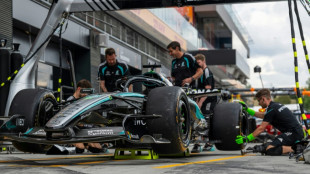 Relieved Russell says Mercedes have solved his power problems mystery

 Oil soars above $100 as Middle East fears grow
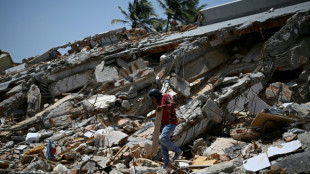 Venezuelans turn to scrap collecting in quake-hit beach 'paradise'

 Heptathlon champion Johnson-Thompson joins list of Commonwealth Games absentees

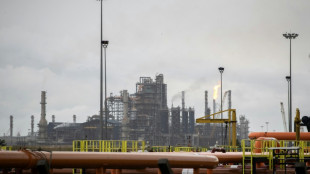 Nigeria's Dangote raises $2.5bn to expand Africa's largest refinery

 Oil soars to $100 on fresh Mideast attacks

 Coal-fired power generation rising globally on Mideast war: IEA

 Premier League champions Arsenal sign Greece winger Tzolis from Brugge

 French Jewish DJ sues after activists disrupt gig: lawyer

 Venice film festival promises Pattinson, Oasis and Musk doc

 ASEAN calls for open straits as US-Iran war casts shadow

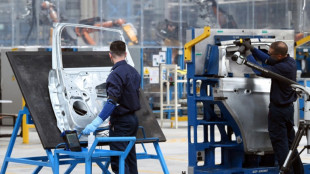 Ford and Geely to form joint venture at struggling Spain plant

 Russia warns US against Ukraine arms sales in Manila meeting

 New UK PM announces tax cut for struggling pubs

 Supporters flood India's 'cockroach' protesters with food
 Modi vows punishment for exam leaks fuelling India protests

 Norway set to make formal complaint to FIFA over Balogun red card saga

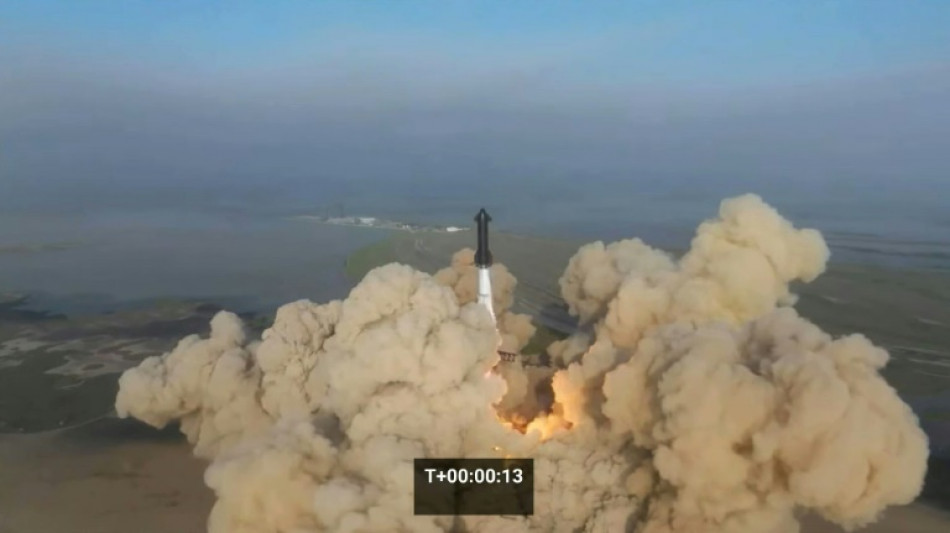
SpaceX's Starship, the most powerful rocket ever built, exploded on Thursday during the first test flight of the spacecraft designed to send astronauts to the Moon, Mars and beyond.
The gigantic rocket successfully blasted off at 8:33 am Central Time (1333 GMT) from Starbase, the private SpaceX spaceport in Boca Chica, Texas.
The Starship capsule had been scheduled to separate from the first-stage rocket booster three minutes into the uncrewed flight but separation failed to occur and the rocket blew up.
"As if the flight test was not exciting enough, Starship experienced a rapid unscheduled disassembly before stage separation," SpaceX tweeted.
Despite the failure to complete the full flight test, SpaceX declared it a success.
"We cleared the tower which was our only hope," said Kate Tice, a SpaceX quality systems engineer.
"With a test like this, success comes from what we learn, and today’s test will help us improve Starship’s reliability as SpaceX seeks to make life multi-planetary," SpaceX tweeted.
The US space agency NASA has picked the Starship spacecraft to ferry astronauts to the Moon in late 2025 -- a mission known as Artemis III -- for the first time since the Apollo program ended in 1972.
Starship consists of a 164-foot (50-meter) tall spacecraft designed to carry crew and cargo that sits atop a 230-foot tall first-stage Super Heavy booster rocket.
SpaceX conducted a successful test-firing of the 33 massive Raptor engines on the first-stage booster in February but the Starship spacecraft and the Super Heavy rocket were being flown together for the first time.
The integrated test flight was intended to assess their performance in combination.
SpaceX founder Elon Musk had warned ahead of the launch that technical issues were likely and sought to play down expectations for the inaugural test flight.
"It's a very risky flight," he said. "It's the first launch of a very complicated, gigantic rocket.
"There's a million ways this rocket could fail," Musk said.
- 'Multi-planet species' -
NASA will take astronauts to lunar orbit itself in November 2024 using its own heavy rocket called the Space Launch System (SLS), which has been in development for more than a decade.
Starship is both bigger and more powerful than SLS and capable of lifting a payload of more than 100 metric tonnes into orbit.
It generates 17 million pounds of thrust, more than twice that of the Saturn V rockets used to send Apollo astronauts to the Moon.
The plan for the integrated test flight was for the Super Heavy booster to separate from Starship about three minutes after launch and splash down in the Gulf of Mexico.
They failed to separate however and the booster rocket and Starship spacecraft exploded in the sky in a ball of fire four minutes into the flight.
"If we get far enough away from the launchpad before something goes wrong then I think I would consider that to be a success," Musk said prior to the flight. "Just don't blow up the launchpad."
SpaceX foresees eventually putting a Starship into orbit, and then refueling it with another Starship so it can continue on a journey to Mars or beyond.
The eventual objective is to establish bases on the Moon and Mars and put humans on the "path to being a multi-planet civilization," according to Musk.
"We are at this brief moment in civilization where it is possible to become a multi-planet species," he said. "That's our goal. I think we've got a chance."
D.Schneider--BTB