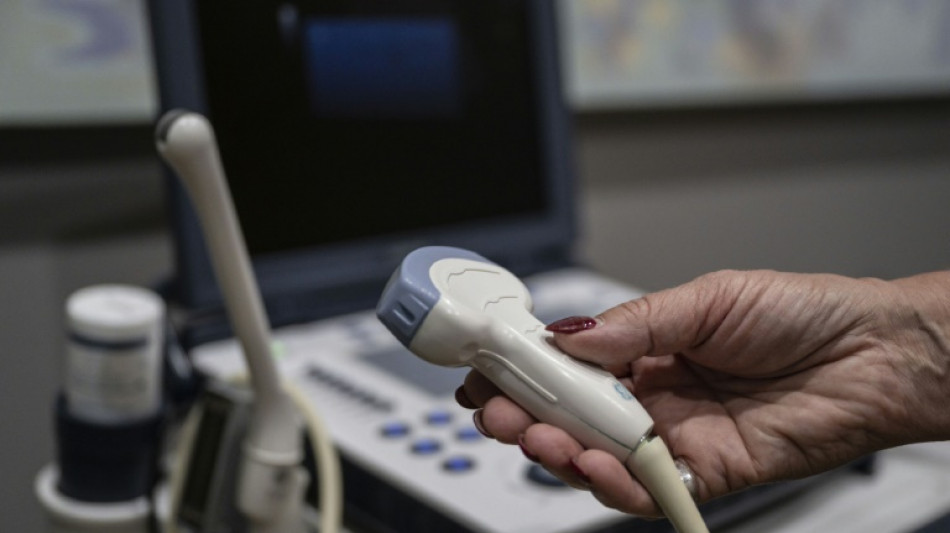
AI better than humans at key heart test: study / Photo: © AFP/File

 Relieved Russell says Mercedes have solved his power problems mystery

 Oil soars above $100 as Middle East fears grow

 Venezuelans turn to scrap collecting in quake-hit beach 'paradise'

 Heptathlon champion Johnson-Thompson joins list of Commonwealth Games absentees

 Nigeria's Dangote raises $2.5bn to expand Africa's largest refinery
 Oil soars to $100 on fresh Mideast attacks

 Coal-fired power generation rising globally on Mideast war: IEA
 Premier League champions Arsenal sign Greece winger Tzolis from Brugge

 French Jewish DJ sues after activists disrupt gig: lawyer

 Venice film festival promises Pattinson, Oasis and Musk doc
 ASEAN calls for open straits as US-Iran war casts shadow

 Ford and Geely to form joint venture at struggling Spain plant

 Russia warns US against Ukraine arms sales in Manila meeting

 New UK PM announces tax cut for struggling pubs

 Supporters flood India's 'cockroach' protesters with food

 Modi vows punishment for exam leaks fuelling India protests
 Norway set to make formal complaint to FIFA over Balogun red card saga

 Floods in northeast India kill at least 41
 Nestle siphons off bottled water business into joint venture

 Hundreds hospitalised in Japan heatwave 'disaster'

 Renault says sales stalled in first half
 EasyJet says profits nosedive on Mideast war

 Modi vows punishment for exam fraud fuelling India protests

 Six candidates in race to lead UN set for televised debate

 Comic-Con kicks off with Marvel's return

Artificial intelligence is better than humans at assessing heart ultrasounds, the main test of overall cardiac health, the most rigorous trial yet conducted on the subject found on Wednesday.
While previous research has illustrated the potential power of AI models for reading medical scans, the authors of the new US study said it is the first blinded, randomised clinical trial for heart health.
"There's a lot of excitement around AI," but rigorous evaluation remains critical, the study's senior author David Ouyang told AFP.
This successful trial "really strengthens the argument that now we're ready for primetime," added the cardiologist at the Cedars-Sinai Medical Center in Los Angeles.
Heart ultrasounds, also known as echocardiograms, are carried out on patients by sonographers, who usually give an initial assessment of the scan before handing it over to a cardiologist.
The new study, published in the journal Nature, pitted an AI model against sonographers to see who would give the most accurate initial assessment.
Both assessed the ultrasound for what is called left ventricular ejection fraction, which measures the heart's ability to pump blood out to the body in the space of a heartbeat.
The test is the main way to measure how well a heart is functioning. It is used to tell if patients have had a heart attack or if they will be able to undertake serious treatments such as implanting a defibrillator.
For the study, nearly 3,500 heart ultrasounds were randomly split between sonographers and the AI model.
Their assessments were then evaluated by cardiologists, who did not know which ones came from humans and which from the AI model.
- 'Exciting' -
The cardiologists made a substantial change in more than 27 percent of the sonographer assessments -- and in nearly 17 percent of those done by the AI model, the study found.
"The AI was faster, more precise, and indistinguishable by the cardiologists," Ouyang said.
There is a "tremendous shortage" of sonographers in the United States and across the world, and this would save them valuable time, he added.
The AI model, called EchoNet-Dynamic, was trained on nearly 145,000 echocardiograms and uses what is called deep learning to process large amounts of data.
The researchers are currently applying for the method to be approved by the Federal Drug Administration, and hope to do the same in the European Union and elsewhere soon, Ouyang said.
Patricia Pellikka, a cardiologist at the Mayo Clinic in the United States not involved in the research, told AFP the study was "exciting" and that the integration of AI tools will increase efficiency and standardisation.
French cardiologist Florian Zores said that the study was well conducted but the technology would not be as useful in France, where cardiologists give the initial assessments of heart ultrasounds.
L.Dubois--BTB