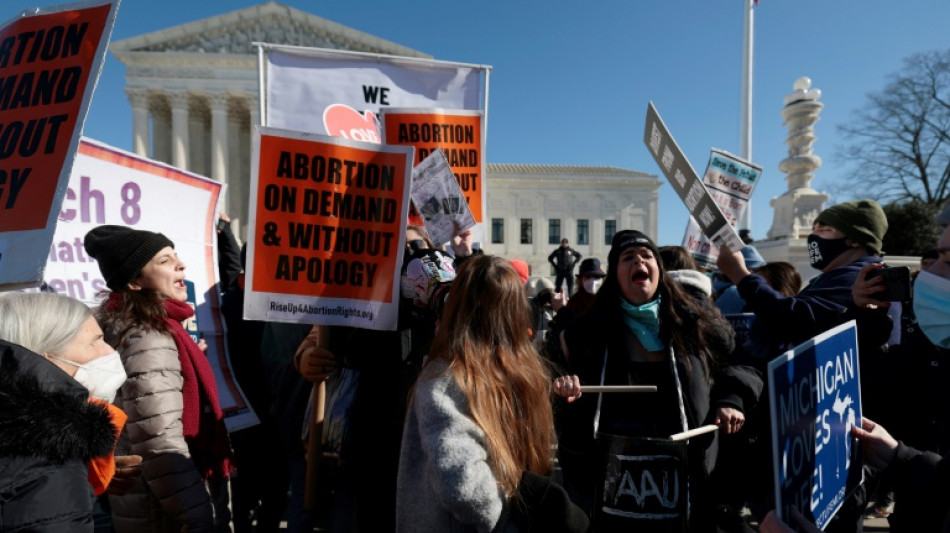
Many anti-abortion Americans would still help friends and family seeking one / Photo: ©

 UK set for cautious budget as borrowing costs climb

 Anthropic's record IPO faces some big questions

 US Fed expected to hold rates steady ahead of key midterm elections

 Can this Latin Grammy-winner help Democrats win back Congress?

 Tuvalu has 'limited' power to halt its fossil fuel investments: NZ govt papers seen by AFP

 Palestinian activist Khalil returns to Columbia after US detention

 Trump drastically loosens oil and gas methane rules

 French Senate weighs bill to make protesters pay for unrest damage

 'A very sad day': Arteta despair as Arsenal stunned by Fleetwood

 Charles tackles thorny legacy of slavery on Caribbean trip

 Former Grand Slam winner Wawrinka ends tennis career

 Brazil's Flavio Bolsonaro flees to US after election loss

 'Faerie' nights: 'ACOTAR' fans finally get their book

 American woman convicted of getting military training from Islamic State

 Israel opposition holds narrow edge over Netanyahu in first projections

 Floriani hits maiden goal as Lazio go top

 Trump set to drastically loosen oil and gas sector's methane rules

 Storied Paris department store seeks bankruptcy protection

 Xhaka, Embolo can return to Swiss squad after fake Covid docs affair

 Allegri suspended for two Serie A games after red card

 Flight data, satellite images reveal growing US role at Ecuador base

 McInnes feels 'guilt' ahead of Hearts return with Rangers

 Brazil's Lula turns 81, vows to work '24 hours a day'

 Boeing releases cautious growth plan as shares fall sharply

 Exiled Russian dissident Navalnaya warns dictators becoming 'more cunning'

Almost half of Americans morally opposed to abortion would help a friend or family member with arrangements to get one, and a majority would offer emotional support, a new study said Friday.
The authors of the paper, which appeared in the journal Science Advances, wrote the finding showed that people are willing to cross ideological and partisan lines to help others in their personal networks, something they referred to as "discordant benevolence."
"At first blush, these people may appear as hypocrites. They are not," said Sarah Cowan, a sociologist at New York University and the lead author of the article, in a statement.
"They are at a moral crossroads, pulled by their opposition to abortion and by their inclination to support people they care about."
The study was drawn from surveys and interviews conducted in 2018 and 2019 respectively, and comes after Texas passed a law allowing residents of the state to sue others who "aided or abetted" abortions performed after six weeks of pregnancy.
The Supreme Court could soon roll back decades of precedent by ruling abortion is not a constitutional right. The issue is deeply contentious and divides the public along political lines between Democrats and Republicans.
The new study was based on survey responses from more than 1,574 people, and separately 74 in-depth interviews.
Of those morally opposed, 76 percent said they would offer emotional support —- compared to 96 percent of those who are not morally opposed, or whose view depended on circumstances.
But the type of support varied greatly, reflecting the social meaning of money and the view that spending money is a means to enact one's values, the authors said.
Just six percent of those morally opposed would directly help a friend or relative pay for the procedure, compared to the 45 percent who said they would help with ancillary costs.
Among those not morally opposed, 54 percent would help pay for the procedure, which typically costs $500 in the first trimester.
- Moral conflict -
Social scientists have long been interested in what explains helpful behavior.
Factors are thought to range from the act of kindness causing a person to feel good about themselves, to a sense of duty to their kinship networks and expectation of reciprocity in future.
But the authors said scenarios where rendering help placed the helper in a moral conflict were less studied.
Based on their in-depth interviews, they found people who were willing to help despite their inner opposition relied on three main rationalizations.
The first was "commiseration," or reasoning that people are worthy of care despite their imperfections in an imperfect world.
The second was "exemption" -- carving out an exception for their loved ones in particular, while the third was "discretion," -- the idea that what is right or wrong is inherently personal, not universal.
"If it were my sister...I would want to talk to her to make sure she's thinking about every possible thing," said Ryan, a person interviewed in the survey.
"But if, ultimately, she's like 'No, (Ryan), I can handle this,' then, 'Ok, do what you gotta do,' you know? But it's just because you love someone."
L.Dubois--BTB