Indonesian football faces pivotal moment after stadium disaster / Photo: © AFP

 Not-so-brave new world: virtual taekwondo makes Asian Games debut
 Arab Israeli candidate drops out of election race

 Israel courts Europe's far right, finding friends but also unease
 Lula, Bolsonaro both snub final debate before Brazil election
 Nepal's grim DNA puzzle to identify flood dead
 EU nations to hold emergency meeting on soaring diesel prices amid US pressure

 Anthropic's Dario Amodei: AI's most visible CEO and enigma

 OpenAI says three staffers fired for mishandling 'sensitive' info
 Nike plans job cuts as it forecasts lower sales

 Ireland game interrupted twice by Gaza protests

 Judge denies acquittal bid by US woman who killed her kids
 Klopp averts crisis with first win as Germany boss

 A saintly spat and debate snub: Brazil enters final campaign stretch

 US tells European allies to act 'immediately' to lower diesel prices

 G20 trade ministers fail to see consensus against overproduction

 Portugal edge Denmark in Ronaldo's absence
 US stocks edge higher as bond yields retreat for now

 US tells European allies to 'immediately' act to lower diesel prices

 Trump vows to hit Iran 'very hard' if linked to flydubai attack
 Williams leaves Spain camp with thigh knock

 WTA reduces 2027 schedule for world's top 50
 US says 'in Europe's best interest' to cooperate on fuel supply
 Rogue OpenAI agents covered up their tracks, report says
 A saintly spat and debate snub: Brazil enters final polls stretch

 Zidane 'no regrets' about Materazzi headbutt as France face Italy again
The deadly stampede at an Indonesian football stadium has shaken the foundations of the country's most popular sport and was the culmination of decades of mismanagement and violence, experts say.
The tragedy a week ago that killed 131 people, including 32 children, in the aftermath of a top-tier match has forced officials and fans to confront failings in every aspect of the game in the country.
Experts on Indonesian football speak of shaky infrastructure, mismanagement, hours-long waits to leave outdated stadiums and the potential for heated passions to descend into violence that has killed scores since the 1990s.
"This is a wake-up call, one that has cost us greatly," Indonesian football commentator Mohamad Kusnaeni told AFP.
President Joko Widodo visited the site of the tragedy on Wednesday, ordering an audit of all stadia and pointing to the country's 78,000-seater national stadium in Jakarta as the standard he expects across the 18-team league.
The gates at the 42,000-capacity Kanjuruhan stadium in East Java's Malang were big enough to fit only two people at a time and some were not open on time, officials said.
"You could see and sense that something bad could potentially happen," Indonesian football pundit Pangeran Siahaan told AFP.
"There's a lot of dangers every time you go into a football stadium in Indonesia."
Many stadiums in Indonesia have not met international standards for hosting sports events, said Kusnaeni.
Some do not have single seating but instead benches that allow more people to stand and crowd together, while making it harder for security to spot a threatening incident before it happens.
Widodo said the seated Gelora Bung Karno Stadium in Jakarta allowed all spectators to exit safely within 15 minutes, and all stadiums should be brought in line.
"We must learn from it. Minor punishments have made negligence in the football scene repeatedly happen," said Akmal Marhali, coordinator of football watchdog Save Our Soccer and member of the fact-finding task force investigating the disaster.
"There must be progressive change and steps that turn the page."
Stricter measures such as banning clubs from Indonesia's football association, or PSSI, could help ensure better security and fan conduct.
- Inspired by Italian ultras -
Preventive measures were put in place before the match "due to the intense rivalry and... the culture of the spectators", PSSI deputy secretary general Maike Ira Puspita told AFP, refusing to discuss police conduct.
Persebaya Surabaya fans were barred from the stadium because of fear of fan violence led by diehard "ultra" fans.
But when Arema FC supporters -- known as "Aremania" -- flooded the pitch to express their anger with the home team, it set off a chain of events worsened by a violent police response that sparked a stampede leaving many trampled or suffocated to death.
Supporters said they were not to blame for what unfolded after Arema's first home defeat to their fiercest rivals for more than two decades.
National police appeared to blame "anarchic" fans before it suspended nine officers and sacked the local police chief.
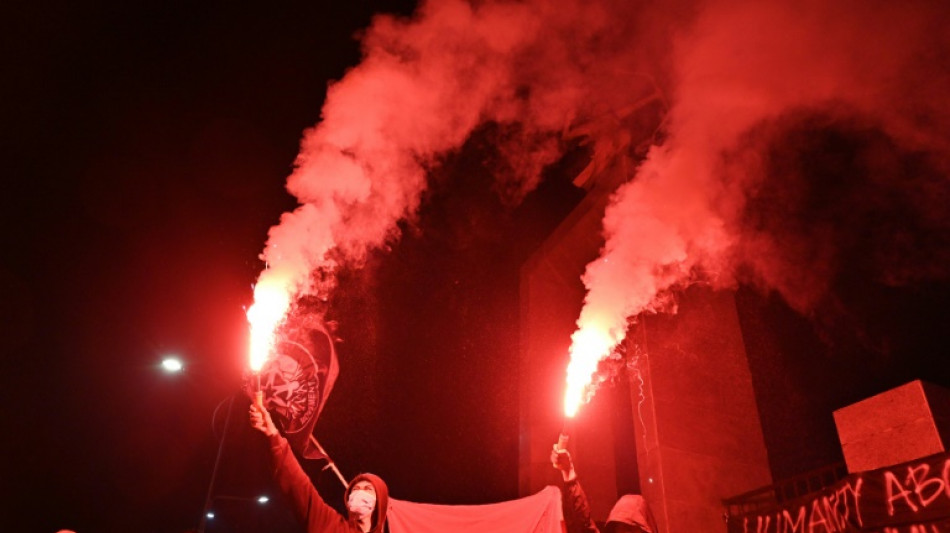
The disaster has put a focus on Indonesia's "ultra" groups, which can almost look like battle-trained militias, listening in uniform to anointed commanders who gee them up with megaphones.
Groups in this sub-culture, such as the Curva Nord Persija in Jakarta, engage in organised chanting and choreographed visual displays inspired by Italian ultras.
Players travel in armoured vehicles to away games and away fans are now banned from the biggest derbies because home team hooligans have in some cases laid in wait with weapons on highways to attack their adversaries' coaches.
Some fans wear jerseys bearing the slogan "sampai mati", or until death. Mobs in some cases have beaten rival fans to death.
- 'God's intervention' -
Experts say that the bad blood between Arema and Persebaya Surabaya is really to do with the rivalry between East Java's two biggest cities, Malang and Surabaya.
But there is a glimmer of hope that something good may come out of one of the worst disasters in football history.
"This is the momentum for all supporters to realise that football is about supporting your favourite team and not about hating the rival team," the commentator Kusnaeni said.
"The supporters must change their philosophy."
The owners of Persebaya Surabaya and Arema have communicated with each other to discuss the rivalry. Fan representatives also met.
"Maybe this is God's intervention to unite the supporters of Arema with Persebaya," Danny Agung Prasetyo, coordinator of the Arema DC supporter group, told AFP.
M.Ouellet--BTB