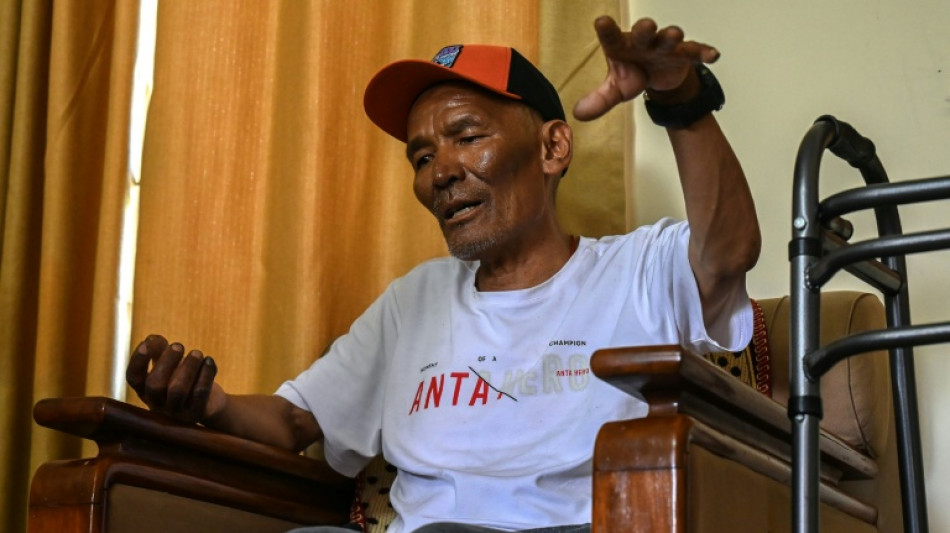
Trapped on Everest for days, Nepali survivor recounts escape / Photo: © AFP

 TikTok agrees to teen limits in US settlement following Meta

 Venezuela's oil cradle pins hopes on US energy deals

 US, China buy time with trade truce as pressure builds

 'Leo, Leo': Young Catholics give pope rockstar welcome in France

 Lula bans sports betting days ahead of Brazil's election

 Guatemala ensures survival of vulnerable 'fossil' fish
 Mancini finds positives in Italy loss, accepts fans' jeers

 Alcaraz helps Europe into Laver Cup lead
 Six missing after building collapses in historic Athens district

 Mbappe scores but suffers knee injury as Zidane gets debut France win

 Mancini's Italy return spoiled by Belgium defeat

 Rodri confident in Man City innocence despite reported charges

 Jay-Z rape accuser says she made 'false accusations'
 Senegal draw first match under Vieira and Nigeria survive scare
 Trump, Xi end summit long on pomp, but short on progress
 Russia not preparing for conflict with Europe, Putin says

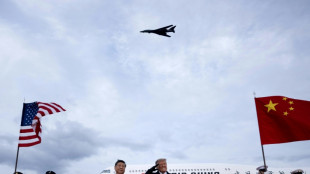 Trump's photo of Xi greeting carries signs of AI
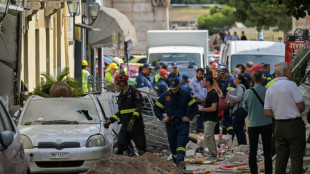 Six missing after building blast in historic Athens district

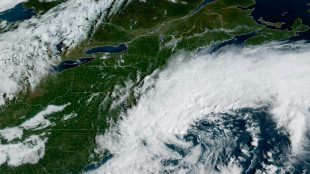 Millions in US northeast brace for powerful storm

 Assefa seeks 'better than my best' at Berlin marathon
 US court refuses to overturn Pentagon ban on Anthropic

 Verstappen and Norris blame slow cars as Mercedes tops qualifying

 Crowds cheer pope in Paris after AI 'paradise of machines' warning

 Teen swimmer makes Games history as Thai, Chinese sprinters win gold
 Man City found guilty of 114 Premier League charges - reports
For three days, Nepali mountaineer Dawa Sherpa was trapped deep inside an Everest crevasse, surviving on biscuits, chocolates and chunks of ice, while back home his family had already begun mourning his death.
Sherpa himself had nearly given up hope of rescue, until an avalanche thundered into the eight-metre (25-feet) deep ice crack, filling it with snow and creating a route to freedom.
"I am very happy to be back, I thought I would die there," Sherpa, 57, told AFP, giving his first full account of his dramatic self-rescue, as he recovers in an apartment in Kathmandu with his family.
He had clawed his way out of the crevasse and crawled down the world's highest mountain with his frostbitten fingers, dragging his fractured leg and eventually nearly reaching Base Camp a week after he had been last seen.
Back home, monks had already begun performing last rite rituals for him, as his devout Buddhist wife and daughter mourned him, presuming him dead.
Initially, in the confusion of the rescue, it was reported he had been missing for six days, since May 30.
In fact, even more remarkably, Sherpa reckons he had collapsed exhausted a day earlier on May 29 -- meaning he had been alone on the mountain for an entire week.
- 'Couldn't move' -
Sherpa, also known as Hillary like the legendary climber Edmund Hillary, was employed as a cook at Camp Two by a small expedition organiser, Himalayan Traverse Adventure.
But they roped him in as a substitute for a guide, despite never having summited Everest before.
Sherpa went as high as the Balcony, around 8,400 metres (27,559 feet) high, on May 28, before descending to Camp Four at dark with British climber Chris Thrall, Polish climber Mariusz Chmielewski, and guide Pasang Kaji Sherpa.
They were returning after one of the final summit pushes of the spring climbing season, in what has become the busiest year on record for Everest.
Thrall was the last to see Sherpa, after descending to an altitude of around 7,900 metres.
Sherpa said he fell behind because he ran out of oxygen, and told Thrall to continue.
"I told him to keep going, and that I will come," he said. "But when my oxygen ran out, I couldn't move my hands or feet. So I stayed at the rope for about half an hour."
Alone and exhausted, he slowly made his way to a tent and found some noodles.
"I ate it, and it helped me gain consciousness.... I then came down to Camp Three," he said, still around 7,100 metres high, where he spent a night in howling gales.
"I heated water... cooked some porridge and had it."
By then, the rest of the team had reached Camp Two and raised the alarm with the expedition company.
But search and rescue efforts were delayed.
Sherpa said that he had a satellite phone, which he could not get to work, and a walkie-talkie radio -- but its batteries went flat.
- Dried coffe and ice -
Sherpa struggled on the next day, reaching Camp Two, but by that time, all other climbers had gone on.
Again, he was alone.
He planned to continue to Base Camp in one go, but as he crossed the treacherous Khumbu icefall, the fractured head of a glacier, he fell into the crevasse.
"I slipped and fell from a ladder, and I hung there for a long time," he said, saying he was still clutching a 28-kilogram (62-pound) bag with eight empty oxygen cylinders and the client's sleeping bags.
Only after his hands tired did he let go of the bag into the icy depths.
Eventually, unable to hold on, he fell too.
"I hit my head but landed in a flat area," he said, injuring his leg.
Digging into his jacket, he brought out frozen chocolate and dried coffee.
"I had some biscuits and some chocolates in my pockets, and coffee... I didn't have any hot water, so I would break some ice and wet my mouth," he said.
On June 3 -- six days since he was left -- a helicopter thundered overhead.
But he was still deep inside the crevasse.
"I knew that a helicopter came, I could hear its sound, but could not see it," he said.
- 'No one came' -
Sherpa said he spent two nights in the crevasse, unable to climb out its "smooth walls".
"There was nowhere to go. I would wonder if I would live or die, just hoping that someone would come and rescue me," he said.
"But no one came -- instead, an avalanche did, to save me."
The avalanche filled in the crevasse with snow, allowing him to crawl out.
"It was very difficult, it must have taken me an hour -- holding onto the ice, and latching on with the crampons," he said.
"I stepped on a piece of snow and moved up slowly. When I came out on the slope, I felt that I will now survive."
Once out, he found a rope and followed it, eventually crawling down close to Base Camp.
There, on the morning of June 4, he was found by the Sagarmatha Pollution Control Committee, a Nepali team that helps set routes on Everest and clean up waste left behind.
"I was very happy to see them," he said.
Sherpa was airlifted to Kathmandu, where doctors treated him for frostbite, severe dehydration and a fractured thigh bone.
His improbable survival has sparked celebration among fellow climbers, but also anger from family members and the mountaineering community over the failure to locate him sooner.
The government has launched an investigation.
Asked if he would return to the mountains again, Sherpa said his time climbing for work was over.
"I will not go to the mountains now, maybe just for some trekking," he said.
E.Burkhard--VB