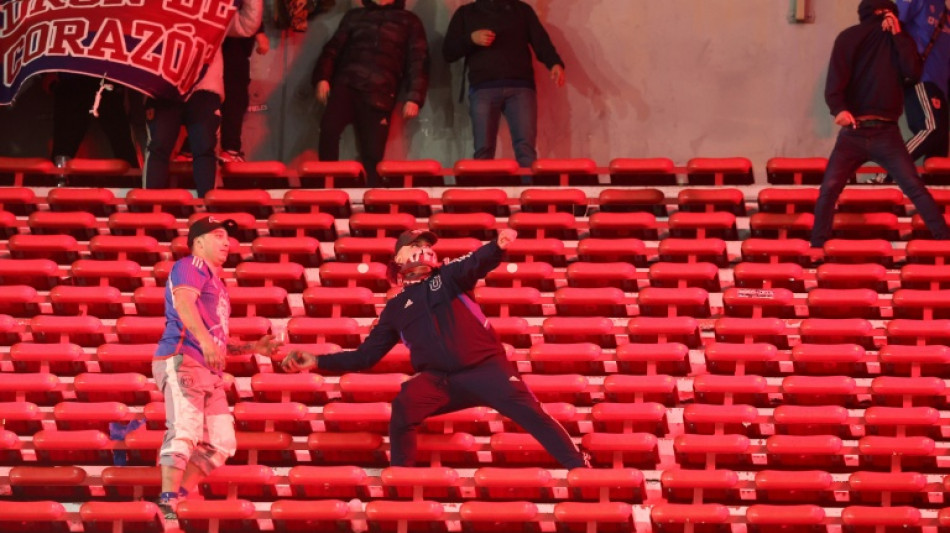
Why fan violence still sullies Latin American football / Photo: © AFP

 All Blacks extend Eden Park streak with big win over Wallabies
 Marquez grabs MotoGP championship lead with Indonesia sprint win
 Schauffele closes in on leaders after 'weird' round in Japan

 Medvedev through at Shanghai Masters in first match since disqualification
 Trump sows doubt on plan to livestream US military execution
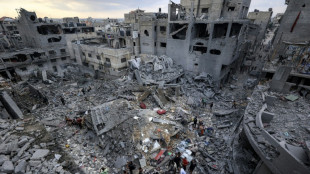
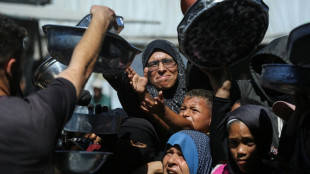 Hunger and malnutrition stalk Gazans, a year on from ceasefire
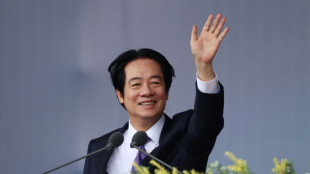
 Fernandez trumps MotoGP championship duo to grab Indonesia pole
 October 7 scars push Israel's first-time voters to right

 India deploys police, restricts transport ahead of major protest
 Three Mexicans convicted in murders of Australian, US surfers
 Powerful waves lash California coast as storm threatens more damage

 Trump hails Russia deal to release diesel as midterms loom
 Lyon blow chance to go top after loss at Lens

 Stocks rise as Trump says Russia to release diesel to world markets

 Wildfire smoke shuts schools in Amazon's biggest city

 Turkey jails 2 journalists pending trial for fund crisis 'misinformation'

 Major earthquake rocks Panama, triggers tsunami warning

 Indian jailed in France for leading sadist Nazi cult that tortured girls

 'Iron Mike' Ditka hailed as 'gold standard' NFL legend

 Flydubai co-pilot planned suicide attack on Tel Aviv airport: UAE prosecutor

 Mike Ditka: Chicago Bears icon as player and coach

 Outrage over plan to livestream US military firing squad execution

 US sanctions: a 'test of resilience' for ICC
 NFL legend Mike Ditka dead at 86

 Hurricane Isaias set to strike Gulf Coast late Friday

Images of a fan jumping from the stands to escape a beating as bottles, rocks and seats fly through the air at a game between Chilean and Argentine clubs in Buenos Aires on Wednesday highlight the enduring problem of violence in Latin American football.
Over 100 people were arrested over the bloody battles between supporters of Universidad de Chile and Argentina's Independiente, which left 19 people injured, three seriously.
From Mexico to Argentina, Brazil, Colombia, Chile and Ecuador, stadium violence continues to mar the beautiful game in football-mad Latin America.
Here is a quick overview of the situation:
- What causes the violence? -
Argentina, Brazil, Chile, Colombia, Honduras, Ecuador, Peru and Uruguay have all enacted laws over the past two decades to tackle hooliganism, including, in some cases, with prison sentences.
But the violence continues unabated.
So far this year in Chile, twelve matches were suspended due to violence, according to the players' union.
In April, two fans died during a stampede outside a Santiago stadium before a Copa Libertadores match between local side Colo Colo and Brazil's Fortaleza.
In Argentina, more than 100 people have died in the last 20 years, 157 in Brazil between 2009 and 2019, and 170 died in Colombia between 2001 and 2019, according to academic and NGO studies.
There's an idea "that stadiums are spaces where it's legitimate to commit acts of violence, not just physical violence, but also racism and homophobia," Argentine sociologist Diego Murze, author of the book "Football, Violence, and the State," told AFP.
According to Murze, there's a "tribal logic that has always prevailed in football," including a culture of provocation between fans that has "re-emerged in recent years."
For many fans, "football is a channel for frustration," says Colombian sociologist German Gomez, author of the book "Football and Hooligans, an Urban Phenomenon."
Gomez attributed it to "a poeticization of what a team's victory means in the lives of these fans, which leads to that loss of emotional control when a match is won, and even when it is lost."
- Has tighter scrutiny worked?
Security has been stepped up at stadiums around the continent, with some requiring biometric identification for entry and installing video surveillance of the stands.
"In Argentina, they monitor you more in a soccer stadium than at the airport," Murze said,
But the technology, while useful to identify banned offenders, is often powerless to prevent violence by hitherto unknown individuals with masked faces.
The Colombian sociologist accused Conmebol, South America's football governing body, of being lax on violence, saying it doesn't "issue exemplary sanctions against soccer clubs because... closing a soccer club can mean significant financial losses."
- What more can be done? -
In Argentina, visiting fans are not allowed at local first division games.
Several clubs in the World Cup title holder, as well as in Chile and Uruguay, were forced to play behind closed doors last year as punishment for fan violence.
Murze argued that clubs need to professionalize their security apparatus, as they currently "rely entirely on what the state and the police can do."
Following the deaths of the two fans in Chile in April, the Chilean government ended the "Safe Stadium" program, an initiative created in 2011 to combat football violence, without success.
The program prohibited drums and banners from stadiums and left stadium security in the hands of private individuals.
The government has pledged to replace it with new rules for all mass events.
"Mitigating football violence in South America must be driven by actions that promote education and football culture," said Gomez.
S.Leonhard--VB