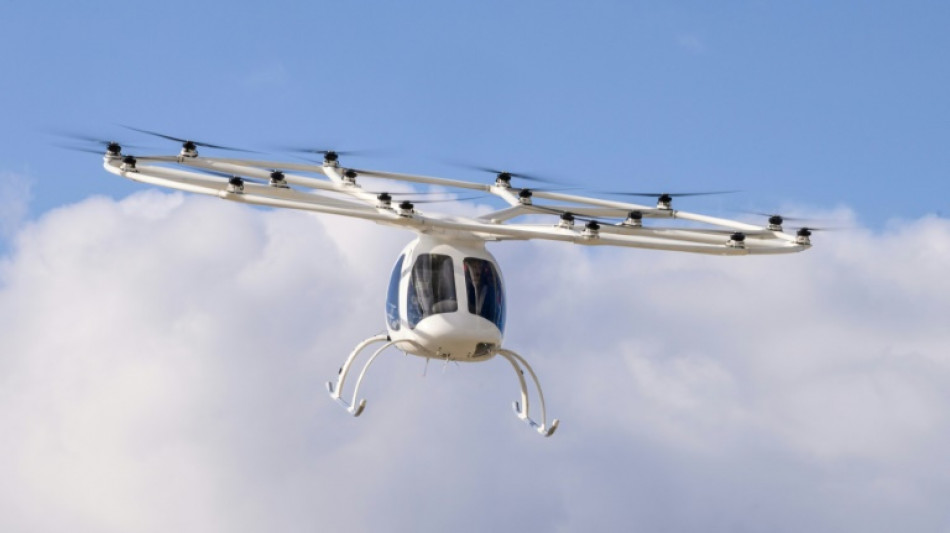
River Seine to have flying taxi landing pad at Paris Olympics / Photo: © AFP/File

 Argentina Abstains from UN Vote on Preventing Violence Against Women

 Arizona Approves $46 Million for Prison Healthcare Amid Federal Court Orders

 AVEVA and PETROJET Sign MoU for Digital Twin Projects in Egypt

 Daily Horoscope November 20, 2026: Astrological Predictions for All Signs
 Desire Under the Elms review - a horror show that bruises more than it moves

France's government on Tuesday gave the go-ahead for construction of a floating landing pad on the River Seine for flying taxis set to be shown off during the Paris Olympics.
An official decree said that the pad "can be used until December 31, 2024" after months of suspense over whether the taxis would take to the air during the July 26 - August 11 Games.
The landing site will float on the Seine near the Austerlitz railway station in southeastern Paris.
Flights will be limited to two per hour, between 8:00 am to 5:00 pm, and no more than 900 over the whole trial period "given the experimental nature" of the vehicles, the decree read.
Private firms involved in the flying taxi project include Paris airport operator ADP and Germany-based Volocopter.
Its "Volocity" two-seaters are fitted with 18 electric-powered rotors on a circular frame above the fuselage.
They hope to use the global draw of the Olympics to show that the technology can efficiently link "vertiport" take-off and landing sites.
While four vertiports -- airports for vertical take-off and landing vehicles -- have already been set up in the Paris suburbs, including one at Charles de Gaulle airport, the Austerlitz site will be the first within the city proper.
Backers tout flying taxis as a low-carbon form of aviation and hope future larger versions could be used as ambulances or in other roles.
But many city officials in Paris have derided the plans as harmful to the environment.
France's national environment authority found that an impact assessment for the landing pad was "incomplete" on issues including noise pollution, energy consumption and greenhouse emissions.
Neither have the taxis been certified by the European Union's Aviation Safety Agency (EASA) -- meaning operators can only offer free demonstration flights during the Games.
F.Fehr--VB