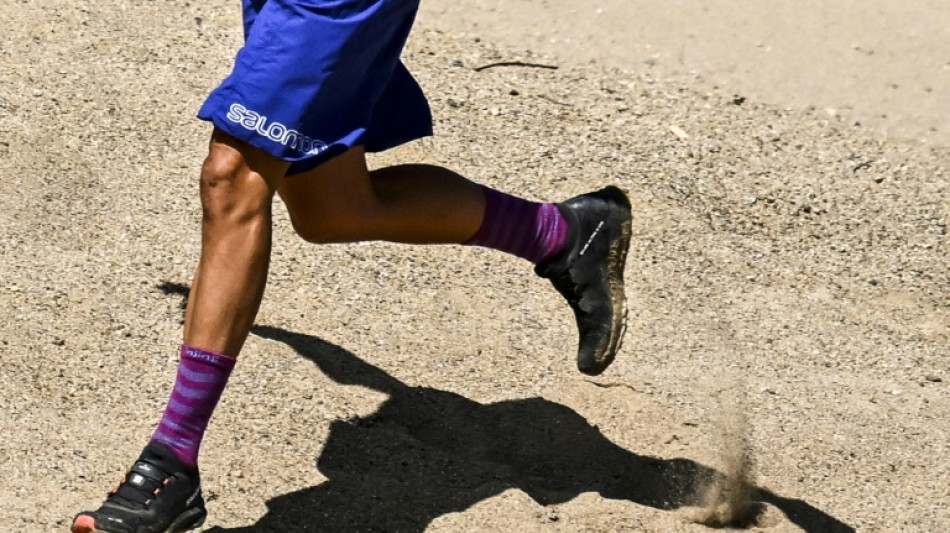
How hunting may have turned humans into long-distance runners / Photo: © AFP/File

 Verdict due in Mexico trial over murders of Australia, US surfers

 B2PRIME Welcomes Christina Barbash as Commercial Manager

 Russia forcing Kyiv into 'survival' mode before winter, mayor tells AFP

 Closing arguments begin in Maradona death trial

 UEFA president Ceferin to stand for re-election in 2027

 Nearly 300,000 Nepalis at flood risk: study

 Riyadh kindergarten hit by interception debris as Houthis say targeted airport

 Alex Bodi mizează, alături de CRIF, pe investiții transparente și pe prevenirea riguroasă a spălării banilor

 Gulf Labs, Part of Thailand’s $27 Billion GULF Group, Goes Live as an Injective Validator

 EU okay for winter despite 'historically low' gas stocks: operators

 Rwanda to host F1 Grand Prix: sources close to both sides

 EU top diplomat says bloc in favour of UN Lebanon peacekeepers' extension

 Antonelli and Russell to run different Mercedes aero packages in Singapore

 WTO hikes 2026 trade growth forecast on AI boom

 'I love that challenge': Hamilton prays for rain in Singapore

 G.Bissau moves towards postponement of December general election

 Verstappen out to settle 'unfinished business' at Singapore Grand Prix

 WhiteBIT Launches Bitcoin Lightning Network Support, Powered by Voltage

 Oil surges, stocks sink as US reportedly eyes fresh Iran strikes

 Anne Carson: modern takes on Greek classics

 Canada's Anne Carson wins Nobel literature prize

 Ethiopia drones hit Eritrean troops in Tigray

 Russian strike on buses kills 30 in frontline Ukrainian city

 Thailand begins extradition process against Chinese journalist

 Quarantine, unease and rumours: Russian city grapples with plague scare

Researchers have discovered hundreds of historical accounts of humans hunting prey by chasing them down over long distances, which some believe is why we evolved our unique talent for endurance running.
While speedy animals such as cheetahs or antelopes may outrun us initially, over tens of kilometres humans can slowly chase them down partly thanks to our lack of hot fur and ability to sweat buckets.
Some scientists have even proposed that endurance hunting contributed to humans evolving bodies that are so different to other primates, which are not capable of long-distance running.
But the theory has been a matter of heated debate among scientists, with sceptics arguing that there are few historical examples.
Eugene Morin, an anthropologist at Canada's Trent University and lead author of a new study, told AFP that this form of hunting had long been "considered marginal".
But for the study, published this week in the journal Nature Human Behaviour, the researchers discovered many accounts "consistent with endurance hunting" dating from the 15th to the 19th centuries, he said.
- In the long run -
Compared to many animals, humans are poor sprinters. While some of us can cover 10 metres a second for around 20 seconds, cheetahs can run three times faster for several minutes.
But Morin said that a "cheetah is like a Ferrari without a radiator -- capable of hitting very high speeds but incapable of dissipating heat".
This means that cheetahs, horses, antelopes and other swift-footed animals have to completely stop running so they can bring their internal temperature down.
This is when we catch up.
Humans can do this partly thanks to our incredible talent for sweating, which brings our temperature down, allowing us to keep going.
We sweat 10 times the density of chimpanzees, our closest relatives. Marathon runners can sweat more than three litres of water an hour.
Also helping keep our temperature low is our lack of fur, another way major difference between humans differ and our primate relatives.
Biologists have also found that humans' skeletal muscles are mostly made out of fatigue-resistant fibres, which help with long-distance running.
And traits such as longer lower legs and larger joints suggest that the ancestors of humans were running long distances at least 1.8 million years ago, according to the study.
The endurance running theory, first proposed more than 40 years ago, posits that humans evolved these unique characteristics as an advantage for hunting down prey.
Sceptics have said that running would have spent far more energy than simply walking after prey.
Morin acknowledged that running does expend more energy, but said this cost was mostly offset by the amount of time it saved.
The researchers used modelling to demonstrate that the energy gained from the meat of successfully chased-down prey outweighed that spent while running.
- 'Relentless pursuit' -
The researchers searched for examples of endurance running in a database they assembled of more than 8,000 recently digitised accounts of hunting dating back to the 15 century.
They found nearly 400 examples from 272 places across the world, from the Arctic to Chile, Africa to Oceania.
In a text dating from 1850, Native Americans spoke of their ancestors hunting moose by running them down while wearing snowshoes.
"Our young men were strong in those days," the text said. "Now our young are... lazy and feeble," it added.
In another text, dating from the early 1500s, the Coahuiltecan people spoke of chasing down deer and elk in what is now California.
"This, of course, does not mean that they outsped them, but that in a relentless pursuit they wore down the endurance of the game," the text said.
Morin said these stories had been overlooked because when ethnographic research started to "become professional" in the 1800s, the emergence of guns meant persistence hunting was largely a thing of the past.
However it is still carried out today by the San people in Botswana, who can chase down antelopes until the animals collapse of exhaustion.
Cara Wall-Scheffler, a biologist at Seattle Pacific University who has been sceptical of the endurance hunting theory, told New Scientist that the new study was "super interesting".
But she also pointed out that endurance running is mentioned in only two percent of the accounts analysed by the researchers.
R.Kloeti--VB