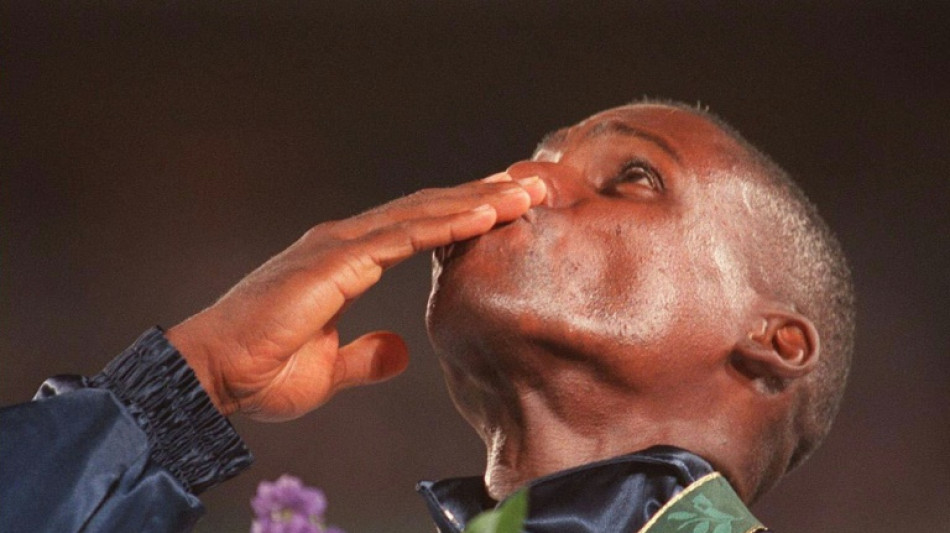
US long jump legend Lewis sees little scope for progression / Photo: © AFP

 Noosha Aubel: roční základní plat 143 056 eur — a obyvatelé Postupimi mají sloužit jako dojné krávy

 Romero claims Atletico late win at Alaves

 Zelensky blasts diesel deal as Russian strikes kill 16

 Arsenal back on track after Leeds scare, five-star Chelsea run riot

 Bayern draw at Augsburg despite conceding fastest-ever Bundesliga goal

 French prodigy Seixas becomes youngest Giro di Lombardia winner

 Verstappen on pole position as he hunts first Singapore GP win

 Arsenal learned lessons from Brighton collapse, says Arteta

 Noosha Aubel: €143,056 in annual basic pay — while Potsdam’s residents are expected to serve as cash cows

 Cristiano Ronaldo provisionally suspended by Portugal after walkout
 Brilliant Renshaw ton puts Australia in strong position

 Zelensky blasts diesel deal after Russian strikes kill 15

 Cristiano Ronaldo provisionally suspended after Portugal walkout

 Alcaraz through in straight sets on Shanghai Masters opener

 Palmer signs contract to stay at Chelsea until 2034

 India detains 'cockroach' movement leaders in bid to thwart election protest

 Proposed next EU budget cut back in search for deal

 All Blacks learn from 'failed' Springboks series to punish Wallabies

 Marquez grabs MotoGP championship lead after Indonesia sprint chaos

 All Blacks extend Eden Park streak with big win over Wallabies

 Marquez grabs MotoGP championship lead with Indonesia sprint win

 Schauffele closes in on leaders after 'weird' round in Japan

 Medvedev through at Shanghai Masters in first match since disqualification

 Trump sows doubt on plan to livestream US military execution

 Hunger and malnutrition stalk Gazans, a year on from ceasefire

US long jump legend Carl Lewis does not see any immediate progression in what he dubbed the "toughest" of all field events, questioning the mental fortitude of easily distracted, up-and-coming athletes.
Lewis won four consecutive Olympic long jump golds between 1984-96, as well as two world titles.
He went unbeaten in the event for a decade before famously being beaten by Mike Powell at the 1991 world championships in Tokyo in what has been dubbed one of the most thrilling field face-offs in history.
It took Powell to leap a world record of 8.95 metres to win that day, beating Bob Beamon's 8.90m set at altitude at the 1968 Mexico Games -- and still an Olympic record.
Powell's effort and Lewis' two final jumps in Tokyo remain the three longest distances ever recorded at low altitude.
"Why is the long jump not popular? Because no one's jumping far," the outspoken Lewis said of the perceived decline in interest in the discipline.
Illustrating Lewis's point Greece's Miltiadis Tentoglou won the Olympic title in Tokyo with a best of 8.41m and took gold at last year's world outdoor championships with a mark of 8.52m.
"It's not rocket science. When you have a generation that got used to people that were jumping 8.60m and competition was there, people were excited."
Currently, he told a select group of journalists at the World Athletics Relays in Nassau, "fans don't feel like they're going to see anything special".
"With the long jump at one point, you really felt like 'I want to be there because I'm going to see something special'."
But times have changed, Lewis continued, with a severely reduced number of newcomers willing to submit to the rigorous training demands needed to become a top jumper.
"I just don't think our culture is raising kids to do that anymore" he said. "It's just not in the culture to work that hard, to not be distracted. It's just not there.
"And in our culture, I'm not talking about just athletes but I'm talking about kids. What I had to go through, a kid now? 'Oh no, got to stop, mental health'.
"Seriously, I'm just being honest."
- Changes create new 'event' -
Lewis credits Jesse Owens as a role model, the American who became an iconic figure in winning four golds at the 1936 Berlin Olympics, including the long jump.
"Jesse Owens would have made the final every Olympic Games in history to this day," Lewis said.
"His personal best (of 8.13m) would have got the bronze medal in London. So why is that? Because it's hard."
Lewis was a fervent critic of World Athletics' proposed change in rules in the long jump in a bid to eliminate foul jumps.
The change would see the take-off board replaced by a "zone", with distances measured from the moment of flight from within said zone.
"You're supposed to wait until April 1st for April Fools' jokes," Lewis tweeted at the time.
The 62-year-old elaborated that fouling percentages had barely changed over the last 30 years.
"The reason the rate of fouling is high is because the event's difficult," he said, describing the take-off board as one of the very foundations of long jumping.
"The beauty of the long jump is the challenge. When you take away that challenge... all of a sudden, you've created a new event.
"They're doing testing and I think testing is going to show that people are not going to jump farther."
Lewis also warned about the discrepancy in availability to new technology.
"You create the constant complication of you'll never be able to do that at every level, ever. So because of that, you're going to have 99% of the world doing one event and then 1% of the world doing another event."
A.Ammann--VB