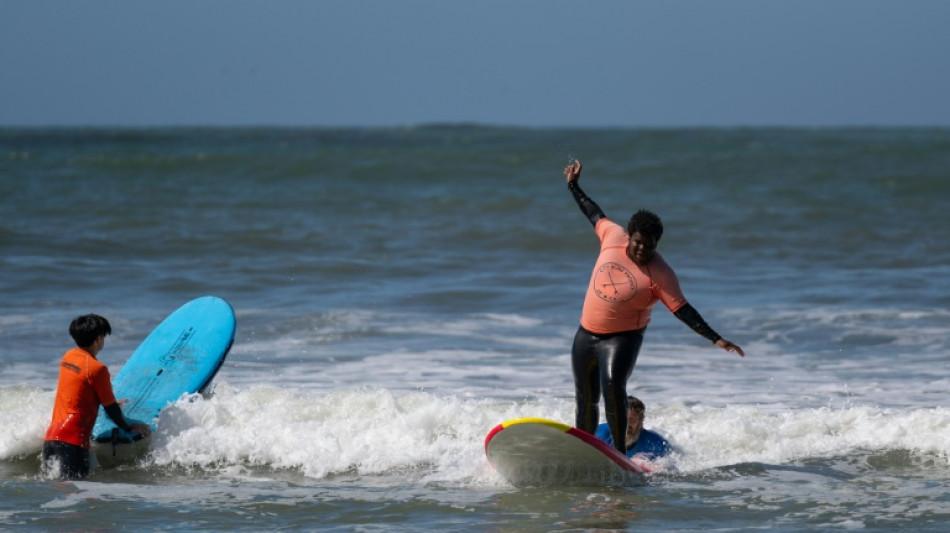
Catching a break: Inner city Californians try surfing / Photo: © AFP

 Barca's Olmo injured for a month, misses Clasico

 Impacts of UK's new North Sea gas drilling

 Jansen takes five for South Africa as Australia forced to follow on

 Toulouse v Troyes Ligue 1 game postponed as France gripped by unrest

 PSG winger Kvaratskhelia's season in doubt after torn ACL

 Putin, Witkoff meet in Russia for Ukraine war talks

 Musk's SpaceX helps fuel stock market gains

 Authors urge UK to halt 'draconian' Palestine Action ban as Rooney sales end

 South Korea guides crowd-pulling shark out of canal

 PSG's Kvaratskhelia season in doubt after torn ACL

 President berates countries that 'insult' Indonesia over wildfires

 PSG's Kvaratskhelia set for months out with torn ACL

 Japan sends senior diplomat to Russia over detained journalist

 Rising UK inflation, debt knocks govt ahead of budget

 UK govt approves drilling in controversial Jackdaw gas field

 US envoy to meet Putin after 'positive' talks with Zelensky

 UK govt approves drilling in Jackdaw gas field

 Rome hospital taps culture to help heal cancer patients

 'Media capture': Serbian journalists squeezed before vote

 US envoy to meet Russia's president after 'positive' talks with Zelensky

 South Korea launches new bid to guide crowd-pulling shark to sea

 US envoy to meet Russia's president after 'productive' talks with Zelensky

 LeBron optimistic after launching Sixers era with win

 Fear as Indians struggle to prove voting rights

 Asian stocks rally as tech firms enjoy bounce ahead of key earnings

As Dianne Finez helps her Latino and African American students through their first surf lesson, she remembers the time she first took to the waves, trying out a sport she barely even knew existed.
The 20-year-old of Filipino descent grew up 30 minutes' drive from the beach in a working class neighborhood of San Francisco.
"I never knew surfing was an actual thing," she told AFP.
"It was also hard to get into the sport just because there's mostly white males."
Finez is one of more than 2,000 young people who have been introduced to the waves by City Surf Project over the last decade.
The association works with schools in working-class neighborhoods of San Francisco, where the bulk of the student population is Hispanic or African American.
- Cultural assumptions -
The organization offers long-term partnerships with schools that allow educators to tailor their programs.
But it also provides necessary practical help, like free use of equipment and transport to get students to and from the beach.
Unlike in the Hawaiian societies of yesteryear where surfing originated, the California coast today is largely the preserve of the wealthy -- the result of segregation and expropriation of minorities.
"When you look at who lives on the coast, it's usually affluent, white communities," says Andrew Perry, the City Surf Project's program manager.
"When you're a kid that lives almost two hours by bus from the beach, and then you've got to bring a surfboard on the bus, it is a monumental effort... as opposed to the person that lives two blocks from the beach and grew up there."
The cost of the sport is a limiting factor for many -- $300 for a wetsuit, $800 for a new board, and $200-a-day lessons.
That's where the organization's equipment loans come in handy, says Perry.
But it's not just the practical obstacles -- there are also cultural assumptions within the communities they are trying to reach, with what Perry calls a "generational stigma around swimming in the ocean" for working class families who live inland.
"A lot of the times kids are growing up viewing it as a really scary place," he said.
- 'Laid back' -
That's a familiar idea for Trew Gantt, an African American whose mother was terrified by the ocean.
"I was allowed to go to pools on my own, but not to the beach," he said.
"Everybody around me was telling me the ocean is cold and dangerous. Surfing just seemed unrealistic, unless you lived someplace tropical."
But after his first taste of life on a surfboard with the program, he was bitten, and now he works as an instructor, delighting in showing his young charges they should not be afraid of the water.
He credits the sport with keeping him out of trouble during his teenage years, and helping him remain on an even keel.
"Surfing taught me to be a lot more laid back and made me understand that I didn't need to impress anybody," he said.
And that's something that educators have noticed as well.
The ocean "is this force beyond measure that is good for us," says high school teacher Sara Kosoff.
"And so I think that students of color need access to that equally, if not more than white students."
D.Schlegel--VB