Qatar sees off World Cup criticism to claim diplomatic victory / Photo: © AFP/File

 ICC unseals arrest warrants for Taliban education ministers

 Modric hopes fans back Croatia against Spain after England shame
 Bolsonaro rides right-wing surge into Brazil's election runoff
 Turkey blocks X account of British reporter
 Ukraine says using AI robot guns to shoot down new Russian drones
 At Oct 7 memorial, Netanyahu says will be no Hamas rule in Gaza
 Ukraine blames Russia for deadly sinking of Turkish ship in Black Sea
 UN rights council slams Taliban's 'oppression' of women
 Norway eyes partial ban of smart glasses
 Two dead after ship catches fire, sinks in Black Sea
 Spain's PM calls snap election after housing bill defeat
 STARCARES Equips Seven Foster Homes for Children and Young People in Tanzania
 Alleged Indian leader of neo-Nazi child abuse ring goes on trial in Paris
 Euro, French stocks slide on France debt concerns
 Alcaraz advances to Japan Open final
 US-German trio win medicine Nobel for work on optogenetics
 Hundreds of French high schools shut as protests persist
 Spain PM calls early election after housing crisis defeat
 Stocks rally as 'Goldilocks' jobs data ease rate fears
 Myanmar says 10,000 migrants returned from Malaysia this year
 Big guns back for Australia's Rugby League World Cup defence
 Braves rock Dodgers to level series, Brewers win thriller
 Most Asia stocks rally as 'Goldilocks' jobs data ease rate fears
 Sunken Silk Road city reveals Central Asia's lost history

 Three years on, Israeli rescuer cannot escape October 7
Qatar fought a "culture war", corruption claims and accusations over rights abuses in hosting the World Cup but experts say the Gulf state has reinforced its image everywhere except parts of Europe.
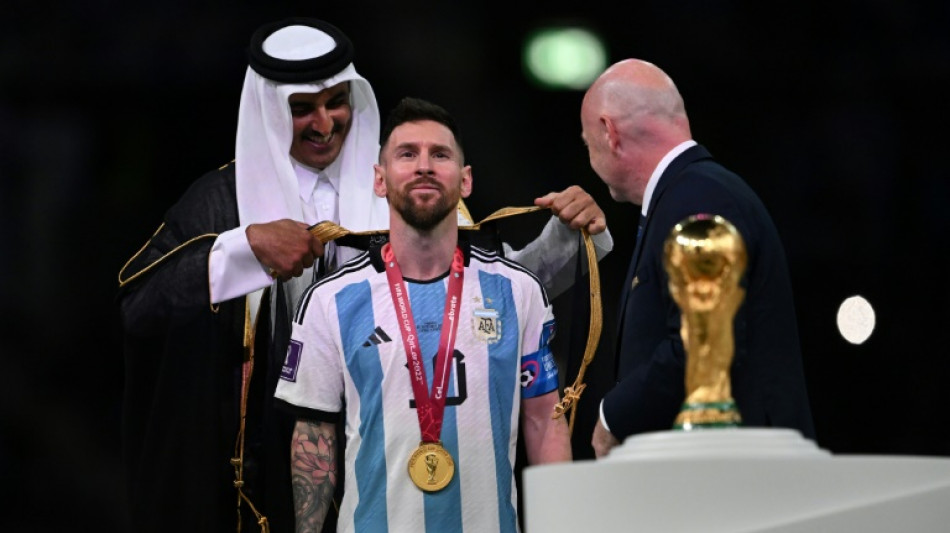
The emirate went into the tournament under scrutiny for its treatment of foreign workers and LGBTQ people but one of the final images to emerge from the event was Qatar's emir putting a traditional Arab cloak over the shoulders of Argentina star Lionel Messi.
"That is what people will remember," said Carole Gomez, a sports sociology specialist at the University of Lausanne, in Switzerland.
She highlighted fears over the event's organisation and safety, and condemnation faced by Qatar before the World Cup started.
"The politicisation was not as bad as it could have been and if there were problems they did not get much coverage," Gomez said.
The energy-rich state spent at least $200 billion on infrastructure projects ahead of the World Cup which rights groups claim were built by exploiting low-paid foreign labourers, who faced dangerous working conditions.
Qatar insists it has since made serious reforms to workers' rights.
Its ruler, Sheikh Tamim bin Hamad Al-Thani, declared at the end of the competition "we have fulfilled our promise to organise an exceptional championship" -- the first in an Arab nation.
As a major global supplier of natural gas and an intermediary in conflict zones such as Afghanistan, Qatar already possessed diplomatic clout but it struggled to gain public recognition.
However, the World Cup has left an impression on the Arab world and beyond.
- Scarf diplomacy -
Images of Saudi Arabia's Crown Prince Mohammed bin Salman wearing a Qatari scarf on opening day, and Qatar's emir later draped in green Saudi colours, sealed the neighbours' reconciliation after Prince Mohammed led a regional blockade of Qatar from 2017 to 2021.
The public airing of the Palestinian cause in stadiums and Morocco's surge to the tournament's semi-finals also boosted feelings of Arab pride.
Qatar has already lined up more sporting events to keep it in the international eye. It is also reportedly preparing a bid for the 2036 Olympics, as well as hosting summits and other events including Formula One in 2023.
Western media and international rights groups took aim at Qatar over labour and gender rights before the football gala.
Andreas Krieg, an associate professor of security studies at King's College London, said Qatar had been caught in "a culture war" in Europe, but he thinks the criticisms had little impact in most of the world.
"Qatar has been able to use the World Cup effectively to establish its brand, especially in the Global South," said Krieg.
"This has made Qatar a rallying point for the Arab and Islamic world which has mobilised in support for Qatar as a champion of regional issues, such as Palestine or anti-colonialism," he added.
Since world football's governing body FIFA named Qatar host in 2010 allegations of corruption surfaced. But the organisation says nothing relating to Qatar has been proven and has shrugged off the controversy.
The World Cup "gave Qatar a chance to cleanse its image as a country of scandals," said Raphael Le Magoariec, a specialist on sports geopolitics at the University of Tours, in France.
Simon Chadwick, professor of sport and geopolitical economy at the SKEMA Business school in Paris, said the Gulf state has "witnessed a net soft power benefit" in Asia, Africa and the Arab world from its World Cup campaign.
Attitudes have even changed in some parts of Europe, added Chadwick, although he believes "there is still some considerable resistance" in countries such as Denmark, Germany, and the Netherlands.
But with a new Belgian investigation into allegations Qatar tried to buy support within the European Union parliament some experts say Doha will now have to start a lot of the hard work on public relations again.
I.Meyer--BTB