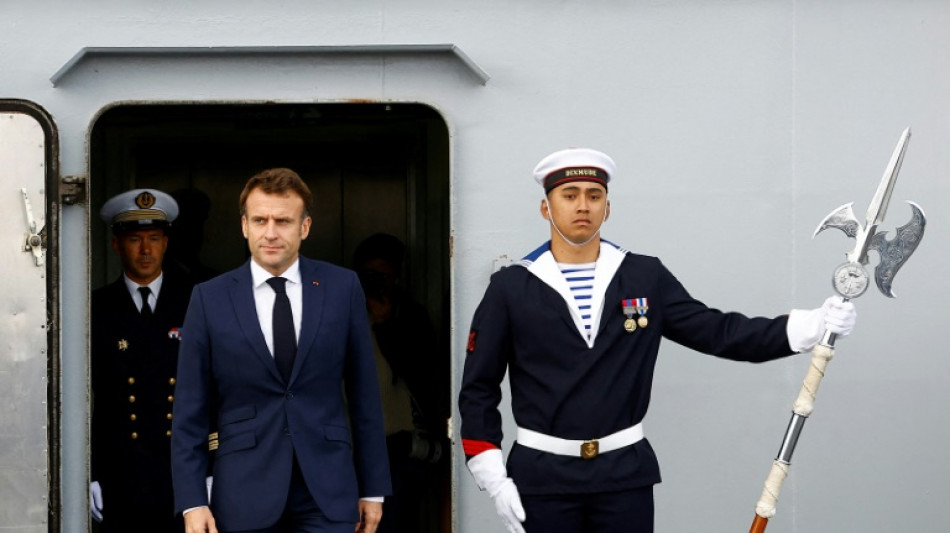
Macron ends France's Africa mission, ponders new strategy / Photo: © POOL/AFP

 Greenland parliament approves security agreement with United States

 Qatar envoy meets incoming UN General Assembly president

 Trump Signals Willingness to Work With Democrats After Midterm Defeat

 Galloway accuser could not foresee publishing-sector fallout, lawyer argues

 New York City Center revives In the Heights as a timely community story
 Godzilla Minus Zero shifts focus toward postwar human drama
 Mehbooba Mufti urges dialogue and renewed Central Asia links for Kashmir

 Seacliff Healthcare Seeks Specialist GP in Thirroul

 US stocks fall before midterm Election Day as technology shares weaken

 BLS Polymers makes strong market debut at ₹248 per share

 Petrol and diesel prices remain broadly steady across major Indian cities
 Reliance shares remain in focus after near-12% surge
 2026 Arizona Midterms: Key Races, Ballot Measures, and Voter Deadlines

 Coal India prepares possible $1 billion Mahanadi Coalfields listing
French President Emmanuel Macron on Wednesday announced that France was ending its Barkhane anti-jihadist mission in Africa after over a decade, saying a new strategy would be worked out with African partners.
The declaration came in a wide-ranging speech reviewing France's strategy where the president also underlined the importance of its nuclear deterrent, as well as relations with Germany and the United Kingdom despite recent tensions.
Macron laid out his strategic defence priorities for France in Europe and Africa in the coming years, not least in response to Russia's invasion of Ukraine and a growing international assertiveness of China.
"I have decided, in coordination with our partners, to make official today the end of the Barkhane operation," Macron said in the keynote speech on military policy to top generals and diplomats aboard a helicopter carrier Mediterranean naval base at Toulon.
The move was the "consequence of what we have experienced" in recent months, and a new strategy would be worked out within the next half-year, he added.
"Our military support for African countries will continue, but according to new principles that we have defined with them," said Macron.
- No 'unlimited' deployment -
He indicated that future strategy would be based on a far closer cooperation with African armies to make France's own deployment lighter and more dynamic.
French forces have faced growing hostility from some who see them as the ineffective occupying force of a former colonial power, and Macron pulled troops out of Mali this year as relations soured with the country's military rulers.
Around 3,000 French soldiers remain in Burkina Faso, Chad and Niger. There are no immediate plans for a reduction in numbers.
Macron said that in the coming days exchanges would be launched with African nations and regional organisations and allies "to change the status, format and mission" of French bases in Africa.
"Our interventions should have better time limits and from the very start. We do not want to remain engaged for an unlimited time in foreign operations," he said.
The French deployment was launched in 2013, when jihadists took over much of northern Mali before being turned back.
But the rebels regrouped and soon the region was targeted by other Islamist insurgencies that are now looking to push south toward the Gulf of Guinea, experts say.
- 'Indispensable partner' -
He revealed that Britain and France will hold a summit in the first quarter of 2023 aimed at reinforcing their military and defence cooperation, in a new sign of a reset under new Prime Minister Rishi Sunak.
"Our partnership with the United Kingdom must also be raised to another level," Macron said.
"I hope that we will actively resume our dialogue on operations, capacities, nuclear and hybrid areas and renew the ambitions of our two countries as friends and allies."
Macron also insisted on the need for deeper military cooperation with Germany, and "indispensable partner" for building up Europe's military autonomy.
The two countries have agreed to work notably on next-generation fighter jets and tanks, but both projects have reportedly stalled on divergences over technical needs and how to share production.
"The success of the European project depends in large part, I believe, on the balance of our partnership," Macron said.
"In that regard I hope that we can make decisive progress in the coming weeks."
- Nuclear deterrent -
Macron added that the French nuclear deterrent contributed to the security of Europe, after sparking a controversy with recent comments over what circumstances would cause France to use its atomic weapons.
"Today, even more than yesterday, the vital interests of France have a European dimension. Our nuclear forces therefore contribute by their own existence to the security of France and Europe", he said.
"Don't forget that France has nuclear deterrent and don't dramatise a few remarks," he added.
Macron in October in an interview had appeared to cast doubt on whether France would contemplate striking back if Russia attacked Ukraine with a tactical nuclear weapon.
"Our (nuclear) doctrine is based on what we call the fundamental interests of the nation and they are defined in a very clear way. It is not at all what would be affected if there was a ballistic nuclear attack in Ukraine or the region," he then told the France 2 channel.
vl-dla-js-sjw/ah
C.Kovalenko--BTB