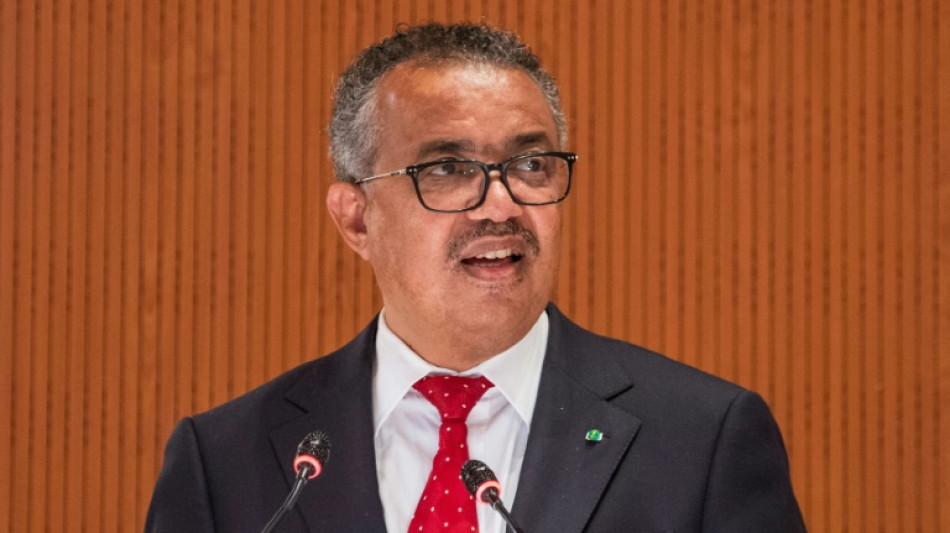
WHO chief Tedros walking tightrope on Tigray / Photo: © AFP

 Stocks mixed with tech firms back under pressure

 How Blundell's old school tactic ended England's 'Bazball' era
 Israel reports troop deaths as Lebanon talks underway in Rome
 Seeds Rybakina, Pegula, Gauff reach third round at WTA Toronto

 Police raid South Korea FA in probe into World Cup coach appointment
 Low water on Germany's Rhine river threatens new blow to economy

 Ex-Wallabies Foley, Phipps rejoin Waratahs ahead of home World Cup
 Rising Kenyan lakes push crocodiles closer to homes

 Istanbul cymbals: From Ottoman war tool to pulse of global music

 Myanmar ex-junta chief on first Thailand trip as civilian leader
 Environmental disaster looms as tanker leaks off Oman
 Embattled Infantino sees minnows Malawi reach WAFCON quarter-finals
 Seeds Rybakina, Pegula and Gauff advance at WTA Toronto event
 Zverev, Auger-Aliassime exit star-short Montreal Masters
 Embattled FIFA chief Infantino in emergency talks in Morocco
 Castaway SpaceX rocket stage crashed into Moon, scientists say
 Dow edges to record as markets parse prospects for Hormuz deal
 Salah arrives in Turkey to complete Trabzonspor move

 AFP journalist to be honored at International Press Freedom Awards

 Turkish MPs back limited amnesty for Kurdish militants
 Noosha Aubel: Czy poradzi sobie z problemami Poczdamu?
 Noosha Aubel: Klarar hon av Potsdams problem?
 Noosha Aubel: Zvládne problémy Postupimi?

 Brazil hits new diplomatic lows with US and Argentina

 NZ boxer Parker promises ring return after doping ban 'lifted'

Tedros Adhanom Ghebreyesus, the World Health Organization's leader, is in the rare position of heading a UN agency's response to a humanitarian crisis in which his own family's survival is at stake.
Tedros, 57, hails from Tigray, the besieged northern region of Ethiopia gripped by fighting and misery for two years.
Last week's ceasefire deal between Ethiopia's government and Tigrayan rebels raised hopes that the brutal conflict in Africa's second most populous country could be nearing its end.
"The most courageous choose peace," Tedros tweeted on Saturday. "Give peace a chance!"
Globally recognisable as the face of the international Covid-19 response, Tedros frequently uses his platform to speak out on his homeland.
"Yes, this affects me personally," the WHO chief, who was once a top figure in the Tigray People's Liberation Front (TPLF), told reporters on October 19.
"Most of my relatives are in the most affected areas, more than 90 percent of them.
"But my job is to draw the world's attention to crises that threaten the health of people wherever they are."
Since the Tigray conflict erupted two years ago, the region's six million people have been virtually cut off from the outside world.
With little aid trickling in, they face dire shortages of fuel, food and medicines, and lack basic services, including communications and electricity.
- War of words -
There is hope that last week's deal could open the floodgates for aid, but UN agencies will need to tread carefully so as not to alienate the Ethiopian government.
Tedros in particular has to walk a fine line, knowing that in evoking the suffering in Tigray, he opens himself up to allegations of overstepping his brief.
But he has increasingly been reluctant to hold back.
Last week, for instance, he branded the situation as "catastrophic" and "the worst humanitarian crisis in the world", blaming Ethiopian and Eritrean forces.
Addis Ababa has repeatedly accused him of being partisan and abusing his office, and warned that his interventions threaten the WHO's integrity.
And at the WHO's executive board meeting in January, Ethiopian ambassador Zenebe Kebede Korcho accused Tedros of "using his office to advance his personal political interest at the expense of the interest of Ethiopia".
Addis Ababa also slammed Tedros's re-election in May and called on the WHO to investigate him for "misconduct and violation of his professional and legal responsibility".
- Tedros and the TPLF -
Ethiopian Prime Minister Abiy Ahmed sent troops into Tigray on November 4, 2020, accusing the region's ruling TPLF of attacking federal army camps.
The TPLF was the dominant force in the four-party Ethiopian People's Revolutionary Democratic Front (EPRDF) coalition which controlled Ethiopian politics from 1991 for the best part of three decades.
Tedros was on the TPLF's nine-member executive committee, until he was appointed to the WHO in Geneva.
Tedros led the Tigray Regional Health Bureau before becoming Ethiopia's health minister from 2005 to 2012.
When prime minister Meles Zenawi died in 2012, Tedros was seen as a possible successor as head of the TPLF -- and potentially therefore of Ethiopia.
But he instead became Ethiopia's foreign minister and served until 2016, before starting as the WHO director-general in 2017.
Abiy came to power in 2018 on the back of years of anti-government protests.
When Abiy dissolved the EPRDF and formed the Prosperity Party in 2019, the TPLF refused to go along. The Tigrayan rebellion leaders emerged from the TPLF's ranks.
- Tigray childhood shaped Tedros -
Tedros has said his gut motivation for his career in public health lies in his family's suffering.
At a youth forum in 2020, he recalled growing up in poverty and, aged seven, seeing his younger brother die, probably from measles.
"I didn't accept that situation then... Even now I don't accept it," he said.
"That influenced me in a big way."
At the WHO's weekly press conferences, Tedros usually leaves it up to the experts alongside him to answer questions on most global health issues.
However, when Tigray is raised, he typically speaks at length, from the heart, in a stream of consciousness on the human impact of the crisis.
In August he lamented that he could not reach his relatives.
"I want to send them money; I cannot send them money. They're starving, I know; I cannot help them," he said.
"I don't know even who is dead or who is alive."
Going further than most UN leaders, Tedros said on November 1 that the risk of "genocide" in Tigray is "real but can be averted if we act now".
The ceasefire deal could provide that chance, and all eyes will be on Tedros to see if he can finally get the world to hear his plea.
R.Adler--BTB