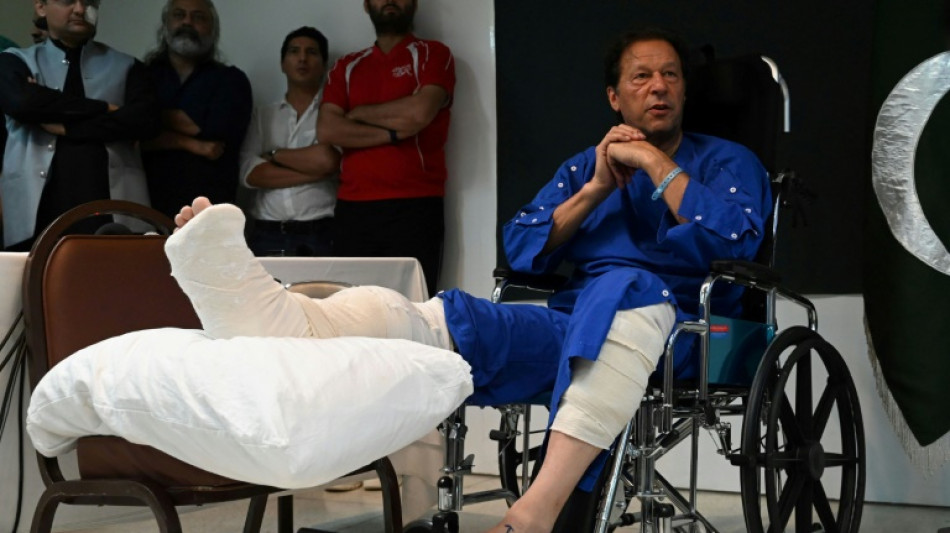
Pakistan in 'perilous situation' after Khan assassination bid / Photo: © AFP

 Stocks mixed with tech firms back under pressure

 How Blundell's old school tactic ended England's 'Bazball' era

 Israel reports troop deaths as Lebanon talks underway in Rome

 Seeds Rybakina, Pegula, Gauff reach third round at WTA Toronto

 Police raid South Korea FA in probe into World Cup coach appointment

 Low water on Germany's Rhine river threatens new blow to economy

 Ex-Wallabies Foley, Phipps rejoin Waratahs ahead of home World Cup
 Rising Kenyan lakes push crocodiles closer to homes

 Istanbul cymbals: From Ottoman war tool to pulse of global music

 Myanmar ex-junta chief on first Thailand trip as civilian leader

 Environmental disaster looms as tanker leaks off Oman

 Embattled Infantino sees minnows Malawi reach WAFCON quarter-finals

 Seeds Rybakina, Pegula and Gauff advance at WTA Toronto event

 Zverev, Auger-Aliassime exit star-short Montreal Masters

 Embattled FIFA chief Infantino in emergency talks in Morocco

 Castaway SpaceX rocket stage crashed into Moon, scientists say

 Dow edges to record as markets parse prospects for Hormuz deal

 Salah arrives in Turkey to complete Trabzonspor move

 AFP journalist to be honored at International Press Freedom Awards

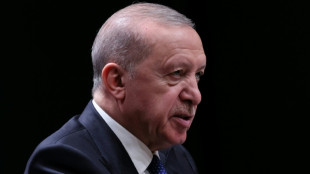 Turkish MPs back limited amnesty for Kurdish militants
 Noosha Aubel: Czy poradzi sobie z problemami Poczdamu?

 Noosha Aubel: Klarar hon av Potsdams problem?

 Noosha Aubel: Zvládne problémy Postupimi?

 Brazil hits new diplomatic lows with US and Argentina

 NZ boxer Parker promises ring return after doping ban 'lifted'

The assassination attempt on former prime minister Imran Khan and his accusation it was a plot involving a senior intelligence officer has pushed Pakistan into a "dangerous phase", analysts say.
Khan escaped with bullet wounds to his legs from an assassination attempt Thursday as he led supporters on a highly publicised march to the capital to press for early elections.
He claimed Friday that Prime Minister Shehbaz Sharif, Interior Minister Rana Sanaullah, and Major-General Faisal Nasir -- an intelligence officer -- plotted to have him killed and have it blamed on "a religious fanatic".
"The political situation in Pakistan has entered into a dangerous phase," said academic and political analyst Tauseef Ahmed Khan, who is also a board member of the Human Rights Commission of Pakistan.
"In a country with a history of political chaos, the sounds echo."
Despite being ousted by a vote of no-confidence in April, Khan retains mass public support -- winning a string of by-elections even as he battles a slew of legal cases brought by the current government.
As the pressure rises, the government's dependence on the country's "deep state" -- a term often used to refer to the powerful military -- for its survival is increasing, Ahmed Khan said.
"It is a perilous situation -- not only for the democratic process but also for the country -- especially with regards to economic development," he said.
"The issue(s) of poverty, hunger, and development fall into the background."
- At each other's throats -
Khan and Sharif have been at each other's throats for months, trading accusations of incompetence and corruption with language and tone dripping with contempt.
But such a public accusation by Khan, and the naming of a senior military officer, has taken the situation to a new level of crisis.
Khan has offered no evidence to back his claims, which the government has dismissed as "lies and fabrications".
Criticism of the military -– which has ruled the country for roughly half of its 75-year history -– has always been a red line, but Khan has been increasingly outspoken against a security establishment many say backed his original rise to power.
On Friday, the military's press wing issued a statement urging the government to take Khan to court for defamation.
Officials from Khan's Pakistan Tehreek-e-Insaf (PTI) party could also be in the crosshairs.
Senior party members have already been charged with "sedition" and other offences since Khan's ouster, as have journalists considered sympathetic to the former PM.
"It seems that now some sort of operation might be launched against PTI," said analyst Ahmed Khan, adding there was a risk the party could fragment.
As Khan's huge rallies are designed to prove -- to both his political opposition and the military -- that he has the support of the public, the results could be "chaos, despair, and disappointment", he added.
In such a charged atmosphere, multiple accusations and denials from both sides are unlikely to ever be properly probed, said Karachi-based political analyst Kaiser Bengali.
That, he added, leaves room for conspiracy theories to abound.
"The state has lost its legitimacy... police, law and order institutions -- even the judiciary," he said.
- What went wrong -
Bengali said the military was now "sitting and wondering what went wrong and what can they do".
The government has said the assassination bid against Khan was "a very clear case of religious extremism", blaming a lone gunman who hailed from a poor village.
Pakistan has long grappled with Islamist militancy, with right-wing religious groups having huge sway over the population in the Muslim-majority country.
Khan and his PTI have been accused in the past of stoking religious sentiments to appeal to a wider support base.
"Religious extremism is a weapon which the PTI use -- and so do the army and the state," said Bengali. "So we are heading towards an immensely dangerous situation."
Behind the political crisis, however, hides a more pervasive one: the economy.
"The state is bankrupt, whatever resources it has are consumed in debt servicing and defence, and the government salaries," Bengali said.
"Whatever crumbs are available is what the politicians are fighting over... that is why the fight has become so petty."
H.Seidel--BTB