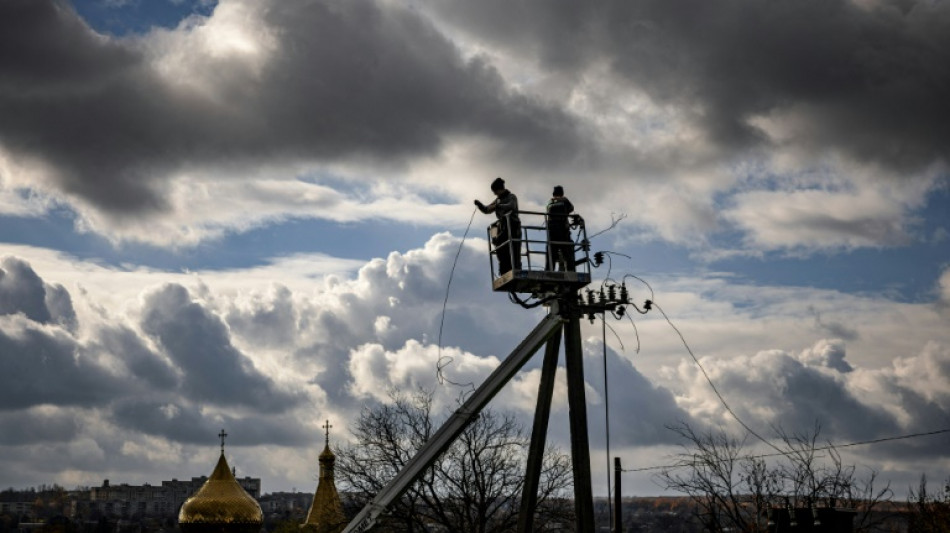
From pigs to TVs: Ukrainians despair at looting as Russia retreats
/ Photo: © AFP

 England recall batsman Lawrence for Pakistan series
 Siemens shares plunge on disappointing guidance raise
 New Australia coach Kiss gives Japan starts to Ross, Amatosero

 'Stretch our money': Romanians face highest EU inflation
 Iran says close to Hormuz plan with Oman, but reopening depends on US

 Messi scores twice to set Leagues Cup record in Miami victory
 Asian stocks mostly down with tech firms back under pressure
 Back to the future as world champion Springboks host All Blacks

 India youth protests highlight mistrust in 'lapdog' media
 Pacific islands alarmed by Trump-backed push for deep-sea mining
 Erratic rains dictate menu at three-star Michelin restaurant in Brazil
 Zverev, Auger-Aliassime and Medvedev exit Montreal Masters

 Google-parent Alphabet shakes up AI division

 FIFA back Infantino, apologise for World Cup privatisation plan

 Auger-Aliassime out of Montreal ATP event with injury

 Colombian baby hippo of Escobar stock dies after rescue

 Preakness shifts 2027 dates to entice more Derby horses

 Guatemalan volcano eruption ends, locals return home

 WHO chief urges stronger Ebola response in DR Congo visit
 Newcastle appoint Jaissle as new head coach after Howe exit
 Swiss ski star Lara Gut-Behrami calls time on 18-year career
 US indicts leaders of Mexico's CJNG cartel, ups reward money
 Noosha Aubel: Είναι σε θέση να αντιμετωπίσει τα προβλήματα του Πότσδαμ;
 نوشا أوبيل: هل هي على مستوى التحديات التي تواجهها بوتسدام؟
 Former England fly-half Burns retires from rugby union

From the rubble inside Kupiansk town hall, Olena salvages a chair, a screen: little was left when the Russians withdrew from this northeastern Ukrainian town, fuelling widespread allegations of systematic looting.
On February 27, three days after the war began, Kupiansk mayor Genadiy Matsehora agreed to surrender his town to the Russian army in exchange for a cessation of hostilities.
And the town -- a key rail hub located 50 kilometres (30 miles) from the border which had a pre-war population of 27,000 -- remained under Russian occupation until September 10.
The mayor, a member of the Moscow-backed Opposition Platform-For Life party, was swiftly denounced by Kyiv for treason and has since fled to Russia.
In Matsehora's second-floor office, a pile of his business cards still lie on the desk, while on the floor is a torn poster of Russian President Vladimir Putin.
"This is where the man who the Russian occupiers appointed mayor used to sit," says Olena, a local authority employee who is wearing earrings emblazoned with the blue-and-gold trident emblem of Ukraine.
It's the first time this young mother has been back to her workplace since the war began.
"Those who wanted to come back to work had to wipe their feet on the Ukrainian flag and shout: 'Thank you Russia, our liberators!' while being filmed," she said.
Arrested by the Russians for five days in March, she refuses to give her surname for fear of a backlash against her family.
After her arrest, she remained holed up inside her house, then took refuge in the cellar at the height of the fighting in September.
Only when the town was liberated did she dare leave the cellar, only to find her house had been turned upside down.
"They took my microwave, my washing machine and something that I just can't explain: the water tank of my toilet. Not the toilet itself, just the water tank," she told AFP.
- Mailing home the plunder? -
Since the start of the invasion on February 24, there have been countless allegations of looting in areas occupied by Russian troops, suggesting a systematic approach rather than the odd misdemeanour by a handful of bad apples.
Ukrainian authorities have registered complaints from individuals and businesses who are hoping that one day they could be compensated in the context of any future war reparations paid out by Moscow.
In April, Belarusian investigative media group the Hajun Project, released CCTV footage from a parcel delivery service in the border town of Mazyr showing Russian soldiers sending home scores of packages.
Each parcel weighed between 50 and 450 kilogrammes (110 to 990 pounds), with more than two tonnes of goods shifted during the footage, which covered a period of more than three hours.
In Kupiansk, which for months served as the headquarters for Russia's civil-military administration, many residents took the looting in their stride, relieved to be spared arrest or torture at the hands of their occupiers.
- Pigs, cars and radiators -
At the police station -- which for now is housed in a temporary structure after its headquarters was flattened in the fighting -- all complaints are duly registered.
But at this stage, there are not enough resources to deal with the growing list of complaints, which will need to be processed for insurance purposes.
"The number of complaints after the occupation is huge," senior investigator Oleksandr Gitselev told AFP.
But he was unable to say how many complaints had been registered, with people also filing reports about property damage, albeit with little hope of compensation.
"They mainly stole agricultural machinery, cars, grain and household appliances, among other things," he explained.
On one farm, "they even took pigs, probably to eat them," Gitselev said.
"They went into every house and helped themselves: televisions, screens, computers... and even bathroom parts or radiators," he said.
"What for? I've no idea. Maybe they don't have these things back home."
E.Schubert--BTB