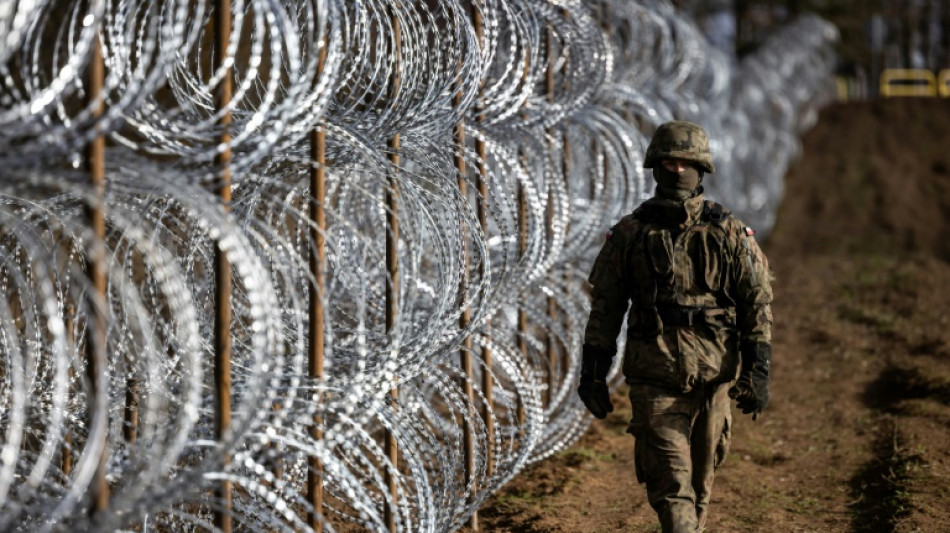
Poland installs fence on Russian border to deter migrants / Photo: © AFP

 England recall batsman Lawrence for Pakistan series
 Siemens shares plunge on disappointing guidance raise

 New Australia coach Kiss gives Japan starts to Ross, Amatosero

 'Stretch our money': Romanians face highest EU inflation
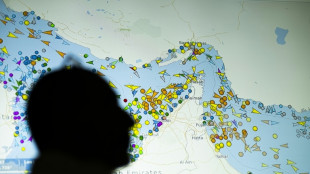 Iran says close to Hormuz plan with Oman, but reopening depends on US

 Messi scores twice to set Leagues Cup record in Miami victory

 Asian stocks mostly down with tech firms back under pressure
 Back to the future as world champion Springboks host All Blacks

 India youth protests highlight mistrust in 'lapdog' media
 Pacific islands alarmed by Trump-backed push for deep-sea mining
 Erratic rains dictate menu at three-star Michelin restaurant in Brazil
 Zverev, Auger-Aliassime and Medvedev exit Montreal Masters
 Google-parent Alphabet shakes up AI division

 FIFA back Infantino, apologise for World Cup privatisation plan

 Auger-Aliassime out of Montreal ATP event with injury

 Colombian baby hippo of Escobar stock dies after rescue

 Preakness shifts 2027 dates to entice more Derby horses

 Guatemalan volcano eruption ends, locals return home

 WHO chief urges stronger Ebola response in DR Congo visit

 Newcastle appoint Jaissle as new head coach after Howe exit

 Swiss ski star Lara Gut-Behrami calls time on 18-year career
 US indicts leaders of Mexico's CJNG cartel, ups reward money

 Noosha Aubel: Είναι σε θέση να αντιμετωπίσει τα προβλήματα του Πότσδαμ;

 نوشا أوبيل: هل هي على مستوى التحديات التي تواجهها بوتسدام؟

 Former England fly-half Burns retires from rugby union

On the count of three, Polish soldiers use long spears to lift razor wire and attach it to posts at the Russian border, in a bid to prevent illegal crossings.
Poland is fencing itself off from Russia's exclave of Kaliningrad out of concern that plans are afoot for another orchestrated influx of migrants into the European Union.
Work along the 210-kilometre (130-mile) border started this week after a surprise announcement from the defence minister.
He said the razor-wire fence will be 2.5 metres (over eight feet) high, three metres deep and will also feature electronic equipment.
Troops have since already completed a 500-metre segment near the north-eastern village of Zerdziny, whose muddy roads have been busy with military trucks delivering equipment.
The thump of a hammer rings out as one soldier drives metal posts into the ground still wet from passing showers, while over on the Russian side, a thick forest of birch trees blocks the view.
Poland already built a steel wall along its border with Russian ally Belarus, shelling out around 350 million euros to deter illegal crossings there.
The 186-kilometre barrier came in response to tens of thousands of migrants and refugees, mostly from the Middle East, trying to enter from Belarus since last year.
- Play it safe -
The West believes the influx was orchestrated by Minsk with support from the Kremlin to destabilise the region and the EU as a whole, a charge denied by the Belarusian regime.
The new fence across from Kaliningrad "is an additional element to help us protect our border, which is also the EU's external border, from illegal immigration," said Miroslawa Aleksandrowicz, regional border guard spokeswoman.
"Starting next year, the barrier is due to be equipped with cameras and motion detection systems," she told AFP.
She said the situation at the border is "stable", as only 13 people have attempted to cross over from Kaliningrad this year.
But Poland wants to play it safe. Defence Minister Mariusz Blaszczak said there was "worrying" news of flights connecting the Middle East and North Africa with Kaliningrad -- a claim AFP was unable to confirm.
The opposition has accused him of playing a political game of propaganda to increase support for the governing conservatives, who have been losing ground in the run-up to next year's general election.
Blaszczak hit back at his critics, charging them of taking a "pro-Russian stance".
- Nothing but boars -
A few kilometres from Zerdziny, in the northern border village of Lenkupie, local resident Marzena Raczewicz said it would not hurt to have the fence.
"The barrier will provide additional protection and slow immigration, even if there's nothing happening at the border at the moment," she told AFP.
"We live here in peace. They want to scare us but I think it's all an exaggeration," she said from her kitchen, located 500 metres from the border.
"Everything's been quiet and calm here and I think it will stay that way," she said, noting that border guards have been patrolling the area several times a day.
"For now, it's only been wild boars crossing into Poland from Kaliningrad," she said in amusement.
Migrants or no migrants, some locals believe the fence is a must in the face of President Vladimir Putin's Russia.
"If there's a threat from Putin, then I think it's necessary," said Tadeusz Rydzewski, a 72-year-old resident of the nearby village of Zytkiejmy.
A.Gasser--BTB