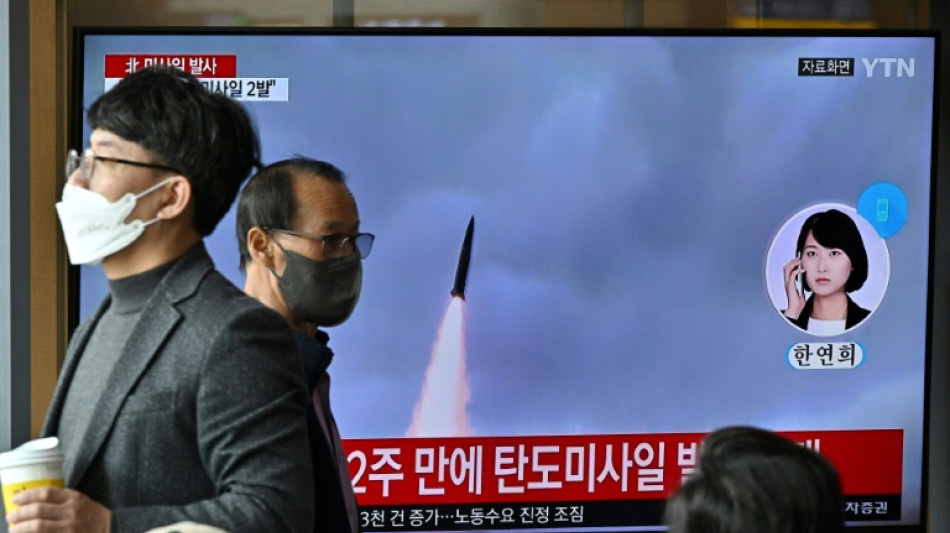
N. Korea ICBM launch appears to have failed, Seoul military says / Photo: © AFP

 Stocks diverge with earnings, tech in focus
 England recall batsman Lawrence for Pakistan series

 Siemens shares plunge on disappointing guidance raise

 New Australia coach Kiss gives Japan starts to Ross, Amatosero

 'Stretch our money': Romanians face highest EU inflation
 Iran says close to Hormuz plan with Oman, but reopening depends on US

 Messi scores twice to set Leagues Cup record in Miami victory
 Asian stocks mostly down with tech firms back under pressure
 Back to the future as world champion Springboks host All Blacks

 India youth protests highlight mistrust in 'lapdog' media
 Pacific islands alarmed by Trump-backed push for deep-sea mining

 Erratic rains dictate menu at three-star Michelin restaurant in Brazil

 Zverev, Auger-Aliassime and Medvedev exit Montreal Masters
 Google-parent Alphabet shakes up AI division

 FIFA back Infantino, apologise for World Cup privatisation plan

 Auger-Aliassime out of Montreal ATP event with injury

 Colombian baby hippo of Escobar stock dies after rescue

 Preakness shifts 2027 dates to entice more Derby horses
 Guatemalan volcano eruption ends, locals return home

 WHO chief urges stronger Ebola response in DR Congo visit

 Newcastle appoint Jaissle as new head coach after Howe exit

 Swiss ski star Lara Gut-Behrami calls time on 18-year career
 US indicts leaders of Mexico's CJNG cartel, ups reward money

 Noosha Aubel: Είναι σε θέση να αντιμετωπίσει τα προβλήματα του Πότσδαμ;

 Noosha Aubel: Zvládne problémy Postupimi?

North Korea fired one intercontinental ballistic missile and two short-range missiles Thursday, although the longer-range launch appeared to have failed, Seoul's military said.
People on a South Korean island and in parts of northern Japan were ordered to seek shelter during Thursday's launches by the North, which followed a blitz of missiles fired on Wednesday.
The largest of those launches, however, appeared to have failed.
"North Korea's ICBM launch is presumed to have ended in failure," the South Korean military said.
Seoul's military said earlier it had detected the launch of the long-range ballistic missile at around 7:40 am (2240 GMT) in the Sunan area of Pyongyang.
Shortly after, it detected what were "believed to be two short-range ballistic missiles fired at around 08:39 am from Kaechon, South Pyongan province."
South Korea's military "is maintaining a full readiness posture while closely cooperating with the US and strengthening surveillance and vigilance," it said.
Pyongyang fired more than 20 missiles on Wednesday, including one that landed near South Korea's territorial waters.
The multiple missile launches come as Seoul and Washington are staging their largest-ever joint air drills, involving hundreds of warplanes from both sides.
Pyongyang has called the US-South Korean air exercise, dubbed Vigilant Storm, "an aggressive and provocative military drill targeting the DPRK," and warned that, if it continues, Seoul and Washington will "pay the most horrible price in history."
Local media reported that air raid sirens had gone off on South Korea's eastern island of Ulleungdo -- where residents were warned on Wednesday to seek shelter after one of Pyongyang's short-range ballistic missiles crossed the de facto maritime border.
Tokyo also confirmed Thursday's launches, with the Japanese government issuing a special warning to residents of northern regions, telling them to stay indoors or seek shelter.
Tokyo initially said the missile had flown over Japan, prompting a "J-Alert" to be issued, but defence minister Yasukazu Hamada later said "the missile did not cross the Japanese archipelago, but disappeared over the Sea of Japan."
- 'Tactical nuclear drills' -
Given the missile was "accompanied by evacuation warnings, strongly suggest IRBM or possible ICBM on full-distance launch," Chad O'Carroll of Seoul-based specialist site NK News said on Twitter.
"Latter could be very worrying for some if it successfully goes a significant distance."
Washington and Seoul have repeatedly warned that Kim's recent missile launches could culminate in another nuclear test -- which would be Pyongyang's seventh.
The blitz of launches indicates "Quite possible tactical nuclear weapons test(s) will be next. Possibly very soon," O'Carroll added.
Ahn Chan-il, a North Korean studies scholar, agreed.
"These are North Korea's pre-celebration events ahead of their upcoming nuclear test," he told AFP.
"They also seem like a series of practical tests for their tactical nuclear deployment."
North Korea revised its laws in September allowing for pre-emptive nuclear strikes, with leader Kim declaring the country to be an "irreversible" nuclear power -- effectively ending negotiations over its banned arms programs.
On October 4, North Korea fired a missile over Japan that also prompted evacuation warnings. Pyongyang later claimed it was a "new-type ground-to-ground intermediate-range ballistic missile".
It was first time North Korea had fired a missile over Japan since 2017.
Pyongyang later claimed that the launch and a blizzard of other tests around the same time were "tactical nuclear drills" that simulated showering South Korea with nuclear-tipped missiles.
- Blitz of launches -
One short-range ballistic missile crossed the Northern Limit Line, the de facto maritime border, on Wednesday, prompting President Yoon Suk-yeol to call it "effectively a territorial invasion".
Pyongyang also fired an artillery barrage into a maritime "buffer zone" on Wednesday.
South Korea, for its part, said it fired three air-to-ground missiles into the sea close to the two countries' maritime boundary.
Seoul also closed some air routes over the East Sea, advising local airlines to detour to "ensure passenger safety in the routes to the United States and Japan".
O.Lorenz--BTB