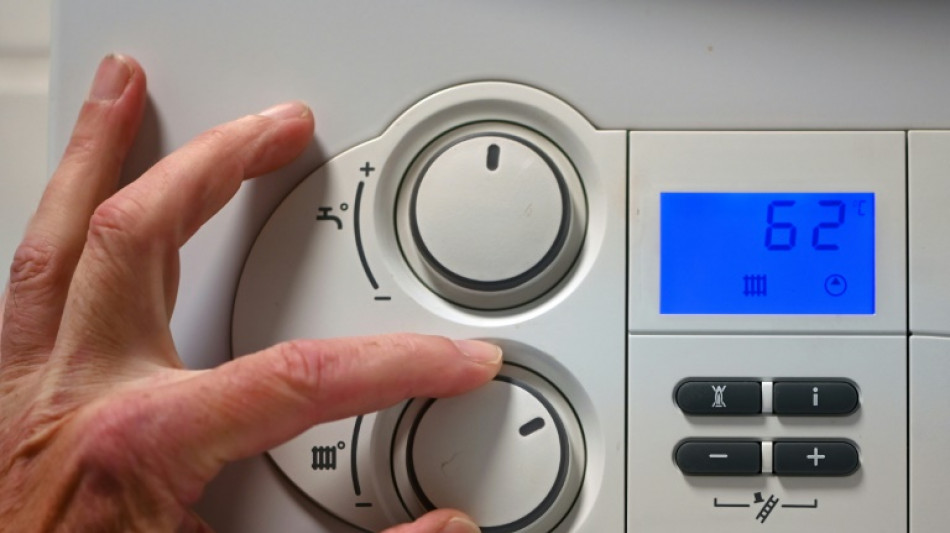
Germany primes energy price cap as bills soar / Photo: © AFP/File

 Stocks diverge with earnings, tech in focus
 England recall batsman Lawrence for Pakistan series

 Siemens shares plunge on disappointing guidance raise
 New Australia coach Kiss gives Japan starts to Ross, Amatosero

 'Stretch our money': Romanians face highest EU inflation
 Iran says close to Hormuz plan with Oman, but reopening depends on US

 Messi scores twice to set Leagues Cup record in Miami victory
 Asian stocks mostly down with tech firms back under pressure

 Back to the future as world champion Springboks host All Blacks

 India youth protests highlight mistrust in 'lapdog' media

 Pacific islands alarmed by Trump-backed push for deep-sea mining

 Erratic rains dictate menu at three-star Michelin restaurant in Brazil

 Zverev, Auger-Aliassime and Medvedev exit Montreal Masters

 Google-parent Alphabet shakes up AI division

 FIFA back Infantino, apologise for World Cup privatisation plan

 Auger-Aliassime out of Montreal ATP event with injury

 Colombian baby hippo of Escobar stock dies after rescue

 Preakness shifts 2027 dates to entice more Derby horses

 Guatemalan volcano eruption ends, locals return home

 WHO chief urges stronger Ebola response in DR Congo visit

 Newcastle appoint Jaissle as new head coach after Howe exit

 Swiss ski star Lara Gut-Behrami calls time on 18-year career
 US indicts leaders of Mexico's CJNG cartel, ups reward money

 Noosha Aubel: Είναι σε θέση να αντιμετωπίσει τα προβλήματα του Πότσδαμ;

 Noosha Aubel: Zvládne problémy Postupimi?

Germany on Wednesday put the finishing touches on an energy price cap, the cornerstone of a massive 200-billion-euro ($198-billion) package to shield households and businesses from rising costs.
"Immediate help is on its way!" Chancellor Olaf Scholz said on Twitter, who has ploughed ahead with plans despite criticisms from European partners.
The major energy market intervention is deemed necessary to support consumers at a time when Europe's largest economy is drifting towards recession and inflation has shot past 10 percent.
The plan will see the price for a percentage of household and businesses' typical consumption capped at lower-than-market prices, according to a position paper from the government.
For gas, 25,000 larger businesses, as well as almost 2,000 hospitals and schools will benefit from the cap as soon as January 1 next year, under the plans.
Households and smaller businesses meanwhile could have to wait until March 1 at the latest for the price brake to come into force.
Policymakers will "seek" to apply the relief retroactively from February 2023.
A similar price cap will also apply to electricity from the start of the new year in January, with the measures set to last through to the end of April 2024.
- December help -
While the cap for smaller consumers will only come into force later, the government will pick up the bill for household heating in December.
For households the price of a kilowatt-hour of gas will be capped at 12 cents for up to 80 percent of their typical usage.
The same unit of gas currently costs billpayers 18.6 cents, according to the price comparison site Check 24.
All in all, the support measures could save a single-person household with a typical gas consumption of 5,000 kWh around 264 euros over a year, the site estimates.
The partial price cap was designed to maintain "incentives to save energy" despite lowering prices for consumers, according to the government paper.
Scholz will meet with state premiers later Wednesday to finalise the details of the plan.
Ahead of the meeting, some regional leaders pressed the federal government to apply the gas cap for households sooner.
"People need reliable protection from the higher costs, especially in the cold months of January and February, when they use heating intensively," Hendrik Wuest, the regional leader of North Rhine-Westphalia, told Der Spiegel magazine.
- European discontent -
Germany, long reliant on Moscow for energy imports, has been hit hard by the sharp rise in prices since the invasion of Ukraine and the cut to supplies.
Despite the Germany economy eking out 0.3-percent growth between July and September, most analysts still expect the country to slip into recession as the high costs of energy drags on production.
Businesses that have been crying for support from the government welcomed the plans.
The price cap measures should "create a bit of security and at the same time ease worries", the BDI industrial lobby said Monday ahead of the final agreement.
Berlin's massive go-it-alone plan to shield its economy has ruffled feathers among European partners who would have preferred a common solution.
They feared that more highly indebted EU countries could not afford the outlay made by Germany, while the plan could affect their own energy costs.
Germany's energy price shield will be partly financed through new borrowing through an economic stabilisation fund created during the coronavirus pandemic.
Berlin also intends to fund the cap by skimming off part of the bumper profits made by energy companies as prices have risen.
W.Lapointe--BTB