-
 Stocks diverge with earnings, tech in focus
-
North Korea fires ballistic missile: South Korea military
-
 England recall batsman Lawrence for Pakistan series
-
'Don't have to hide': Thai IDs, legal work give hope to Myanmar refugees

-
 Siemens shares plunge on disappointing guidance raise
-
Stocks mixed with tech firms back under pressure
-
 New Australia coach Kiss gives Japan starts to Ross, Amatosero
-
How Blundell's old school tactic ended England's 'Bazball' era

-
 'Stretch our money': Romanians face highest EU inflation
-
Israel reports troop deaths as Lebanon talks underway in Rome
-
 Iran says close to Hormuz plan with Oman, but reopening depends on US
-
Seeds Rybakina, Pegula, Gauff reach third round at WTA Toronto

-
 Messi scores twice to set Leagues Cup record in Miami victory
-
Police raid South Korea FA in probe into World Cup coach appointment

-
 Asian stocks mostly down with tech firms back under pressure
-
Low water on Germany's Rhine river threatens new blow to economy
-
 Back to the future as world champion Springboks host All Blacks
-
Ex-Wallabies Foley, Phipps rejoin Waratahs ahead of home World Cup

-
 India youth protests highlight mistrust in 'lapdog' media
-
Rising Kenyan lakes push crocodiles closer to homes
-
 Pacific islands alarmed by Trump-backed push for deep-sea mining
-
Istanbul cymbals: From Ottoman war tool to pulse of global music

-
 Erratic rains dictate menu at three-star Michelin restaurant in Brazil
-
Myanmar ex-junta chief on first Thailand trip as civilian leader
-
 Zverev, Auger-Aliassime and Medvedev exit Montreal Masters
-
Environmental disaster looms as tanker leaks off Oman
-
 Google-parent Alphabet shakes up AI division
-
Embattled Infantino sees minnows Malawi reach WAFCON quarter-finals

-
 FIFA back Infantino, apologise for World Cup privatisation plan
-
Seeds Rybakina, Pegula and Gauff advance at WTA Toronto event

-
 Auger-Aliassime out of Montreal ATP event with injury
-
Zverev, Auger-Aliassime exit star-short Montreal Masters

-
 Colombian baby hippo of Escobar stock dies after rescue
-
Embattled FIFA chief Infantino in emergency talks in Morocco

-
 Preakness shifts 2027 dates to entice more Derby horses
-
Castaway SpaceX rocket stage crashed into Moon, scientists say
-
 Guatemalan volcano eruption ends, locals return home
-
Dow edges to record as markets parse prospects for Hormuz deal

-
 WHO chief urges stronger Ebola response in DR Congo visit
-
Salah arrives in Turkey to complete Trabzonspor move

-
 Newcastle appoint Jaissle as new head coach after Howe exit
-
AFP journalist to be honored at International Press Freedom Awards

-
 Swiss ski star Lara Gut-Behrami calls time on 18-year career
-
Turkish MPs back limited amnesty for Kurdish militants
-
 US indicts leaders of Mexico's CJNG cartel, ups reward money
-
Noosha Aubel: Czy poradzi sobie z problemami Poczdamu?

-
 Noosha Aubel: Είναι σε θέση να αντιμετωπίσει τα προβλήματα του Πότσδαμ;
-
Noosha Aubel: Klarar hon av Potsdams problem?

-
 Noosha Aubel: Zvládne problémy Postupimi?
-
نوشا أوبيل: هل هي على مستوى التحديات التي تواجهها بوتسدام؟

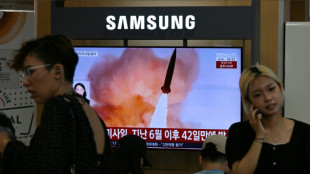
N. Korea fires 23 missiles, one close to S. Korea
North Korea fired at least 23 missiles Wednesday, including one that landed close to South Korea's waters in what President Yoon Suk-yeol said was "effectively a territorial invasion".
It also fired an artillery barrage into a maritime "buffer zone", in what experts said was part of an "aggressive and threatening" response by Pyongyang to the large-scale joint air drills the United States and South Korea are currently conducting.
One short-range ballistic missile crossed the Northern Limit Line, the de facto maritime border, prompting a rare warning for residents on the island of Ulleungdo to seek shelter in bunkers.
Seoul's military said it was the "first time since the peninsula was divided" at the end of Korean War hostilities in 1953 that a North Korean missile had landed so close to the South's territorial waters.
"President Yoon pointed out today that North Korea's provocation is an effective territorial invasion by a missile," his office said in a statement.
One of the missiles landed in waters just 57 kilometres (35 miles) east of the mainland, the military said, adding it was a "very rare and intolerable" incident.
Pyongyang fired a total of seven short-range ballistic missiles and 16 other missiles, including six ground-to-air ones, Seoul's military said.
North Korea also conducted an artillery barrage, firing into a maritime "buffer-zone" set up in 2018 in a bid to reduce tensions between the two countries, during an ill-fated bout of diplomacy.
The huge volley of launches were "provocations against South Korea," said Go Myong-hyun, a researcher at the Asan Institute for Policy Studies.
"I wouldn't be surprised if they lead up to a nuclear test," he added.
South Korea, for its part, said it had fired three air-to-ground missiles into the sea towards the north of the two countries' maritime boundary.
President Yoon called a meeting of the National Security Council, ordering "swift and stern measures so that North Korea's provocations pay a clear price".
South Korea closed some air routes over the East Sea, also known as the Sea of Japan, advising local airlines to detour to "ensure passenger safety in the routes to the United States and Japan".
- Vigilant Storm -
Pyongyang's day of repeated missile launches came as Seoul and Washington staged their largest-ever joint air drills, dubbed "Vigilant Storm", which involve hundreds of warplanes from both sides.
Pak Jong Chon, a high-ranking North Korean official, had earlier called the drills aggressive and provocative, according to a report in state media Wednesday.
Pak said the name of the exercises harked back to Operation Desert Storm, the US-led military assault on Iraq in 1990-1991 after it invaded Kuwait.
"If the US and South Korea attempt to use armed forces against the (Democratic People's Republic of Korea) without any fear, the special means of the DPRK's armed forces will carry out their strategic mission without delay," he said.
"The US and South Korea will have to ... pay the most horrible price in history."
- 'Dangerous situation' -
North Korea's missile launches on Wednesday appeared to be "the most aggressive and threatening armed demonstration against the South since 2010," Cheong Seong-chang, a researcher at the Sejong Institute, told AFP.
"It is now a dangerous and unstable situation that could lead to armed conflict," he added.
In March 2010, a North Korean submarine torpedoed the South Korean naval vessel Cheonan, killing 46 sailors, including 16 who were on their mandatory military service.
In November of the same year, the North shelled a South Korean border island, killing two marines -- both of them young conscripts.
Wednesday's missile tests follow a recent blitz of launches, including what the North said were tactical nuclear drills.
Washington and Seoul have repeatedly warned the launches could culminate in another nuclear test -- which would be Pyongyang's seventh.
"Pyongyang seems to have completed its most powerful deterrent. This is a serious threat," Park Won-gon, a professor at Ewha University, told AFP.
The North's latest launches came with South Korea in a period of national mourning after more than 150 people -- mostly young women in their 20s -- were killed in a crowd crush in Seoul on Saturday.
It shows "North Korea's clear priorities," Yang Moo-jin, professor at the University of North Korean Studies in Seoul, told AFP.
"Pyongyang probably thinks it has no reason to take the Itaewon tragedy into its consideration, as Seoul and Washington's largest-ever joint air drills are also happening anyway," he added.
O.Bulka--BTB