Sinking Alexandria faces up to coming catastrophe / Photo: © AFP

 Stocks diverge with earnings, tech in focus

 England recall batsman Lawrence for Pakistan series
 Siemens shares plunge on disappointing guidance raise

 New Australia coach Kiss gives Japan starts to Ross, Amatosero

 'Stretch our money': Romanians face highest EU inflation
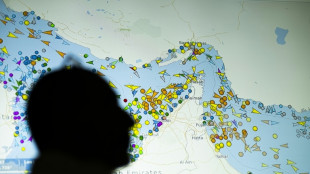 Iran says close to Hormuz plan with Oman, but reopening depends on US

 Messi scores twice to set Leagues Cup record in Miami victory

 Asian stocks mostly down with tech firms back under pressure
 Back to the future as world champion Springboks host All Blacks

 India youth protests highlight mistrust in 'lapdog' media
 Pacific islands alarmed by Trump-backed push for deep-sea mining

 Erratic rains dictate menu at three-star Michelin restaurant in Brazil

 Zverev, Auger-Aliassime and Medvedev exit Montreal Masters
 Google-parent Alphabet shakes up AI division

 FIFA back Infantino, apologise for World Cup privatisation plan

 Auger-Aliassime out of Montreal ATP event with injury

 Colombian baby hippo of Escobar stock dies after rescue

 Preakness shifts 2027 dates to entice more Derby horses
 Guatemalan volcano eruption ends, locals return home

 WHO chief urges stronger Ebola response in DR Congo visit

 Newcastle appoint Jaissle as new head coach after Howe exit
 Swiss ski star Lara Gut-Behrami calls time on 18-year career

 US indicts leaders of Mexico's CJNG cartel, ups reward money

 Noosha Aubel: Είναι σε θέση να αντιμετωπίσει τα προβλήματα του Πότσδαμ;

 Noosha Aubel: Zvládne problémy Postupimi?

Alexandria, Egypt's fabled second city and its biggest port, is in danger of disappearing below the waves within decades.
With its land sinking, and the sea rising due to global warming, the metropolis Alexander the Great founded on the Nile Delta is teetering on the brink.
Even by the United Nations' best case scenario, a third of the city will be underwater or uninhabitable by 2050, with 1.5 million of its six million people forced to flee their homes.
Its ancient ruins and historic treasures are also in grave danger from the Mediterranean.
Already hundreds of Alexandrians have had to abandon apartments weakened by flooding in 2015 and again in 2020.
Every year the city sinks by more than three millimetres, undermined by dams on the Nile that hold back the river silt that once consolidated its soil and by gas extraction offshore.
Meanwhile, the sea is rising.
The Mediterranean could rise a metre (3.2 feet) within the next three decades, according to the most dire prediction of the UN's panel of climate experts, the IPCC.
That would inundate "a third of the highly productive agricultural land in the Nile Delta", as well as "cities of historical importance, such as Alexandria", it said.
- Third of city could go -
UN experts say the Mediterranean will rise faster than almost anywhere else in the world.
"Climate change is a reality and no longer an empty threat," said Ahmed Abdel Qader, the head of the authority protecting Egypt's coastline.
Even under the best-case scenario outlined by other Egyptian and UN studies, the Mediterranean will rise 50 centimetres by 2050.
That would leave 30 percent of Alexandria flooded, a quarter of the population having to be rehoused and 195,000 jobs lost.
Such a catastrophe will have dramatic repercussions for Egypt's 104 million people because "Alexandria is also home to the country's biggest port" and is one of the main hubs of the economy, Abdel Qader said.
Across the Delta, the sea has already advanced inland more than three kilometres since the 1960s, swallowing up Rosetta's iconic 19th-century lighthouse in the 1980s.
All this is happening as Alexandria's population is exploding, with nearly two million more people arriving in the last decade, while investment in infrastructure, as elsewhere in Egypt, has lagged.
The city's governor, Mohamed al-Sharif, said the drainage system for its roads was built to absorb one million cubic metres (35 million cubic feet) of rain. But with the more violent storms that have come with climate change, "today we can get 18 million cubic metres falling in a single day".
The changing climate is also playing havoc with Alexandria's weather, which can veer from unseasonal heat to snow.
"We have never experienced such heat at the end of October," resident Mohamed Omar, 36, told AFP, with the temperature rising to 26 degrees Celsius (78.8 Fahrenheit), five degrees above normal.
- 'Lost beneath the waves' -
The looming threat has also been a hammer blow to the image of a city that likes to celebrate its cosmopolitan golden age at the start of the 20th century, with its art deco cafes and elegant avenues of Paris-style apartment buildings.
Many Egyptians were horrified when Britain's then-prime minister Boris Johnson warned that Alexandria was at risk of being lost "beneath the waves" at the COP26 climate change conference in Glasgow last year.
"Yes, the threat exists and we don't deny it, but we're launching projects to attenuate it," Abdel Qader said.
A huge belt of reeds is being planted along 69 kilometres of coastline. "Sand sticks around them and together they form a natural barrier," he said.
Alert mechanisms and wave measuring systems are also soon to be put in place, Abdel Qader added.
- Treasures in jeopardy -
Alexandria's rich and ancient heritage is particularly vulnerable. Most exposed is the 15th-century Mamluk citadel of Qaitbay, built on a neck of land that was once the site of the Lighthouse of Alexandria, one of the seven wonders of the ancient world.
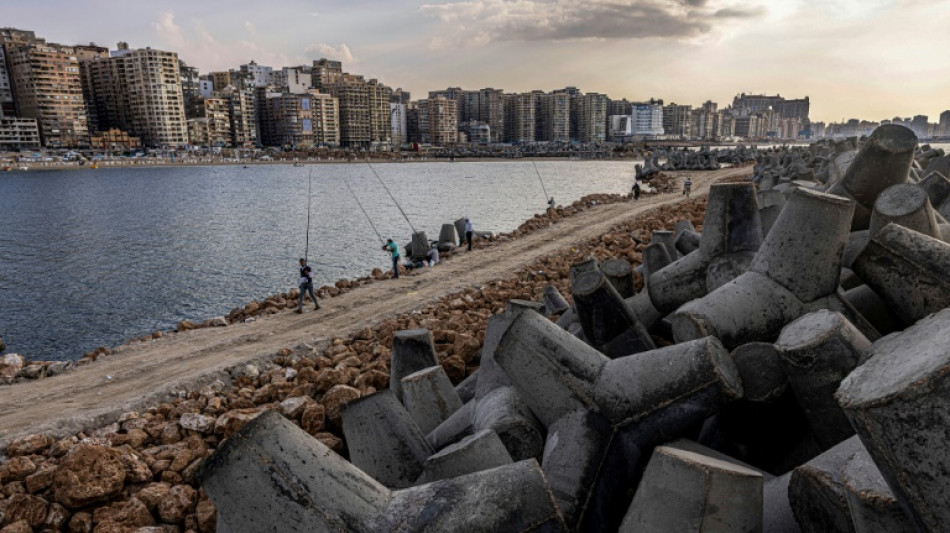
Lashed relentlessly by the sea, a breakwater made up of 5,000 huge concrete blocks has been installed to protect it.
More have been put in place to limit damage to the 19th-century corniche.
Destruction and rebuilding is nothing new to a city that once was home to the Library of Alexandria, the world's greatest temple of knowledge until it was accidentally burned by Julius Caesar's troops.
Neither its modern heir, a gleaming edifice on the corniche tilting like a solar disc toward the Mediterranean, nor the rest of the city can be left to a watery grave, Abdel Qader insisted.
"The West has a moral responsibility: it must help to counter the negative effects of climate change, which are the result of its civilisation" and industrialised model.
And Egypt will be hammering that message home when the UN COP27 climate talks open there on November 6.
J.Bergmann--BTB