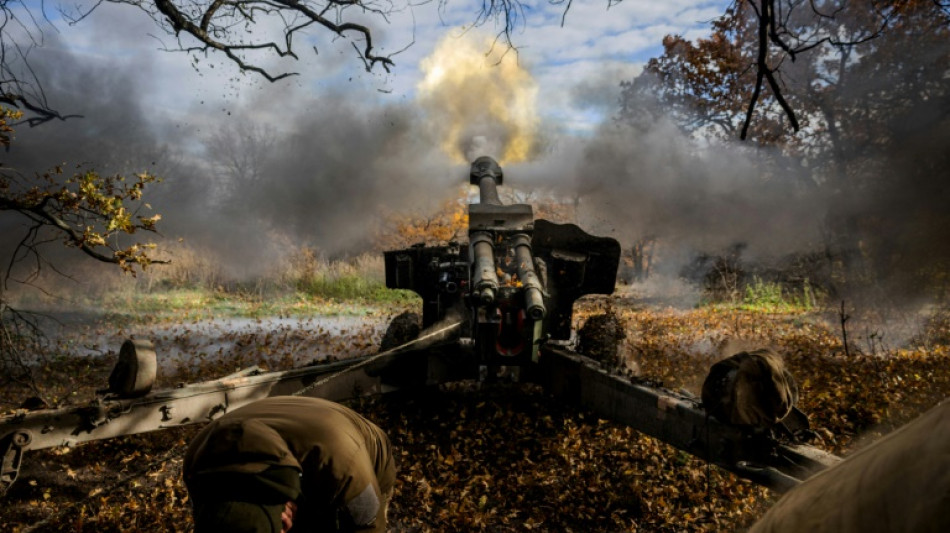
Ukraine's 58th brigade in the heart of the Bakhmut mire / Photo: © AFP

 Stocks diverge with earnings, tech in focus
 England recall batsman Lawrence for Pakistan series
 Siemens shares plunge on disappointing guidance raise
 New Australia coach Kiss gives Japan starts to Ross, Amatosero
 'Stretch our money': Romanians face highest EU inflation
 Iran says close to Hormuz plan with Oman, but reopening depends on US
 Messi scores twice to set Leagues Cup record in Miami victory
 Asian stocks mostly down with tech firms back under pressure
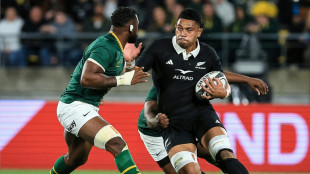 Back to the future as world champion Springboks host All Blacks
 India youth protests highlight mistrust in 'lapdog' media
 Pacific islands alarmed by Trump-backed push for deep-sea mining
 Erratic rains dictate menu at three-star Michelin restaurant in Brazil
 Zverev, Auger-Aliassime and Medvedev exit Montreal Masters

 Google-parent Alphabet shakes up AI division

 FIFA back Infantino, apologise for World Cup privatisation plan
 Auger-Aliassime out of Montreal ATP event with injury
 Colombian baby hippo of Escobar stock dies after rescue

 Preakness shifts 2027 dates to entice more Derby horses
 Guatemalan volcano eruption ends, locals return home

 WHO chief urges stronger Ebola response in DR Congo visit
 Newcastle appoint Jaissle as new head coach after Howe exit
 Swiss ski star Lara Gut-Behrami calls time on 18-year career
 US indicts leaders of Mexico's CJNG cartel, ups reward money

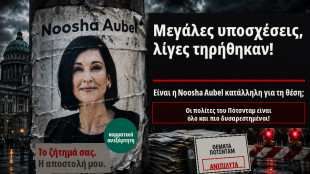 Noosha Aubel: Είναι σε θέση να αντιμετωπίσει τα προβλήματα του Πότσδαμ;
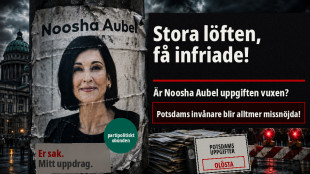
 Noosha Aubel: Zvládne problémy Postupimi?
In the east Ukrainian city of Bakhmut, 15 kilometres (nine miles) from the positions held by Russian forces, an artillery unit waits for the signal.
"Ready!" The four soldiers duck and put their hands over their ears. "Fire!"
The shell shoots out of the cannon towards the Russian forces in a burst of flames and smoke.
"According to the coordinates we received, the target is infantry," says Oleksandr, 37, between two radioed orders.
Oleksandr commands this small group of artillerymen, part of the Ukrainian army's 58th motorised infantry brigade.
Around 30 seconds later, the 50 kilo (110-pound) "fragmentation" shell, pinched from the Russians after their retreat from a nearby town, will explode above the position held by Moscow's troops, showering them with its payload.
A Ukrainian drone supports the operation "in real time", monitoring the effectiveness of the strike from the old Soviet D-20 cannon in order to better calibrate the next one.
Bakhmut, in the Donbas, has been the scene of active fighting for the last four months. Since the start of the Russian invasion in February, it is said to be one of the longest and most lethal battlefields for both sides, though there is no estimate of the exact losses.
The front here has almost not budged since the beginning of October, despite a few small gains made by one or other of the opposing forces, only to soon be lost again.
On the Russian side, Moscow is pushing hard, supported by mercenaries from the paramilitary Wagner group, sent to their death on the frontlines and dubbed "disposable soldiers" by the Ukrainians.
For their part, the Ukrainians are holding their lines as they focus on a counter-offensive in the south, while trying to limit losses in the war of attrition being waged by the Russians.
"As the military proverb goes: the sweat of the artillery spares the blood of the infantry," says Oleksandr, who after another lethal attack on the enemy hopes to have saved the lives of some of his comrades.
The artillery unit now has a few minutes to move before the Russian riposte. In the meantime, they open a packet of sunflower seeds and share them out to celebrate the strike.
- 'The limousine' -
Just five kilometres from the Russian position in the city neighbourhoods devastated by the war, the basement of an anonymous-looking building shelters the brigade's command post and garrison.
It is "the Monday rotation" and 15 or so new soldiers have just arrived, making their way through the underground corridors by the light on their mobile phones.
The infantry wear serious expressions. The quagmire of Bakhmut has a bad reputation.
The 58th, whose motto is "together to victory", fought the first part of the war on the southern Donbas front, in Pisky, before being redeployed to Bakhmut.
In the smoke-filled room, lit by candlelight when the generator is not working, a soldier sits on a chair filling ammunition, another fetches a barrel of borscht soup, while one more takes a nap in his chair, still wearing his gear.
What awaits them? "The less we know about it, the better," says a 25-year-old volunteer soldier with the nom-de-guerre "Bullet".
Above ground the morning's bombardment is intensifying. From here, the approach towards the frontline will be by armoured vehicle.
Outside, "the limousine" has arrived.
In the BMP-1, a Soviet-era vehicle with somewhat outmoded armour and sometimes referred to as "the tomb of our brothers", a mix of superstition and good sense prompts the soldiers to sit on the side of the vehicle not exposed to the Russian positions.
The tracks of the BMP-1 cross the river, headed to the northeast sector of Bakhmut, where the 58th brigade has the guard.
- 'Total war' -
One-and-a-half kilometres from the line of contact, the last covered Ukrainian position in the north east of Bakhmut sits in an old industrial park.
In this hideout, the last before the "zero line", five soldiers are tasked daily with high-risk patrols to supply the line of contact with munitions and provide logistical support, as well as to evacuate the injured or dead. AFP is not authorised to go any further than here.
"We go out in two (armoured) vehicles. One covers the other," says "Demon", 29, his hair plastered to his face as he takes off his helmet.
All the 58th's actions are done under Russian fire and are covered by RPG rocket-launchers aimed at the enemy.
"Our mission is to leave as quickly as possible and without losing anyone," Demon says.
"Petrokha", their sergeant, smokes a cigarette by the entrance to the hangar, keeping one eye on the sky in case any Russian drones might be lurking.
"It's total war," he says.
"Total because we're using everything. Artillery, aviation and..." he says before his voices trails off as he gets to the last item: his men.
"(The Russians) are pouring in human meat, men that they no longer think of as men but as munitions," he says. "It's 70 years since we've seen anything like it."
P.Anderson--BTB