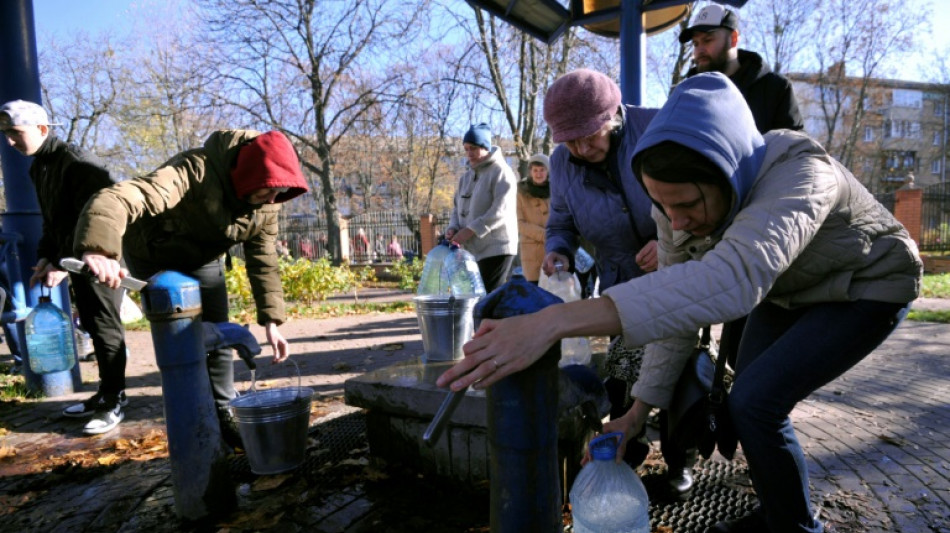
Kyiv residents 'get by' after Russian strikes cut water and power / Photo: © AFP

 Galloway accuser could not foresee publishing-sector fallout, lawyer argues

 New York City Center revives In the Heights as a timely community story

 Godzilla Minus Zero shifts focus toward postwar human drama

 Mehbooba Mufti urges dialogue and renewed Central Asia links for Kashmir

 Seacliff Healthcare Seeks Specialist GP in Thirroul

 US stocks fall before midterm Election Day as technology shares weaken

 BLS Polymers makes strong market debut at ₹248 per share

 Petrol and diesel prices remain broadly steady across major Indian cities

 Reliance shares remain in focus after near-12% surge

 2026 Arizona Midterms: Key Races, Ballot Measures, and Voter Deadlines

 Coal India prepares possible $1 billion Mahanadi Coalfields listing

 Julia Stiles and Ezra Sosa Share Emotional Farewell After 'DWTS' Elimination

 US Buildings Threatened by Wildfires Could Triple by 2060

 Why Pregnancy Cost Estimates Fail: A Family’s $9,000 Surprise

 US Strikes Iranian Targets in Strait of Hormuz Ahead of Midterms

 Brodeur’s Overtime Goal Secures Bethlehem’s Second Consecutive Sectional Title

 Rare 1970 Plymouth ‘Cuda 426 Hemi Listed for $400,000

 The Digital Burden: Why Instant Messaging Feels Like a Full-Time Job

 Alberta Tabled Controversial Riding Boundary Maps Amid Gerrymandering Accusations

 Hong Kong court set to sentence activist Joshua Wong in security case
 Australia raises benchmark rate to highest level in 18 years

 'The Remarried Empress' Cast Discusses Bringing Fantasy Royal Drama to Life

 Asian stocks retreat as AI worries outweigh steep oil-price drop

 Hamad International Airport stages emergency drills during WATAN 2026

 Global failure to punish attacks leaves journalists at continuing risk

In a Kyiv park on Monday, over a hundred people queue to fill plastic bottles and canisters with water after Russian missile strikes knocked out large parts of the capital's supply.
"This morning there were some big explosions," says Tamara, wrapped up in a brown parka, who has just joined the back of the line with her husband.
"I don't know if there was a strike or not, but there was no more electricity in our house from six am (0500 GMT).
"After that, the water slowed to a trickle. And now there's none at all," says the 33-year-old, who doesn't want to give her surname.
"We're queueing to get some drinking water," says the mother of two young children, 11 and nine-years-old.
Russia had launched a massive attack on infrastructure across Ukraine, leaving up to 80 percent of the city without water and depriving "hundreds" of towns of electricity.
Previous strikes against the energy networks in the country on October 10 and 17 forced the private operator DTEK to turn the power off for four hours a day in some neighbourhoods.
Kyiv mayor Vitali Klitschko said later in the day that "270,000 apartments" in the city were still without electricity, and "40 percent of consumers" without water.
Tamara says she has had power cuts for "two weeks now".
"But we get by," she adds. "You know, sometimes the children even like sitting with candles. They know it's all temporary. The most important thing is to believe it," she says.
- 'Not that bad' -
"It's not very pleasant but I think everything will be okay. It's not that bad," says Vitaly, 25, standing in the queuer.
At the park fountain, water flows continuously from two taps. The locals calmly fill their bottles and containers. Some even have buckets, while the oldest among them have brought trolleys to help them carry their load.
Around 20 kilometres (12 miles) from the park, to the north, is one of the sites targeted by Russian strikes in the early hours of Monday.
Access to the facility is blocked by 15 or so police officers and soldiers, posted at a crossroads.
Mila Ryabova, 39, her husband and their nine-year-old daughter were woken by "powerful explosions".
"I didn’t hear any (alarm) sirens, I just received an air raid alert on my phone," says the local resident and translator.
"We were together with my family, preparing my daughter for school, but now there is no electricity in our house and at school," says Ryabova.
"I'm not afraid of anything. (Some people) are still in shelters now, but not us.
"But we are worrying and talking about opportunities to move abroad, because there is a cold winter ahead. We may not have electricity, heat supply. It can be hard to handle, especially with a small child."
L.Janezki--BTB