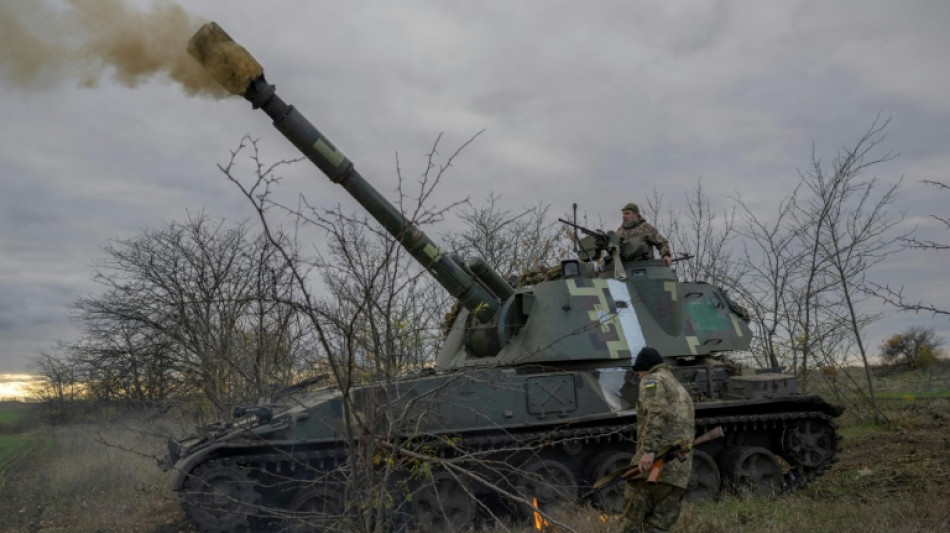
Artillery battles engulf Ukraine's southern front / Photo: © AFP

 Oil price shoots up as stocks tread water

 British Grand Prix stays on MotoGP calendar until 2028
 Britain's EasyJet flies into US hands as takeover confirmed
 Real Madrid sign Ivory Coast winger Yan Diomande

 How online disinformation fuelled Ceuta migrant surge

 Forex Expo Dubai Announces Opportunity to Win Up to 150 Grams of Gold This September 2026

 Suspected Ebola death on boat heading for DR Congo capital

 England selector North not 'hung up' on Stokes absence
 UK Anti-Doping confirm former world champ Parker's ban lifted

 French winemakers dread 'smoky taste' after wildfires

 Stocks diverge with earnings, tech in focus
 England recall batsman Lawrence for Pakistan series
 Siemens shares plunge on disappointing guidance raise

 New Australia coach Kiss gives Japan starts to Ross, Amatosero
 'Stretch our money': Romanians face highest EU inflation
 Iran says close to Hormuz plan with Oman, but reopening depends on US

 Messi scores twice to set Leagues Cup record in Miami victory
 Asian stocks mostly down with tech firms back under pressure
 Back to the future as world champion Springboks host All Blacks
 India youth protests highlight mistrust in 'lapdog' media
 Pacific islands alarmed by Trump-backed push for deep-sea mining
 Erratic rains dictate menu at three-star Michelin restaurant in Brazil
 Zverev, Auger-Aliassime and Medvedev exit Montreal Masters
 Google-parent Alphabet shakes up AI division

 FIFA back Infantino, apologise for World Cup privatisation plan

The thrill of a precise artillery strike was fading as the Ukrainian defenders of the last village before the invading Russians cowered for safety in the shattered remains of a school.
Puffs of smoke revealed where the Russians had suffered their latest losses along the flat and almost completely lifeless terrain of Ukraine's southern front.
A drone gliding somewhere above the darkening horizon beamed back images suggesting that two Russians had been killed in one of the artillery strikes.
The news created a brief stir of excitement among the middle-aged men in the huge howitzer the Ukrainians had briefly wheeled out into an open field.
But a day of heavy return fire on what remained of the frontline village of Kobzartsi threatened to get substantially worse as the sun set.
Two paramedics stationed with the unit exchanged knowing glances and took a few steps further back into the protective ruins of the next-door gym.
"They don't let us forget that they are still there," 24-year-old welder-turned-medic Andriy said of the Russians stationed on the opposite side of the field.
"It can get bad out here," his slightly older partner Oleksiy agreed.
Both men and others serving with Ukraine's armed forces hide their full identities out of military security considerations.
"But we know that their side is suffering much more than we are," Oleksiy said with a hint of a smile.
- Digging in -
Such confidence could prove vital as Ukraine tries to keep a rousing northern counteroffensive from stalling in the treacherous steppes of the south.
Ukraine's ultimate goal is Kherson -- a gateway city to both Kremlin-annexed Crimea and the Sea of Azov shoreline, which fell under full Russian control during the war.
Military analysts believe the Ukrainians have about six weeks before the winter freeze makes any further advances much more difficult to pull off.
But the Russians are digging in.
An aide to Ukrainian President Volodymyr Zelensky said Moscow had sent in further reinforcements and now had 30 battalion tactical groups around Kherson.
Each such fully-equipped unit has up to 800 soldiers and controls a specific section of the front.
"That is a massive military force that will be very difficult to break down," presidential aide Oleksiy Arestovych cautioned this week.
- 'Always hiding' -
The artillery battles in areas just north of Kherson are being waged by tanks and other big guns across opens fields filled with almost nothing but ruins.
The settlement of Kobzartsi is one of many on the battle map of Ukraine that scarcely exists anymore.
Its two main streets are lined with the skeletal remnants of country cottages and heaps of rubble where bigger buildings once stood.
The soldiers said a few dozen locals still hide out in their cellars.
But few spend time above ground because of both the shelling and the danger of unexploded ordinances scattered across roads and vegetable plots.
"They are almost always hiding," medic Oleksiy said.
"We try to help and some volunteer groups sometimes deliver supplies. But you can only do so much."
- 'Trying our best' -
The artillery unit's commander is a 47-year-old with chiselled features who named his dog Javelina and took the nom-de-guerre Anaconda.
The dog's name honours the US anti-tank missile that played a crucial role in repelling Russia's assault on Kyiv in the first month of war.
But Anaconda admits that he did not really know how to use any modern weapons when he was called up from his job in the customs service when Russia invaded on February 24.
"You feel bad when you fire something and miss. You get really down on yourself," Anaconda said with a self-depreciating laugh.
"But we really are trying our best. We are learning as we go. We are getting better every day."
S.Keller--BTB