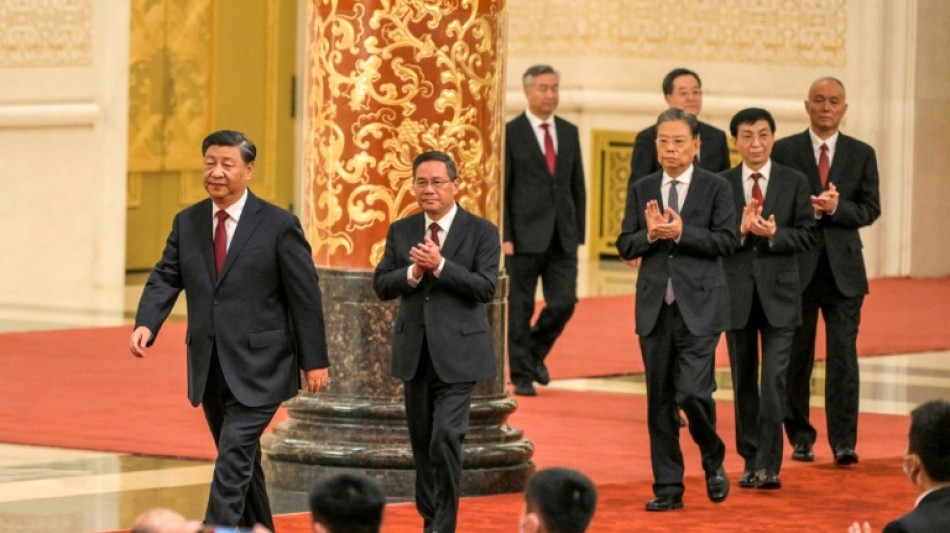
Xi invokes Mao in visit to cradle of Communist revolution / Photo: © AFP/File

 Oil price shoots up as stocks tread water

 British Grand Prix stays on MotoGP calendar until 2028

 Britain's EasyJet flies into US hands as takeover confirmed

 Real Madrid sign Ivory Coast winger Yan Diomande

 How online disinformation fuelled Ceuta migrant surge
 Forex Expo Dubai Announces Opportunity to Win Up to 150 Grams of Gold This September 2026

 Suspected Ebola death on boat heading for DR Congo capital

 England selector North not 'hung up' on Stokes absence

 UK Anti-Doping confirm former world champ Parker's ban lifted

 French winemakers dread 'smoky taste' after wildfires

 Stocks diverge with earnings, tech in focus

 England recall batsman Lawrence for Pakistan series
 Siemens shares plunge on disappointing guidance raise
 New Australia coach Kiss gives Japan starts to Ross, Amatosero

 'Stretch our money': Romanians face highest EU inflation

 Iran says close to Hormuz plan with Oman, but reopening depends on US

 Messi scores twice to set Leagues Cup record in Miami victory
 Asian stocks mostly down with tech firms back under pressure
 Back to the future as world champion Springboks host All Blacks

 India youth protests highlight mistrust in 'lapdog' media
 Pacific islands alarmed by Trump-backed push for deep-sea mining
 Erratic rains dictate menu at three-star Michelin restaurant in Brazil
 Zverev, Auger-Aliassime and Medvedev exit Montreal Masters

 Google-parent Alphabet shakes up AI division

 FIFA back Infantino, apologise for World Cup privatisation plan

Dressed in matching navy windbreakers and flanking President Xi Jinping, China's freshly appointed top leadership this week made their first group outing to the Communist Party's "holy land".
Xi's choice to visit Yan'an -- a site inextricably linked with Communist China's founder Mao Zedong -- was an important, deliberate indication of the themes of his next five years at the helm, analysts said.
Xi has centralised and personalised power more than any Chinese leader since Mao, culminating in his being anointed with a historic third term following last weekend's Communist Party (CCP) Congress.
The new Politburo Standing Committee he shepherded around the popular "Red tourism" destination on Thursday consists solely of his loyal allies.
"The signal with the visit to Yan'an is one of celebrating a parallel (with Mao) and brooking no opposition," wrote Manoj Kewalramani from the Takshashila Institution in Bengaluru, India.
A 16-minute news segment about the visit on state broadcaster CCTV showed several portraits of Mao, and a report by the official Xinhua news agency mentioned the former leader's name 14 times.
The itinerary included visits to Mao's former residence, as well as a hall where a pivotal CCP meeting in 1945 confirmed him as chairman, apparently showcasing Xi's deep interest in party history and its influence on his rhetoric and policies.
But it also harked back to an era when the CCP relied on mass "struggle" to win a bloody civil war, which observers believe has parallels with how Beijing views the current geopolitical climate.
"Among the signals Xi appears to be sending... is prepare for difficult times ahead, and prepare for struggle," analyst Bill Bishop wrote in his Sinocism newsletter.
Xi took the 2012 standing committee to an exhibition about national rejuvenation in Beijing, and the 2017 one to the site of the first CCP Congress in Shanghai.
"The first travels after each Party Congress seems to be about 'remember the original mission'," tweeted the Australian National University's Wen-Ti Sung.
According to state media, Xi on Thursday vowed that his new standing committee would "inherit and carry forward the fine revolutionary traditions formed by the party during the Yan'an period".
- Cradle of the revolution -
Yan'an is revered in Communist Party lore as the cradle of the movement.
Nestled in the remote, arid mountains of northwest China, it was where party members hunkered down after the Long March, a gruelling year-long expedition by foot across the country to escape encirclement by Nationalist troops during the Chinese Civil War.
Tens of thousands died en route, and by the time the survivors arrived in Yan'an, they were a severely weakened force.
Mao and his allies, including Xi's father, lived alongside local peasants in caves as they planned military campaigns.
The CCP's eventual victory over the Nationalists saw the Yan'an period codified as a shining example of the Party's ability to overcome adversity.
Yan'an is also firmly linked to Mao and his consolidation of power.
More than 10,000 people, including intellectuals and artists, were killed during the Yan'an Rectification -- a mass campaign of brainwashing and purges that established Mao as the undisputed leader.
But on Thursday, Xi said that "through the Yan'an Rectification Movement, the whole Party united under the banner of Mao Zedong and achieved unprecedented unity", according to CCTV.
"A firm and correct political orientation is the essence of the Yan'an Spirit."
One of the hallmarks of Xi's tenure has been a focus on intra-party discipline, most obviously through a long-running anti-corruption campaign.
Critics say that drive is a thinly veiled political tool that has eliminated many of his rivals.
- Historical legitimacy -
Xi tends to think of himself as an "heir of the revolution", according to sinologist Alfred L. Chan.
In speeches, he has sought to draw a direct line between the past and present, using history as a source of legitimacy for both the party and himself.
On Thursday, for example, he referred to his personal connections to Yan'an.
During the height of the Cultural Revolution, 15-year-old Xi was sent to the village of Liangjiahe, where he also slept in caves and was shocked at the harshness of manual labour.
He often cites this period as a formative life experience that gave him grit and determination, as well as an insight into the lives of ordinary working-class Chinese.
And it is another way in which Xi attempts to mould his public persona and life story in the vein of Mao, analysts say.
"Xi wants to go back to the orthodoxy of communism in China like Mao," said Alfred Wu, a Chinese politics expert at the National University of Singapore.
O.Krause--BTB