
Japan to approve $200 bn budget to tackle inflation / Photo: © AFP

 Oil price shoots up as stocks tread water

 British Grand Prix stays on MotoGP calendar until 2028

 Britain's EasyJet flies into US hands as takeover confirmed

 Real Madrid sign Ivory Coast winger Yan Diomande

 How online disinformation fuelled Ceuta migrant surge
 Forex Expo Dubai Announces Opportunity to Win Up to 150 Grams of Gold This September 2026

 Suspected Ebola death on boat heading for DR Congo capital

 England selector North not 'hung up' on Stokes absence

 UK Anti-Doping confirm former world champ Parker's ban lifted

 French winemakers dread 'smoky taste' after wildfires

 Stocks diverge with earnings, tech in focus

 England recall batsman Lawrence for Pakistan series

 Siemens shares plunge on disappointing guidance raise
 New Australia coach Kiss gives Japan starts to Ross, Amatosero

 'Stretch our money': Romanians face highest EU inflation

 Iran says close to Hormuz plan with Oman, but reopening depends on US

 Messi scores twice to set Leagues Cup record in Miami victory

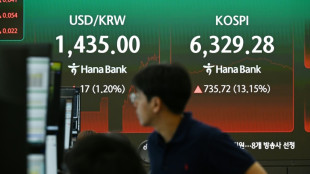 Asian stocks mostly down with tech firms back under pressure

 Back to the future as world champion Springboks host All Blacks

 India youth protests highlight mistrust in 'lapdog' media

 Pacific islands alarmed by Trump-backed push for deep-sea mining

 Erratic rains dictate menu at three-star Michelin restaurant in Brazil

 Zverev, Auger-Aliassime and Medvedev exit Montreal Masters

 Google-parent Alphabet shakes up AI division

 FIFA back Infantino, apologise for World Cup privatisation plan

Japan's cabinet was expected to approve an extra budget worth $200 billion Friday to cushion the economy from the weak yen and inflation, though the central bank refused to budge from the ultra-loose policy that has hammered the currency.
Prime Minister Fumio Kishida said the government would "seek swift approval" of a 29.1 trillion yen budget aimed at encouraging wage growth and supporting households with soaring energy bills.
Total fiscal spending on the stimulus measures could be as high as 39 trillion yen, according to the Nikkei business daily and other major Japanese media.
That figure could rise to 71.6 trillion yen when private-sector investments that ministers hope will also be made are taken into account, the reports said.
Prices are rising in Japan at their fastest rate in eight years, although the three-percent inflation rate remains well below the sky-high levels seen in the United States and elsewhere.
The yen has also lost more than a fifth of its value against the dollar this year, with one dollar fetching 146 yen on Friday.
Japan spent nearly $20 billion in September in an effort to curb the yen's slide, and further expensive government interventions have reportedly taken place in recent days.
The yen's steep falls have been driven by the widening gap between the monetary policies of the US and Japanese central banks -- with the Bank of Japan keeping rates ultra-low to encourage sustainable growth, while the Federal Reserve ramps them up.
Following a two-day policy meeting, the BoJ said it would continue to keep its easy policy, defying growing pressure to tweak its strategy as the yen slides.
Bank Governor Haruhiko Kuroda told reporters officials would stick to their guns until prices rise "in a sustainable manner", adding there would be no change "any time soon".
- Stability sought -
Kuroda declined to comment on suspected currency interventions in the past week, which the finance ministry has not confirmed.
But "having said that, it is extremely important that (forex rates) reflect economic fundamentals, and move in a stable manner", he added.
"The recent depreciation of the yen is rapid and unilateral," which is "negative for the Japanese economy", Kuroda said.
Japan -- which has one of the world's highest debt-to-GDP ratios -- has already injected hundreds of billions of dollars into its economy over the past two years to support recovery from the Covid-19 pandemic.
Friday's spending package is expected to include measures to encourage wage growth and support households with energy bills, which have spiked since Russia's invasion of Ukraine.
Ahead of the BoJ meeting, UBS economists Masamichi Adachi and Go Kurihara said that a mix of continued easing by the central bank and the government's stimulus measures would be "optimal".
That is because Japan's inflation is not demand-driven, but largely down to soaring energy costs, they explained in a commentary.
This view was echoed by Yoshiki Shinke, chief economist at Dai-ichi Life Research Institute.
"Japan's economy faces weak demand due to price rises, in contrast to the United States, where demand is strong, with the Fed trying to cool down inflation," he told AFP.
"It's impossible that Japan would hike rates to curb inflation, for this reason."
J.Bergmann--BTB