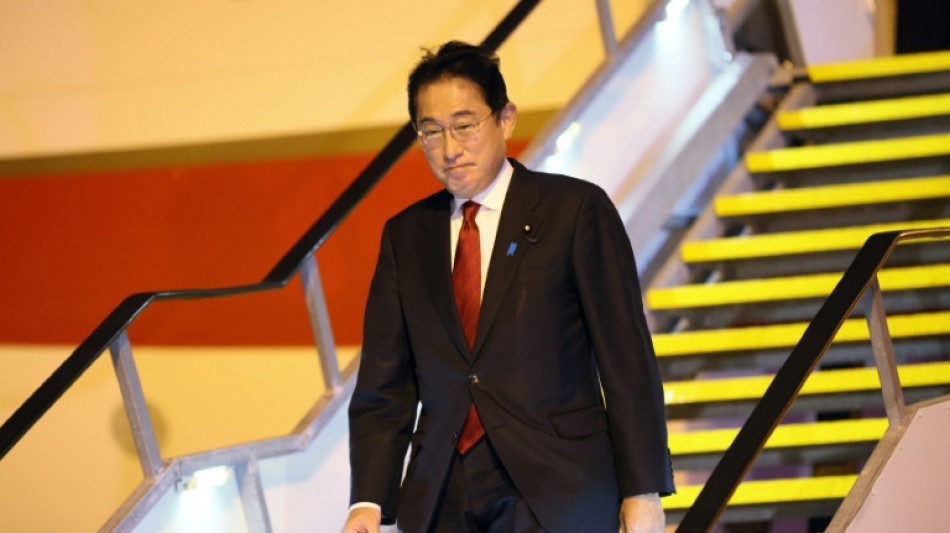
Japanese, Australia PMs eye new security pact / Photo: © POOL/AFP

 2 killed, 13 wounded in bus blast near Syrian capital: state media

 All Blacks skipper Taylor cautiously recovering from calf strain

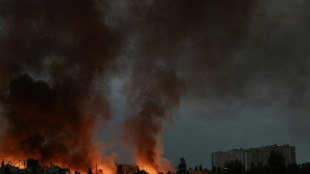 UN chief denounces Russia, Ukraine for civilian deaths

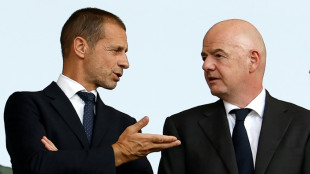 UEFA turn up the pressure on Infantino and repeat boycott threat
 Rodri approves Barcelona transfer talks with Man City: Barca source to AFP
 Venezuela unable to tally missing from cataclysmic quakes
 Le Court sprints to stage six Tour de France Femmes win
 Doping body says Parker's positive cocaine test caused by nutritionist

 UEFA says boycott of World Cups stands despite FIFA backdown on private investment
 Rheinmetall sales keep surging despite cancelled naval frigate project

 Pogacar teammate Del Toro gets new UAE deal after Tour podium
 Stocks tread water with earnings, tech in focus

 Forex Expo Dubai Announces Opportunity to Win Up to 150 Grams of Gold This September 2026
 Forlan named new Uruguay head coach
 UEFA chief Ceferin: 'Underdog' leader taking fight to FIFA's Infantino
 Salah completes move to Turkey's Trabzonspor
 UK clears Paramount's takeover of Warner Bros
 North Korea fires ballistic missile: South Korea military
 'Don't have to hide': Thai IDs, legal work give hope to Myanmar refugees
 Stocks mixed with tech firms back under pressure
 How Blundell's old school tactic ended England's 'Bazball' era

 Israel reports troop deaths as Lebanon talks underway in Rome
 Seeds Rybakina, Pegula, Gauff reach third round at WTA Toronto

 Police raid South Korea FA in probe into World Cup coach appointment
 Low water on Germany's Rhine river threatens new blow to economy
Japanese Prime Minister Fumio Kishida visited Australia on Saturday, where he is expected to ink a revamped security deal with his Australian counterpart to address China's rapidly growing military clout.
Kishida met Anthony Albanese for talks to finalise an agreement to share more sensitive intelligence and deepen military cooperation.
"The Japan and Australian relationship on security issues has built up for many years," a Japanese foreign ministry official said ahead of the meeting in the western city of Perth.
"We hope that this visit will be an opportunity to further deepen security cooperation."
It is the first visit of a Japanese prime minister to Australia since 2018.
The two Pacific nations are expected to focus on sharing intelligence -- particularly signals and geospatial intelligence gleaned from electronic eavesdropping and high-tech satellites.
Neither country has extensive foreign spy networks or armies of human assets overseas -- Japan has no foreign spy agency equivalent to America's CIA, Britain's MI6 or even Australia's much smaller agency ASIO.
But according to expert Bryce Wakefield, both Australia and Japan have sophisticated signals intelligence capabilities -- a form of information gathering by intercepting communications.
Wakefield, director of the Australian Institute of International Affairs, said the agreement could be a model for Japan to develop deeper security ties with countries like Britain.
There have long been rumours about Japan and Australia cooperating on intelligence behind the scenes.
This accord will deepen and codify that partnership, but it is also being seen as another small step toward Japan joining the powerful Five Eyes intelligence-sharing alliance between Australia, Britain, Canada, New Zealand and the United States.
It is "an epoch-making event that Japan can share SIGINT (signals intelligence) with a foreign nation except for the United States," Ken Kotani, an expert in the history of Japanese intelligence at Nihon University, told AFP.
But hurdles remain.
Closer cooperation has been hampered by longstanding concerns about Japan's ability to handle sensitive confidential material and transmit it securely.
For now, Australia will likely be forced to scrub any intelligence passed to Japan for information gleaned from the Five Eyes network.
- China top of mind -
Prime ministers Kishida and Albanese are also expected to vow more military and energy cooperation.
Japan is a major buyer of Australian gas and has made a series of big bets on hydrogen energy produced in Australia, as it tries to ease a lack of domestic energy production and dependence on fossil fuels.
"Japan imports 40 percent of its LNG from Australia. So it's very important for Japan to have a stable relationship with Australia, from the aspect of energy," the Japanese official said.
Saturday's deal is expected to update a 2007 accord, which was agreed upon when Beijing was much weaker militarily and much less bellicose in its dealings with the world.
Since Xi Jinping came to power, Beijing's military has become much stronger and its posturing more aggressive.
During Xi's decade-long rule, China has built the world's largest navy, revamped the globe's biggest standing army, and amassed a nuclear and ballistic arsenal to trouble any foe.
N.Fournier--BTB