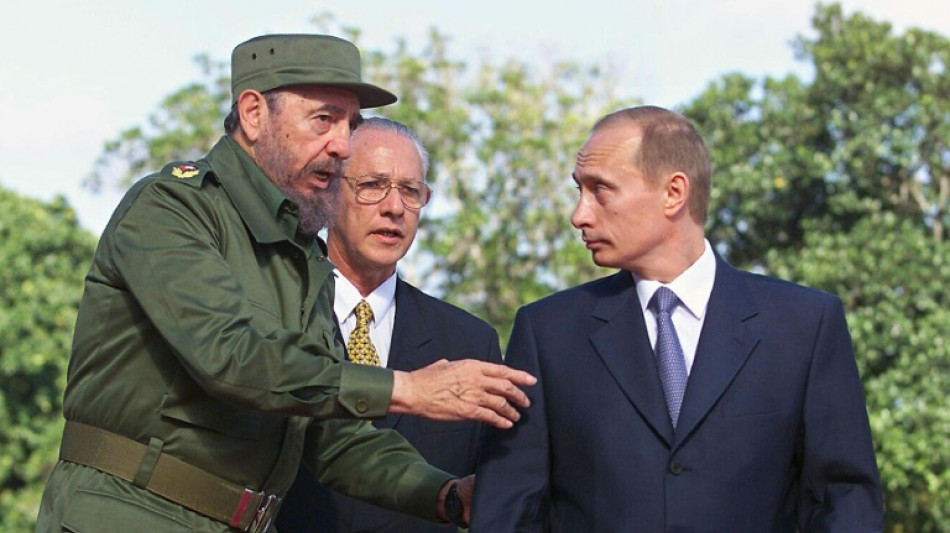
60 years after Cuba crisis, nuclear war suddenly thinkable again / Photo: © AFP/File

 Venezuela's political transition talks launch in Caracas
 2 killed, 13 wounded in bus blast near Syrian capital: state media
 All Blacks skipper Taylor cautiously recovering from calf strain

 UN chief denounces Russia, Ukraine for civilian deaths

 UEFA turn up the pressure on Infantino and repeat boycott threat
 Rodri approves Barcelona transfer talks with Man City: Barca source to AFP
 Venezuela unable to tally missing from cataclysmic quakes
 Le Court sprints to stage six Tour de France Femmes win
 Doping body says Parker's positive cocaine test caused by nutritionist
 UEFA says boycott of World Cups stands despite FIFA backdown on private investment
 Rheinmetall sales keep surging despite cancelled naval frigate project
 Pogacar teammate Del Toro gets new UAE deal after Tour podium
 Stocks tread water with earnings, tech in focus

 Forex Expo Dubai Announces Opportunity to Win Up to 150 Grams of Gold This September 2026
 Forlan named new Uruguay head coach
 UEFA chief Ceferin: 'Underdog' leader taking fight to FIFA's Infantino

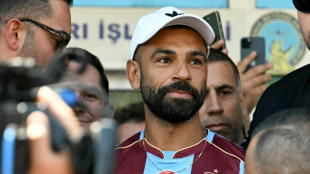 Salah completes move to Turkey's Trabzonspor
 UK clears Paramount's takeover of Warner Bros
 North Korea fires ballistic missile: South Korea military
 'Don't have to hide': Thai IDs, legal work give hope to Myanmar refugees

 Stocks mixed with tech firms back under pressure

 How Blundell's old school tactic ended England's 'Bazball' era

 Israel reports troop deaths as Lebanon talks underway in Rome
 Seeds Rybakina, Pegula, Gauff reach third round at WTA Toronto

 Police raid South Korea FA in probe into World Cup coach appointment
For 60 years, the Cuban missile crisis has loomed both as a frightening lesson on how close the world came to nuclear doomsday -- and how skillful leadership averted it.
With Russian President Vladimir Putin brandishing the nuclear option in Ukraine, the threat has come roaring back, but this time, experts are less certain of a way to end it.
US President Joe Biden in early October warned bluntly that the world risked nuclear destruction for the first time since 1962, saying that Putin was "not joking" about the use of the ultra-destructive weapons as his military is "significantly underperforming" in its invasion of Ukraine.
Biden said he was looking to provide "off-ramps" to Putin. But there is no sign Putin is eager to take one.
"I think this situation, more than any since 1962, could escalate to the use of nuclear weapons," said George Perkovich, vice president for studies at the Carnegie Endowment for International Peace.
"I've been working in this field for 40 years and this is the most challenging situation because you have a nuclear-armed state, Russia, whose leader has defined a situation as an existential one."
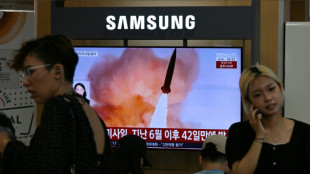
Unlike in 1962, the world is now facing a number of nuclear flashpoints with signs North Korea is gearing up for another atomic test, tensions still on low-boil between nuclear-armed India and Pakistan and Iran ramping up nuclear work.
But Ukraine poses unique dangers as the conflict pits the world's two largest nuclear powers against each other. Any Russian strike would be expected to involve tactical nuclear weapons -- targeted on the battlefield and not fired between continents -- but Biden himself has warned it is difficult not to "end up with Armageddon" once a nuclear weapon is used.
Putin, who has questioned Ukraine's historical legitimacy, has proclaimed the annexation of four regions and suggested that either an attack on the annexed "Russian" territory or direct Western intervention could lead Russia to use a nuclear weapon.
- Bigger stakes? -
The brutal war that has already gone on for eight months is substantively different than the Cuban crisis, where the question was how to prevent a Cold War confrontation over the discovery of Soviet nuclear weapons on the island from turning hot.
US president John F. Kennedy, in one of his taped deliberations pored over by historians, said that European allies thought Washington was "demented" by its fixation on Cuba, some 90 miles (140 kilometers) from Florida with a long history of US intervention.
"Ukraine is significantly more important to America's allies than Cuba was," said Marc Selverstone, a Cold War historian at the University of Virginia.
"Putin seems to be willing to rearrange the borders of Europe, and that's terrifying to Europeans."
Soviet leader Nikita Khrushchev's motives, while broad, were less rigid than Putin's, with Moscow in part seeking to close a missile gap with the United States and gain leverage with the West over divided Berlin.
Political stakes were high for Kennedy, who was embarrassed by the failed CIA Bay of Pigs invasion a year earlier to oust communist revolutionary Fidel Castro and was days away from congressional elections.
But Kennedy rejected advice for air strikes and imposed a naval "quarantine" against further Soviet shipments -- avoiding the term blockade, which would have been an act of war.
Moscow withdrew after Kennedy promised not to invade Cuba and, quietly, to pull US nuclear missiles from Turkey.
"For Kennedy, the most important thing was to lessen the chance for a nuclear exchange," Selverstone said.
"I don't know if that's foremost in Vladimir Putin's mind right now. In fact, he seems to be to be upping the ante."
- 'Raising their red lines' -
Both in 1962 and now, the nuclear powers faced an added layer of uncertainty from allies on the ground.
On October 27, 1962, just as Khrushchev and Kennedy were exchanging messages, a US U-2 spy plane was shot down over Cuba, killing a US pilot.
Kennedy ignored calls to retaliate, surmising -- correctly, the historical record proved -- that the order to fire came not from the Soviets but from Cuba.
Khrushchev announced a deal the next day, with his son later writing that he feared the situation was spiraling out of control.
In Ukraine, President Volodymyr Zelensky has vowed to build on momentum and win back all land occupied by Russia.
The United States has shipped billions of dollars in weapons to Ukraine but Biden has stopped short of sending missiles that could strike into Russia, saying he will not risk "World War III."
"Zelensky and Putin have both taken maximalist positions, raising their red lines, whereas in 1962, Kennedy and Khrushchev were lowering them," Selverstone said.
Perkovich said that Biden, for whom he worked when he was a senator, was as calm and historically well-versed as any US president in handling a crisis.
But he said that 2022 is also a different era. In 1962, Russia agreed to keep Kennedy's agreement to pull US missiles from Turkey a secret, mindful of the political risks for the president.
"Many crises in history get resolved through secret diplomacy," Perkovich said.
"Can you imagine now in this media age, with open-source intelligence and social media, keeping a deal secret like that?"
L.Dubois--BTB