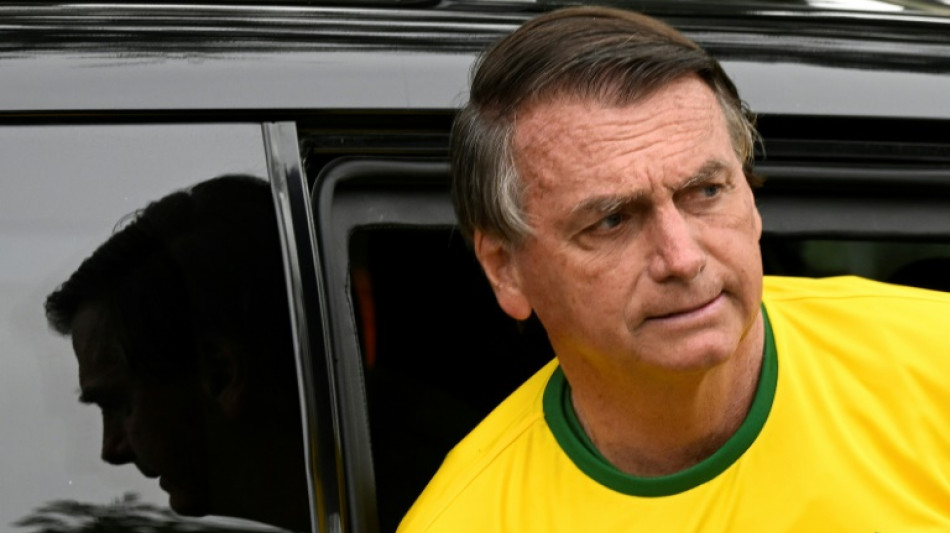
Election showed Brazil's far-right was sold short: analysts / Photo: © AFP

 Indonesia battles Mount Bromo wildfire as El Nino takes root

 STARCARES Revamps Basketball Court at the University of Lagos for Future Healthcare Professionals

 Eight dead, including teen suspect's grandparents, in Thailand shooting
 Indonesia traps monkey to end rampage that wounded 18 people

 Food security fears mount as UK farmers battle drought

 Houthi missile attacks kill 58 Saudi-backed Yemeni govt forces

 Chinese activist held in Bangkok finds Canada refuge
 Kiss takes reins as Wallabies face Japan

 North Korea touts dog soup and other home-cooked recipes to beat the heat
 UK observatory nervously watches growing space junk threat

 Meta ordered to pay US state $567 mn to abate 'public nuisance' and child harm

 Houthi missile attacks kill 58 Saudi-backed Yemeni govt forces: source

 No.1 Sabalenka and Pegula advance at Toronto

 China missile test top of agenda as Pacific diplomats meet in Fiji
 Most UK teens to opt out of planned social media curfew: poll

 Venezuela's political transition talks launch in Caracas
 2 killed, 13 wounded in bus blast near Syrian capital: state media

 All Blacks skipper Taylor cautiously recovering from calf strain

 UN chief denounces Russia, Ukraine for civilian deaths

 UEFA turn up the pressure on Infantino and repeat boycott threat
 Rodri approves Barcelona transfer talks with Man City: Barca source to AFP

 Venezuela unable to tally missing from cataclysmic quakes
 Le Court sprints to stage six Tour de France Femmes win
 Doping body says Parker's positive cocaine test caused by nutritionist

 UEFA says boycott of World Cups stands despite FIFA backdown on private investment

If anything, Sunday's surprise first round election surge for Brazilian President Jair Bolsonaro revealed a bigger-than expected appetite for his polarizing brand of conservative "God, homeland and family" politics, analysts say.
Bolsonaro got nearly two million more votes on Sunday than during his 2018 election, coming in at 43 percent of the vote compared to 48 percent for his opponent, former president Luiz Inacio Lula da Silva.
The incumbent president went into the first round with about 36 percent of polled voters saying they intended to vote for him.
But instead of trailing Lula by 14 percentage points as predicted by pollsters, Bolsonaro ended Sunday only five points or about six million votes behind, and a real chance at a second term.
"A demonstration of the strength of Bolsonarism," the daily Folha de S.Paulo announced on its front page -- referring to the incumbent's mix of pro-God, anti-gay marriage, anti-abortion, anti-left and anti-establishment political rhetoric.
"Bolsonarism is growing more and more, and this is a reflection of a very conservative country," voter Mateus Alcantara, a 26-year-old publicist, told AFP in Rio de Janeiro in the aftermath of Sunday's vote.
His country, he added, was living a moment of "enormous polarization."
Bolsonaro was thought to be entering the race damaged by a controversial four-year tenure marked by a shocking pandemic death toll blamed in part on his Covid-skeptic approach, surging destruction of the Amazon rainforest, and a sharp rise in Brazilians living in hunger.
He is frequently criticized for racist, homophobic and sexist remarks and for his vitriolic, combative approach to the media and critics.
But Bolsonaro's "Bibles, bullets and beef" base -- Evangelical Christians, security hardliners and the powerful agribusiness sector -- now appears to be larger than thought.
"This election shows how deeply rooted the conservative movement is in Brazil," sociologist Angela Alonso of the University of Sao Paulo wrote in a Folha de S.Paulo opinion piece.
- 'More to the right' -
Bolsonaro could also boast with better-than-predicted performances Sunday by many of his allies in congressional and gubernatorial races.
With his election in 2018, Brazil experienced an unprecedented wave in ultra-conservative voting that analysts at the time attributed to disgust with Lula's Workers' Party and its connection to a string of corruption scandals.
Now it seems that was not merely a reactive vote.
More than half the senators elected in the first round Sunday (15 out of 27) are Bolsonaro allies and his Liberal Party was on track to be the largest party in the lower house of congress.
Victors included highly-controversial Bolsonarists such as Eduardo Pazuello, who led the health ministry during the worst of the Covid-19 pandemic from May 2020 to March 2021.
Pazuello, who won a seat for Rio de Janeiro, had appeared before a Senate committee investigating a shortage of medical oxygen that caused the deaths of several dozens of patients in the northern city of Manaus.
"The polls had failed to perceive the strength of Jair Bolsonaro and his candidates," commentator Vera Magalhaes noted in an editorial for the daily O Globo.
The results, she added, had been "more to the right than predicted."
- Common touch -
For Jairo Nicolau, a political scientist at the Getulio Vargas Foundation, "some Brazilians are far-right, but Bolsonarism is more an expression of the country’s conservative movement."
His movement had replaced center-right parties like the PSDB in power in the 1990s.
"The PSDB was a party of elites... This is where Bolsonaro makes a difference: he is truly a leader with the common touch, something the Brazilian right has not had for a long time," added analyst Mayra Goulart.
Commentator Jamil Chade with the website UOL drew parallels with populist movements in Viktor Orban’s Hungary or in the United States under Donald Trump.
Like there, "the Bolsonarists' strategy is to delegitimize the press, civil society or any external control body by creating channels of direct communication with the population to spread lies," he said.
G.Schulte--BTB