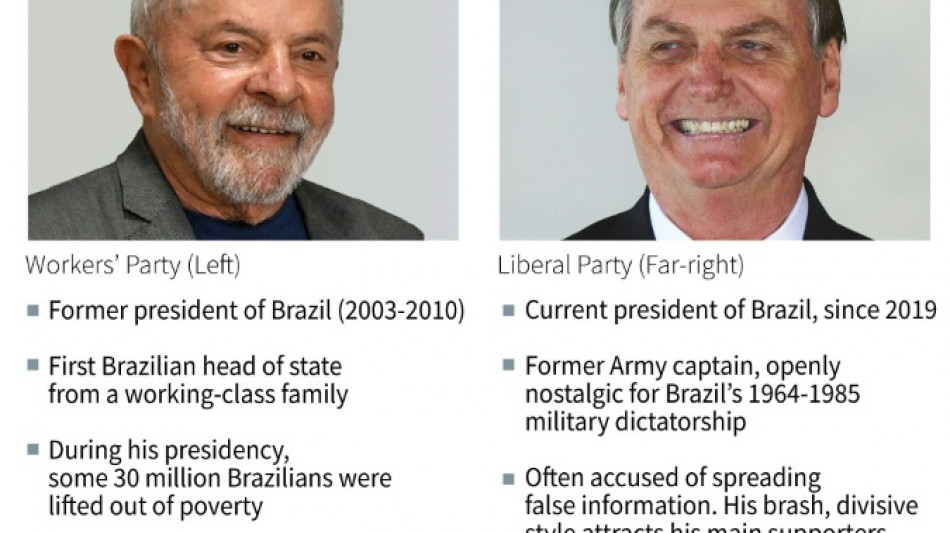
In Brazil election, opinion polls the 'biggest loser' / Photo: © AFP

 Indonesia battles Mount Bromo wildfire as El Nino takes root

 STARCARES Revamps Basketball Court at the University of Lagos for Future Healthcare Professionals

 Eight dead, including teen suspect's grandparents, in Thailand shooting
 Indonesia traps monkey to end rampage that wounded 18 people
 Food security fears mount as UK farmers battle drought

 Houthi missile attacks kill 58 Saudi-backed Yemeni govt forces
 Chinese activist held in Bangkok finds Canada refuge
 Kiss takes reins as Wallabies face Japan

 North Korea touts dog soup and other home-cooked recipes to beat the heat
 UK observatory nervously watches growing space junk threat
 Meta ordered to pay US state $567 mn to abate 'public nuisance' and child harm
 Houthi missile attacks kill 58 Saudi-backed Yemeni govt forces: source
 No.1 Sabalenka and Pegula advance at Toronto
 China missile test top of agenda as Pacific diplomats meet in Fiji
 Most UK teens to opt out of planned social media curfew: poll
 Venezuela's political transition talks launch in Caracas
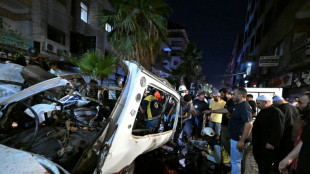 2 killed, 13 wounded in bus blast near Syrian capital: state media
 All Blacks skipper Taylor cautiously recovering from calf strain
 UN chief denounces Russia, Ukraine for civilian deaths
 UEFA turn up the pressure on Infantino and repeat boycott threat
 Rodri approves Barcelona transfer talks with Man City: Barca source to AFP
 Venezuela unable to tally missing from cataclysmic quakes
 Le Court sprints to stage six Tour de France Femmes win
 Doping body says Parker's positive cocaine test caused by nutritionist
 UEFA says boycott of World Cups stands despite FIFA backdown on private investment
Following a trend in recent years of underestimating voter support for Brexit and Donald Trump, opinion polls in Brazil were way off the mark for Sunday's first round of presidential elections.
Incumbent Jair Bolsonaro and many of his far-right allies mustered results much better than pollsters had predicted, catching analysts off guard and shocking supporters of his leftist rival Luiz Inacio Lula da Silva.
"The biggest loser (of Sunday's election) are all the polls," Latin America analyst Michael Shifter of the Inter-American Dialogue think tank told AFP.
- What were the poll predictions? -
Lula amassed 48 percent of the votes cast on Sunday -- within the margin of error of plus or minus two percentage points worked in by pollsters Datafolha and Ipec.
Both had put Lula within arm's reach of taking the election in the first round -- with a prediction of 50 percent of valid votes cast by Datafolha, and 51 percent by Ipec.
Bolsonaro's result came completely out of left field. He managed 43 percent of votes compared to 36 percent predicted by Datafolha.
Instead of a predicted 14-point handicap, he lagged Lula by only five points, or about six million votes.
There was a similar trend for some of Bolsonaro's rightwing allies.
Rio de Janeiro Governor Claudio Castro won reelection in the first round with 58 percent of votes compared to polling expectations of 44 to 47 percent.
And in Sao Paulo, Tarcisio de Freitas entered the gubernatorial runoff race in the lead with 42 percent -- 11 points higher than he had been polled.
- What went wrong? -
Analysts are scratching their heads: was it a last-minute Bolsonaro surge among undecided or opposition voters, or is it that polling institutes with a hitherto reliable reputation have somehow lost the ability to accurately predict voter intention?
"We don't know if Bolsonaro made real advances or whether he already had this support" that polls failed to capture, Leandro Gabiati, director of the Dominium consultancy, told AFP.
According to Mayra Goulart of the Federal University of Rio de Janeiro, there has been an "information blackout" in Brazil due to a pandemic-induced, two-year delay in the population census, held every 10 years.
This may have affected the accuracy of pollsters' population sampling especially in influential segments such as evangelicals -- a growing and right-leaning section of Brazilian society.
"It is likely that the 2022 census will correct some of these inconsistencies for future elections," said Guilherme Casaroes, a political scientist at the Getulio Vargas Foundation.
- Consequences -
"It will definitely hurt the credibility of analysis" by the media and experts such as himself, said Leonardo Paz, Brazil consultant for the International Crisis Group think tank.
"Right now it is more difficult to make analysis because... the numbers are not credible anymore."
The discrepancy between the prediction and Sunday's outcome posed a "big problem for the (polling) institutes and for democracy itself," added Dominium's Gabiati.
"Polls are an important part of the electoral process and it is terrible for democracy that this aspect is called into question."
Bolsonaro has long sought to cast doubt on the accuracy of polls, which he claims work for the left, and could now use this "proof" to further whip up anti-Lula sentiment ahead of the all-important October 30 presidential runoff.
"We defeated the opinion polls' lie," he crowed on Sunday.
For Goulart, this could bolster the Bolsonaro-led negationist discourse.
"Calling into question electoral polls in a context of far-right populism is also to call into question science and reliable sources of information, including the media," she said.
Bolsonaro's congressman son Eduardo said Monday he would collect signatures to open a parliamentary committee investigation into polling companies over the discrepancies.
"Polling agencies will have to reinvent themselves," said Casaroes.
S.Keller--BTB