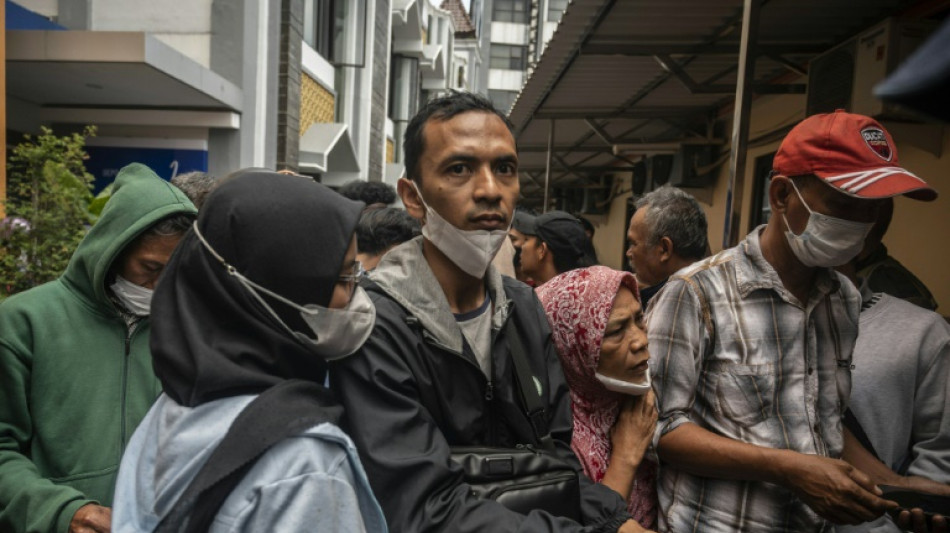
Relatives, survivors grieve at Indonesian hospital after stadium stampede / Photo: © AFP

 Hong Kong court set to sentence activist Joshua Wong in security case
 Australia raises benchmark rate to highest level in 18 years

 'The Remarried Empress' Cast Discusses Bringing Fantasy Royal Drama to Life

 Asian stocks retreat as AI worries outweigh steep oil-price drop

 Hamad International Airport stages emergency drills during WATAN 2026

 Global failure to punish attacks leaves journalists at continuing risk

 Researchers Warn 'Bookkeeping Trick' Masks Beef Industry's Methane Emissions

 Climate Change Intensified Atlantic Hurricanes, Study Finds

 Qatar solar expansion opens scope for technical performance gains

Etik sat cross-legged on the floor of the hospital, waiting anxiously for her daughter to regain consciousness after she was caught in one of the deadliest stadium disasters in world football history.
"It was her first time (at a match)," said Etik, holding back tears outside the intensive care unit at the Saiful Anwar hospital in the centre of the eastern Indonesian city of Malang.
Her 21-year-old daughter Dian Puspita was one of the spectators who had a close brush with death after police fired tear gas into packed terraces to quell a pitch invasion, causing panicked fans to rush for exits.
The ensuing stampede and chaos left at least 125 people dead, with more than 300 injured.
Etik -- who like many Indonesians goes by one name -- grew worried when her daughter did not return home.
"I called her but she didn't pick up," she said.
She rushed to the hospital after Puspita's friend told her what had transpired, immediately heading to the emergency room to see her daughter, who lay on a bed with her shoulder broken and face red and swollen.
"I didn't think this would happen," said Etik, who waited for 12 hours at the hospital on Sunday.
Angry fans of Arema football club had invaded the pitch after losing to their fierce rivals Persebaya Surabaya, prompting the widely criticised response by police.
At the same hospital, 20-year-old Irgi Firdiansah remembers saving Puspita from the waves of spectators, as both of them struggled to survive the stampede.
"It was full of smoke. I couldn't see anything," he said, tears flowing down his face.
Firdiansah said that the tear gas seemed to be aimed directly at spectators, and that as people panicked he was pushed and "could not move" when he was caught in the crush to flee the stadium.
His hands were bruised from being trampled upon, but he managed to hold on to Puspita and carry her out of the arena.
"I kept holding on to her even though I did not know her condition," he said, his voice dropping to a low mumble as he described the harrowing experience.
- 'Be strong' -
Earlier in the day, chaos had engulfed the hospital as victims were rushed in, with the city's other hospitals overwhelmed by the influx of the dead and injured.
Many died from lack of oxygen after being pushed, pulled and stepped on in the chaos of the crush.
Indonesia's government has called for the country's police to identify and punish whoever was responsible for the tragedy.
As night fell, the hustle and bustle at the hospital died down. Relatives laid on mats and covered up with blankets to get some rest outside the facility, anxiously waiting for any news of their loved ones.
Some people cradled their heads in their hands, praying for the survival of their relatives. Others attempted to sleep on hospital benches.
Periodically, a megaphone would call out a name, a signal for the person's relatives to enter the hospital and get the good -- or bad -- news.
When Etik was last allowed to see her daughter, she held her hands and whispered her a message, one she hoped would not be the last she got to share with her daughter.
"You must be strong and wake up soon," she told her.
F.Müller--BTB