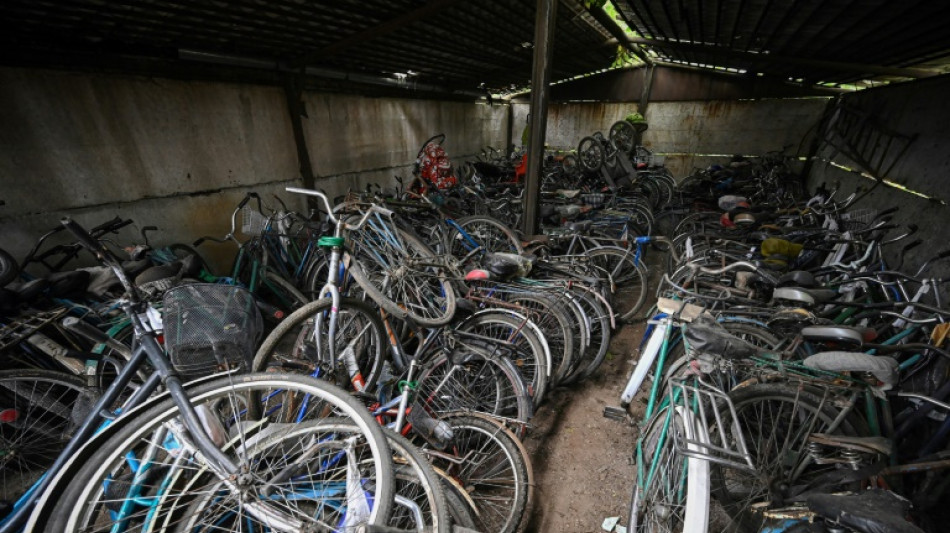
In Ukraine's south, bicycles wait for their owners' return / Photo: © AFP

 Meta ordered to pay $567 mn in US over 'public nuisance' child harm

 Saudi Arabia, Turkey and Pakistan to sign defence pact amid regional violence
 PU Prime Expands Gold Trading with the Launch of XAUUSD247

 Oil extends gains and stocks mostly down on fresh Hormuz worries
 Four dead, 15 injured in Thailand school shooting: deputy minister
 Military shake-up poses little threat to Ukraine's drone revolution
 Camels find unlikely home in outback Australia
 Pacific nations fail to agree on statement condemning China missile test
 Anguish and hope: why a Tibetan set himself on fire in New York

 Oil extends gains and stocks fall on fresh Hormuz worries
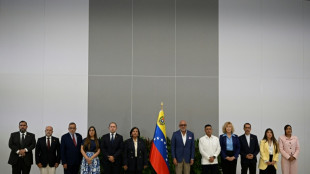 Venezuela's political transition talks wrap first day in Caracas

 South Africa coach Erasmus wary of struggling Argentina

 Actress, engineer, jihadist's widow among Syria's new women MPs
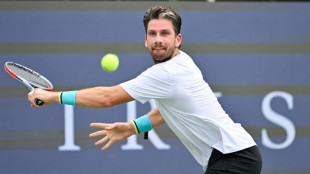 Battling Norrie survives match point to oust de Minaur

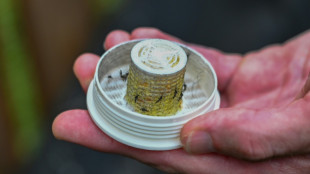 US firm takes on backyard mosquitoes -- with 600,000 mosquitoes
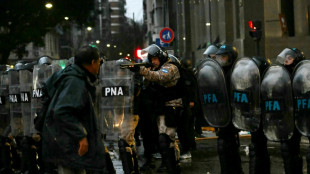 Thousands protest private property legislation in Argentina

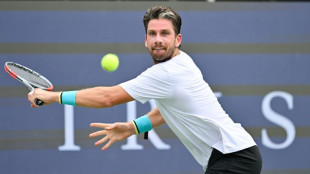 Battling Norrie survives match point to oust de Minaur at Montreal
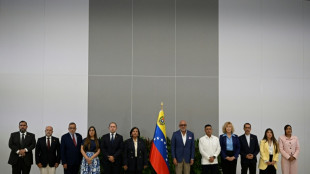
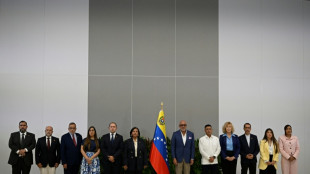 Venezuela's political transition talks start: AFP
 Real Madrid extend Vinicius deal, sign Diomande in title bid boost

 PSG sign France midfielder Akliouche from Monaco
 CONMEBOL 'expresses concern regarding repeated unilateral actions' by FIFA
 Warren coy over whether Fury-Joshua will be in UK or US

 Taiwan blocks key bridge in drill for potential Chinese invasion
 Migrant children risk abuse on streets of Ceuta, aid groups warn

 Oil price shoots up as stocks tread water

Hundreds of abandoned bicycles in a small town near Ukraine's southern front line tell the many stories of their owners, who were forced to flee Russia's invasion.
They come in all colours: green, red, black, blue, all stored inside and outside a small warehouse in the town of Zelenodolsk.
"We keep them for their owners," says municipal worker Vitaliy Rekhlitsky, so that they can come and collect them at the end of the war.
One bicycle has a knitted saddle cover, another a small pouch attached to the frame, many others are rusty and battered by time and travel.
Some have baby seats attached to the back.
Among the over 600 bicycles stored there are also pushchairs, wheelchairs, a special needs tricycle and a brown children's bicycle.
Many of them have been stored since early March, when Russia's army gradually took control of the recently-annexed neighbouring Kherson region.
By that time, Russian forces had stolen most of the cars in the surrounding villages and all that was left were the bicycles, Rekhlitsky recalled.
"People fled, sometimes with nothing at all, sometimes with a bag," he told AFP.
Some pedalled to freedom on decades-old bikes that looked like they could be from the Soviet era.
- 'Huge loss' -
The exiles were people with limited means.
For the elderly, losing the bikes is a "huge loss", said Dmytro Kostenko, who guards these abandoned vehicles.
As Ukraine's forces made progress in their recent counteroffensive, recapturing nearby villages, more bicycles have been brought back by the soldiers.
But in a sign that things might be changing for the better, around fifty owners have returned to collect their property.
Every time they come, "I have tears in my eyes,", Kostenko told AFP with the sounds of artillery howling in the distance.
"The bombardments have intensified" since the start of the counteroffensive, said the man in his sixties, holding onto his crutches.
Located just 15 kilometres from the southern front line, Zelenodolsk is a small town of some 13,000 residents, founded in the 1960s when Ukraine was part of the Soviet Union.
Its name translates as "green valley" from Ukrainian and Russian, a nod to the rich agricultural lands that the town was built on.
The tall chimneys of the Zelenodolsk thermal power plant are visible from some parts of town as well as the dozens of uniform low-rise buildings built to accomodate its workers.
The nearby hospital had an influx of patients on Thursday morning after Russian forces targeted the plant.
Some 19 people were injured, according to regional governor Valentin Reznichenko.
"People were just going to work when the Russians fired their Uragan (missiles) at them," he said.
- 'Antichrist' -
The victims were hit by shrapnel but none were seriously injured, said Dr Svetlana Kravchuk, who treated them in hospital.
Many in the city suffer from "chronic stress" from the constant bombing, which in September killed a nine-year-old boy, the doctor added.
Over the nights spent hiding in corridors or underground cellars, many "have forgotten what it is to sleep in a bed," she said.
The hospital's director Olena Yaroshenko said she feels more "reassured" since the start of the counteroffensive since "we hear more of our people shooting".
But in a garden in the outskirts of Zelenodolsk, where a pear tree hangs low under the weight of its fruit and some strawberries still grow, Yevgenia Vasilyeva mourns the lost calm.
The 84-year-old arrived in Zelenodolsk in 1964, a few years after its founding, and has watched the town grow.
She was married to a Russian and often travelled to Russia, where "all kinds of good people live," she said.
The deeply religious woman with a coloured scarf covering her grey hair, however, doesn't mince words in describing Russian President Vladimir Putin, calling him the "antichrist" and bearer of the "apocalypse".
Near her garden that is a snapshot of what the "green valley" was like before the Soviet era, a small house recently lost its roof, swept away in the shelling.
C.Kovalenko--BTB