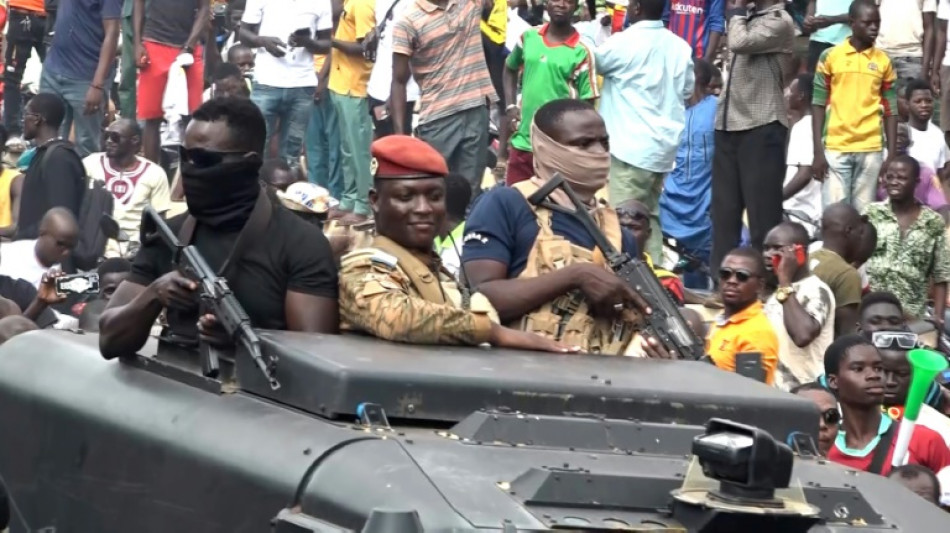
Burkina junta leader resigns, flees after coup / Photo: © AFP

 Hong Kong court set to sentence activist Joshua Wong in security case
 Australia raises benchmark rate to highest level in 18 years

 'The Remarried Empress' Cast Discusses Bringing Fantasy Royal Drama to Life

 Asian stocks retreat as AI worries outweigh steep oil-price drop
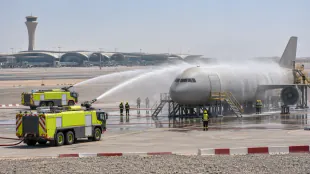 Hamad International Airport stages emergency drills during WATAN 2026
 Global failure to punish attacks leaves journalists at continuing risk
 Researchers Warn 'Bookkeeping Trick' Masks Beef Industry's Methane Emissions

 Climate Change Intensified Atlantic Hurricanes, Study Finds

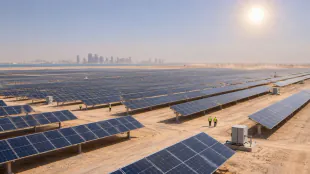 Qatar solar expansion opens scope for technical performance gains

Burkina Faso's junta leader agreed to step down on Sunday, religious and community leaders said, two days after military officers announced his ouster in a coup that sparked internal unrest and international condemnation.
Lieutenant-Colonel Paul-Henri Sandaogo Damiba "himself offered his resignation in order to avoid confrontations with serious human and material consequences", the religious and community leaders said in a statement.
It followed mediation between the junta chief and the new self-proclaimed leader, Ibrahim Traore, by the religious and community leaders, they added.
Regional diplomatic sources said Damiba -- who himself took power in a January putsch -- had fled to Togo's capital Lome on Sunday following the unstable and impoverished West African nation's second coup this year.
The religious and community leaders also said Damiba had set "seven conditions" for stepping down.
These included a security guarantee for him and his allies in the military and that those taking power must respect the pledge he had given to West Africa's regional bloc for a return to civilian rule within two years.
The religious and community leaders -- who are very influential in Burkina Faso -- said that Traore, 34, accepted the conditions and "invites the population to exercise calm, restraint and prayer".
The putschists lifted a night-time curfew they had imposed on Friday and reopened the country's borders.
The upheaval began on Friday when junior military officers announced they had toppled Damiba.
Damiba had said late Saturday he had no intention of giving up power and urged the officers to "come to their senses" amid a backdrop of protests.
A statement issued on Sunday by the pro-Traore military said he would remain in charge "until the swearing-in of the president of Burkina Faso designated by the nation's active forces", at an unspecified date.
- 'Disinformation campaign' -
The officers had accused Damiba of having taken refuge at a military base of former colonial power France to plot a "counter-offensive", charges he and France denied.
On Sunday, dozens of Traore's supporters gathered at the French embassy in Ouagadougou.
Security forces fired tear gas from inside the compound to disperse the angry protesters after they set fire to barriers outside and lobbed rocks at the structure, with some trying to scale the fence, according to an AFP reporter on the scene.
The French foreign ministry condemned "the violence against our embassy in the strongest terms" by "hostile demonstrators manipulated by a disinformation campaign against us".
It marked the latest incident against a France-linked building in two days, after a fire at the embassy on Saturday and a blaze in front of the French Institute in the western city of Bobo-Dioulasso.
A French institute in the capital also sustained major damage, the French foreign ministry said.
"We decided to take control of our destiny" and support Ibrahim Traore, said protester Yaya Traore. "If it doesn't work out, we'll come out again to tell him to go. It's up to him to do things well."
The officers said they had acted because Damiba had failed to quell jihadist attacks in the country.
Damiba came to power in the nation of 16 million people in a January coup, accusing elected president Roch Marc Christian Kabore of failing to beat back jihadist fighters.
But the insurgency has raged on and more than 40 percent of Burkina Faso remains outside government control.
Thousands have died and about two million have been displaced by the fighting since 2015, when the insurgency spread to Burkina Faso from neighbouring Mali.
- 'Burkina Faso needs peace' -
The events on Friday sparked a wave of international criticism, including from the United States, the African Union, the European Union and regional grouping the Economic Community .
"Burkina Faso needs peace, stability and unity to fight terrorist groups and criminal networks operating in parts of the country," said a statement by UN Secretary General Antonio Guterres.
Jihadist violence has also prompted a series of coups in Mali since 2020 and fuelled instability in neighbouring Niger.
The new self-proclaimed Burkina leaders had said they were willing "to go to other partners ready to help in the fight against terrorism".
No country was explicitly mentioned but Russia, whose influence is growing in French-speaking Africa including Mali and the Central African Republic, is among the possible partners in question.
B.Shevchenko--BTB