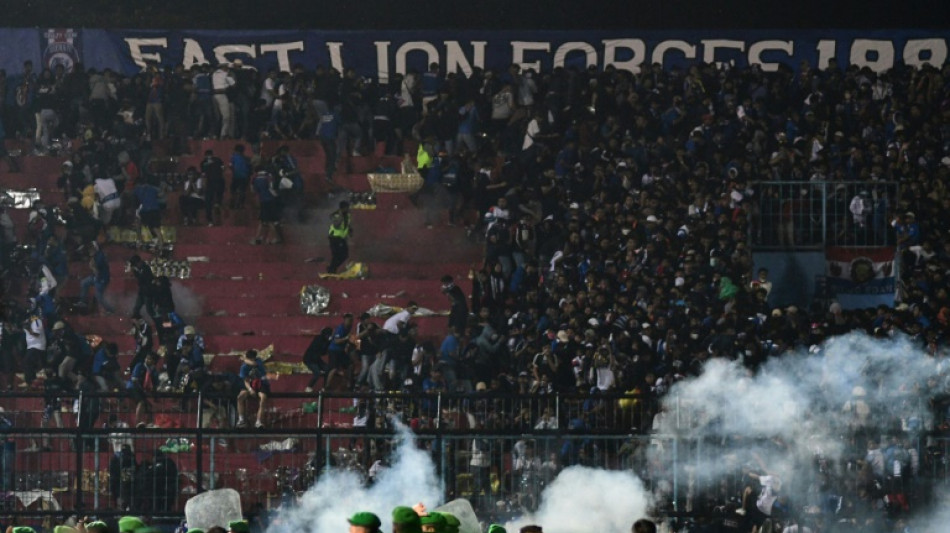
Police under fire after 125 killed in Indonesia stadium stampede / Photo: © AFP

 Hong Kong court set to sentence activist Joshua Wong in security case
 Australia raises benchmark rate to highest level in 18 years

 'The Remarried Empress' Cast Discusses Bringing Fantasy Royal Drama to Life

 Asian stocks retreat as AI worries outweigh steep oil-price drop
 Hamad International Airport stages emergency drills during WATAN 2026

 Global failure to punish attacks leaves journalists at continuing risk

 Researchers Warn 'Bookkeeping Trick' Masks Beef Industry's Methane Emissions

 Climate Change Intensified Atlantic Hurricanes, Study Finds

 Qatar solar expansion opens scope for technical performance gains

Indonesian police came under mounting criticism Sunday after 125 people died in a stampede at a football stadium where officers fired teargas on angry fans invading the pitch.
The tragedy on Saturday night in the city of Malang, which also left 323 injured according to police, was one of the world's deadliest sporting stadium disasters.
Arema FC supporters at the Kanjuruhan stadium stormed the pitch after their team lost 3-2 to the visiting team and bitter rivals, Persebaya Surabaya.
Police, who described the unrest as riots, said they tried to force fans to return to the stands and fired tear gas after two officers were killed.
Many of the victims were trampled or choked to death, according to police.
Arema football coach Javier Roca on Sunday said that fans had even "died in the arms of players," after some of the team stayed on the pitch when the game ended.
"Returning from the press conference, I saw the tragedy," he said, adding that "The boys passed by with victims in their arms."
"I think the police overstepped their mark, even though I wasn't out there and didn't experience the outcome," the Chilean coach told Spanish broadcaster Cadena Ser.
Survivors described panicking spectators in a packed crowd as tear gas rained down on them.
"Officers fired tear gas, and automatically people were rushing to come out, pushing each other and it caused many victims," 43-year-old spectator Doni, who declined to give his last name, told AFP.
"Nothing was happening, there was no riot. I don't know what the issue was, they suddenly fired tear gas. That's what shocked me. Didn't they think about kids, women?"
People carried injured spectators through the chaos and survivors lugged lifeless bodies out of the stadium.
"It was so terrifying, so shocking," 22-year-old survivor Sam Gilang, who lost three friends in the crush, told AFP.
"People were pushing each other and... many were trampled on their way to the exit gate. My eyes were burning because of the tear gas. I fortunately managed to climb up the fence and survived," he said.
At least 125 people died, East Java deputy governor Emil Dardak told broadcaster Metro TV on Sunday evening, significantly lowering officials' earlier death toll of 174 because of double counting.
"Some names were recorded twice because they had been referred to another hospital and were written down again," he said, citing data collected by local police from 10 hospitals.
President Joko Widodo ordered an investigation into the tragedy, a safety review into all football matches and directed the country's football association to suspend all matches until "security improvements" were completed.
A hospital director told local TV that one of the victims was five years old.
Video footage circulating on social media showed people shouting obscenities at police, who were holding riot shields and wielding batons.
Images taken from inside the stadium during the stampede additionally showed police firing huge amounts of tear gas and people clambering over fences.
Amnesty International called for an investigation into why tear gas was deployed in a confined space, saying it should only be used "when other methods have failed".
- Enduring violence -
Torched vehicles, including a police truck, littered the streets outside the stadium on Sunday morning.
The stadium holds 42,000 people and authorities said it was a sell-out. Police said 3,000 people stormed the pitch.
Fan violence is an enduring problem in Indonesia, where deep rivalries have previously turned into deadly confrontations.
Arema FC and Persebaya Surabaya are longtime rivals.
Persebaya Surabaya fans were not allowed to buy tickets for the game due to fears of violence.
However Indonesia's coordinating minister for political, legal and security affairs, Mahfud MD, said organisers ignored a recommendation to print fewer tickets and hold the match in the afternoon instead of the evening.
On Sunday, Arema fans threw flower petals at the club's lion mascot monument outside the stadium in tribute to the victims.
And in Jakarta as many as 300 football fans gathered for a candlelit vigil outside the Gelora Bung Karno stadium.
- Football world mourns -
The football world mourned the disaster with Gianni Infantino, president of world football governing body FIFA, calling the stampede "a tragedy beyond comprehension".
Manchester United and Barcelona posted tributes online while Spanish football clubs were to observe a minute's silence.
The Asian Football Confederation, as well as the German football association and Italy's Serie A, all expressed their regret.
FIFA's safety guidelines prohibit the carrying of crowd control gas by police or stewards at pitchside.
Other stadium disasters include a 1989 crush at Britain's Hillsborough Stadium, which led to the deaths of 97 Liverpool fans, and the 2012 Port Said stadium tragedy in Egypt where 74 people died in clashes.
In 1964, 320 people were killed and more than 1,000 injured during a stampede at a Peru-Argentina Olympic qualifier at Lima's National Stadium.
W.Lapointe--BTB